NHS trust criticised for remote patient monitoring

 BBC
BBCA former mental health inpatient says the use of "frightening" cameras and sensors in patients' bedrooms made her even more unwell during her stay.
The patient - known as Miss B - complained about the use of the Oxevision system while under the care of Essex Partnership University NHS Foundation Trust (EPUT).
Her complaint has been partly upheld by the health ombudsman, which said EPUT's use of Oxevision "exacerbated [Miss B's] anxiety and undermined her trust".
An EPUT spokesperson apologised to Miss B and said changes were being made to its policies on consent.
The ombudsman instructed the trust to pay Miss B £925 "in recognition of the impact [she] has suffered".
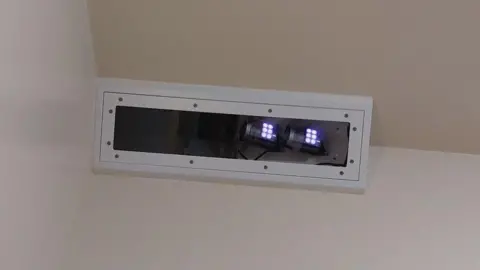
Oxevision uses infra-red cameras installed in patients' bedrooms, which can track their pulse and breathing rates. Video footage is recorded, with up to 15 seconds of live feed able to be viewed by staff in the office.
Its manufacturer says it has played a 'critical role' in preventing serious incidents, but campaign group Stop Oxevision claimed that although the system uses AI to raise alerts and warnings if a patient is in the bathroom or certain locations in the room, it does not alert to changes in vital signs, and too many false alarms can lead to 'alert fatigue' for staff.
The technology has already been examined at the Lampard Inquiry, which is looking into more than 2,000 deaths of mental health inpatients in Essex and east London, over a 20-year period.
On Friday, the inquiry said that hearings in July would scrutinise the use of technology and how patients were observed.
'Confused and distrustful'
Miss B was admitted to an undisclosed EPUT ward in October 2021, initially under one-to-one observation but eventually she was allowed to be in her room on her own.
She said she soon became fearful of the Oxevision system that was observing her.
"I would have a shower, staff would come in and say, 'you've been in here for so many minutes' and say things like, 'we're getting loads of alerts, can you hurry up in the bathroom'," Miss B told the BBC.
"It was distressing… that feeling of constantly being watched, like never being alone, but also no-one's there."
She said staff told her contradictory information about whether she was being recorded and how long any video footage was kept for.
"I was really confused and I really didn't feel safe on that ward," Miss B said.
"I didn't trust the staff, and I felt like they also genuinely weren't educated on what this technology was doing either."
Miss B said staff did not ask for her consent to be remotely monitored, there was no information on the ward about it, and when she asked staff to turn the system off in her room, her request was refused.
Her anxiety was the "worst" it had ever been during a further five to six months she remained on the ward, she explained.
"I was the most unwell I'd ever been, and Oxevision played a huge part in that."
 Richard Daniel/BBC
Rebecca Hilsenrath KC, chief executive at the Parliamentary and Health Service Ombudsman, said EPUT "failed to seek Miss B's consent for the use of Oxevision, or to properly explain the system and how it would be used to observe her".
"The use of technology can greatly improve health outcomes, but its use must follow national guidelines. In this case that did not happen," she added.
"At a time when [Miss B] was already distressed, this lack of transparency exacerbated her anxiety and undermined her trust."
She said "meaningful change" was needed to prevent "similar failings".
The ombudsman's report - seen by the BBC - also criticised EPUT's lack of record-keeping relating to Oxevision.
NHS England - which issued guidance in 2025 to all mental health trusts about the use of digital technologies in mental healthcare - said "any vision-based monitoring technology… must support a human rights-based approach to care and only be used in line with legal requirements, with patient and family consent in place".
A spokesperson added: "NHS England has instructed all mental health trusts to review their use of visual monitoring systems to ensure it is always humane and compassionate."
Ann Sheridan, executive nurse for EPUT, said changes were being made in the way it sought consent for contactless monitoring across wards, ensuring "we are fully in line with national guidance".
"I want to say how sorry I am both personally and on behalf of the trust for the experience of our patient," she said.
Baroness Lampard's final set of recommendations - which could have national implications for how mental health is handled across the country - are not expected until 2028.
Do you have a story suggestion for Essex? Contact us below.
Follow Essex news on BBC Sounds, Facebook, Instagram and X.
