Why the key to losing weight may be enjoying your food

 Getty Images
It’s not just what you eat, but how you think about it that matters. The mind-body connection can shape our appetite because our expectation of what we've eaten influences the brain's perceptions of hunger and satiation.
If confronted with a delectable chocolate bar or a low-calorie, naturally sweetened alternative, which would you pick?
Most of us may rationally know we should pick the latter, but a tasty treat is incredibly hard to avoid, making it hard for individuals who are trying to lose weight to maintain a diet.
We're wired to crave energy dense, sweet treats, partly because our early ancestors once depended on it.
And to add to this challenge, our environment is filled with high-calorie, ultra-processed foods, which when we do eat them, can increase feelings of guilt around our eating habits.
"Ultra-processed products are essentially like being at a heavy metal concert. They're designed to drown everything else out. And it's really hard for folks to tune in to the subtle classical music of a fruit or a vegetable," says Ashley Gearhardt, a professor of psychology at the University of Michigan.
But research points to the idea that to maintain a healthier weight, we shouldn't only focus on what we eat – but our mindset around food. In fact, there are health benefits to finding pleasure in eating, precisely because the expectation of what we've eaten goes on to shape how hungry we are.
Unsatisfying 'healthy' milkshakes
In a now well-known experiment published 15 years ago, a group of scientists found that what we believe we are eating can affect how our body responds.
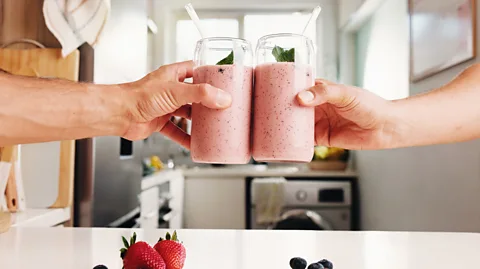
A team led by Alia Crum, a psychologist at Stanford University in the US, demonstrated that if participants believed they were eating a decadent high-calorie milkshake, their body's hormonal response differed depending on what they believed they were consuming – not how many calories they actually consumed.
Participants were given the exact same milkshake but were either told it was healthy and only 140 calories or that it was a 620-calorie "indulgent" shake. In reality, it was only 380 calories.
 Getty Images
When participants believed they were drinking the "indulgent" shake, they experienced a significantly sharper drop in the hunger hormone ghrelin, which stimulates appetite and tends to rise when we are hungry and drop when we're full. But when they were told they were drinking a healthy shake, there was less of a drop in ghrelin.
This revealed that their mindset and expectations about the food altered how their body responded. "Believing you're eating enough makes your body respond as if it's had enough," says Crum.
This is important when it comes to maintaining a healthy weight, because ghrelin influences our metabolism. If we don't feel full and our metabolism slows down, we won't burn as much energy. A restraint mindset could therefore be counterproductive for maintaining a healthy weight. "If you're trying to lose weight and you reduce sugar and fat and caloric intake, but you're in a restraint mindset, that will keep you from losing as much weight."
Crum has found similar results when it comes to our own genetic predisposition to feeling full. Individuals who were told they had genes that made them fuller easier produced more of the weight-regulating hormone GLP-1, even if they didn't have those genes.
Why labelling matters
Labelling makes a difference too. In another study, participants were asked to eat a protein bar either labelled as "tasty" or "healthy", but both had the same nutritional contents. A third group of participants were only asked to rate the appearance of the bar.
 Getty Images
After eating the "healthy bar" participants reported feeling less satisfied and more hungry, and went onto consume more food, even compared to those who didn't eat the bar. This shows that health labels can reduce the expectation of experiencing pleasure, meaning foods labelled as healthy could leave us feeling less satisfied.
Labelling healthy foods to emphasise taste and enjoyment rather than health or nutrition has also been found to increase the likelihood of people enjoying those foods. Similarly, individuals who feel guilty about eating something indulgent like chocolate cake, have been found to be less successful at losing weight.
Taken together, this research has important implications for those who are looking to lose weight. As my colleague David Robson has explored in depth in his book The Expectation Effect, denying yourself a treat doesn't automatically mean you will be eating fewer calories overall. In fact, restraint could lead to compensatory overeating later.
What we could instead focus on, says Crum, is trusting our bodies and avoiding food descriptors that suggest deprivation, such as "light", "low" or "reduced". A mindset of feeling like you're not getting enough, could actually be counteracting the work of dieting," she says.
Gearhardt agrees, and says it would benefit us to think of food as enjoyable rather than solely focusing on nutrients and calories. "When we limit ourselves it can become a chore," she says.
More like this:
Instead, we need to focus on unprocessed food including proteins and plenty of fruits and vegetables, Gearhardt says. "This is what the human body was designed to be nourished by and to find rewarding and appealing."
Reducing ultra-processed foods will also help with that as they do not provide the nutrients we need, and can leave us wanting more.
We can do this with a "mindset of indulgence" too, Crum argues. This means ensuring your body is getting exactly what it needs rather than focusing on restraint. "Trust yourself and your body to be hungry for the right things at the right time," Crum says.
Eating an occasional treat and enjoying it, alongside a balanced diet, can clearly play a role in maintaining a healthy weight.
--
* Melissa Hogenboom is a senior health correspondent at the BBC and author of Breadwinners (2025) and The Motherhood Complex. She is melissa_hogenboom on Instagram.
--
For trusted insights on health and wellbeing, sign up to theHealth Fix newsletter by senior health correspondent Melissa Hogenboom who also writes theLive Well For Longer andSix Steps to Calm courses.
