Farage blames Makerfield defeat on anti-Starmer votes

 Reuters
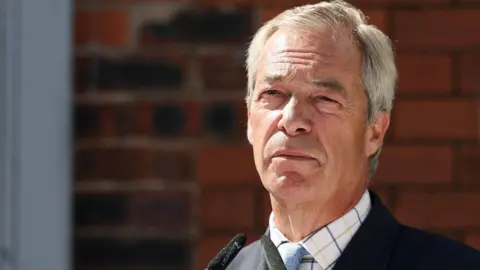
Nigel Farage says he is disappointed with Reform UK's performance in the Makerfield by-election, as he blamed his party's defeat on a desire among voters to eject Sir Keir Starmer from Downing Street.
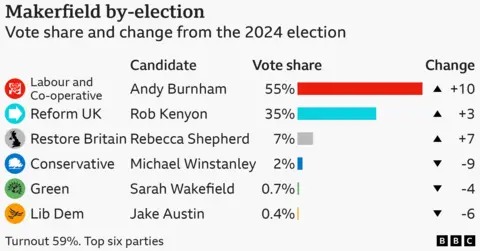
The Reform leader claimed frustration with the embattled prime minister had driven Andy Burnham's "emphatic" Labour victory over his party's candidate, Rob Kenyon, who finished more than 9,000 votes behind.
He also conceded his party had also lost votes to right-wing rival Restore Britain, founded by ex-Reform MP Rupert Lowe, which finished third in a breakthrough night for the fledgling party.
He issued a plea for Restore voters to back Reform instead, as the main "challenger party to the left".
Reform had sought to defeat Burnham in the Makerfield seat, giving it a high-profile scalp to boost its credentials as the likely main opposition party to Labour at the next general election.
But Burnham increased Labour's majority over Reform in the constituency in a rare feat for a candidate from the governing party.
The outgoing mayor of Greater Manchester is now expected to challenge Sir Keir for the Labour leadership and keys to No 10.
He would otherwise be barred from doing so without a seat in Parliament, making the Labour leadership a key issue in the contest in Makerfield, just south of Wigan, which has been held by the party for over a century.
In a video clip posted online, Farage said his party's second-place finish was a "disappointing" result, adding Burnham had won the contest with a "vote share that nobody could quite see coming".
"In many ways, he's a popular local mayor, just as Boris Johnson was a popular mayor in London just a few years ago," he said. "But what really happened here is it was 'vote Burnham, get Starmer out'."
He added that Reform had been "slightly hoist with our own petard", having previously framed a series of local and national elections in May as a chance for voters to put an end to Starmer's faltering premiership.
He also expressed frustration with Restore, which sought to outflank Reform on the right with bold promises including "the most ambitious programme of mass deportations ever seen in Britain".
"I thought we'd get 18,000 votes, we got just shy of 16 [thousand]. So I'm disappointed by that, no question about it," Farage added.
"There's a couple of thousand voters there who would normally have gone out and voted Reform, that voted Restore. And I would say directly to them, what do you want?
"We are the challenger party to the left in this country. And I would urge you to think again, I really, really would."
Reform candidate Kenyon, a self-employed plumber who became a councillor in England's May local elections, had stood in the constituency in the 2024 general election, coming second to Labour.
Although he grew Reform's share of the vote overall, this time around his campaign was dogged by controversy over past social media comments about women unearthed by journalists and campaign groups.
Rise of Restore
The by-election marks the first time that Restore Britain, which was registered as a political party in March, has contested a Westminster seat, marking its emergence on the national political stage.
It had been polling at around 3% nationwide but its performance in the high-profile Makerfield contest, where it captured around 7% of the vote, presents a strategic dilemma for Farage ahead of the next general election.
In the run-up to the vote, Reform had announced plans to ban non-British nationals from social housing and tax companies hiring foreign staff, as it tacked rightward to shore up its voter base.
Speaking after the result, a jubilant Lowe posted on X that his candidate Rebecca Shepherd had achieved a "remarkable" result, adding that previous new parties had taken "years to do what we did in a few months".
"Restore Britain is now officially on the map," he added.
The Makerfield vote was one of three by-elections taking place on Thursday, alongside two in Scotland sparked by the resignation of sitting MPs to take seats in the Scottish Parliament.
The Conservatives won in Aberdeen South, taking the seat from the SNP, while the SNP held on in Arbroath and Broughty Ferry.

Sign up for our Politics Essential newsletter to keep up with the inner workings of Westminster and beyond.
