Farmers told 'not too late' to fight virus outbreak

 Getty Images
Peak District farmers are being told "it's not too late to vaccinate" as cases of bluetongue virus pass 1,000 nationwide.
Government figures show 1,132 confirmed cases of the insect-borne viral disease affecting sheep and cattle have been confirmed in the 2026-27 season.
Organisers of Derbyshire's Dovedale Sheepdog Trials cancelled the 2026 event in August "in respect of the spread of this devastating virus".
AHDB is hosting an event at Bakewell Auction Mart on Monday to give farmers the chance to find out more about vaccination and other support available from experts.
So what are the symptoms of bluetongue, and is it just farmers who need to be worried?
What is bluetongue?
James Dixon, of Peakfield Farm Vets in Sapperton near Sudbury, told the BBC that bluetongue is a virus that is spread primarily from animal to animal by biting midges.
The virus is "exotic" meaning it originated overseas, spreading to the UK from Belgium and the Netherlands, he said, and therefore cases need to be reported to Defra.
The midges thrive in long, hot summers like the one the UK has experienced, and given the rise in cases the disease is now likely to be here to stay.
"A good summer for midges means a bad summer for livestock," he said.
Are people at risk?
Bluetongue does not affect humans.
Dixon added while goats and camelids like llamas and alpacas were also susceptible to the disease, pets were not at risk from bluetongue.
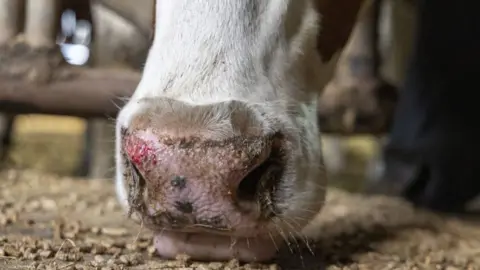
Symptoms in livestock include fever, facial swelling and lameness and can be hard to spot.
Dixon said that most people would walk through a field of sheep or cattle that was infected and not know.
There is no direct medical cure but treatment focuses on easing pain and nursing sick stock.
The virus is often fatal for sheep, and in cattle can be fatal, cause a drop in milk production, and lead to failed pregnancies and birth defects.
What is the impact?
Infection can lead to serious financial problems for farms with affected animals.
"We spend a lot of time trying to get animals pregnant because they then produce the next generation of animals to be either beef, lamb or the next generation of dairy cows," said Dixon, "and obviously if farmers choose to use the vaccine that's now available to protect their stock then that has a cost as well."
Bluetongue has doubled in the past three weeks, said the Agriculture and Horticulture Development Board (AHDB), with the outbreak expected to peak at the end of September.
Defra has said on top of the 1,132 infections confirmed, 1,769 potential cases of bluetongue are currently under investigation.
On Friday it announced that where farmers previously needed to wait for samples to be sent to a laboratory to confirm bluetongue, vets can now diagnose the disease after examining animals.
All of England and Wales, and the south west of Scotland, are a bluetongue restricted zone, which means people require a licence to freeze livestock semen, ova and embryo and testing is required.
But there are no restrictions on movements, like there were during foot and mouth, as infection is spread via midges rather than through direct contact between animals.
Advice for farmers
AHDB said it was "an anxious time" for a lot of farm businesses and Dr Mandy Nevel, head of animal health and welfare, said: "Vaccination firmly remains the single most effective tool available to help protect vulnerable animals.
"Farmers should speak with their local vet to ensure their animals are protected from this deadly disease.
"The key message remains clear: It is not too late to vaccinate."
Farmers interested in attending the Bakewell event should register via the AHDB website.
Listen to BBC Radio Derby on Sounds and follow BBC Derby on Facebook, on X, or on Instagram. Send your story ideas to eastmidsnews@bbc.co.uk or via WhatsApp on 0808 100 2210.
