How changes to visa rules could impact the care sector

 MARTIN GILES/BBC
A care provider says shifting immigration rules have made life harder for care workers from overseas and further restrictions could impact the sector.
Andrea Thasan, a care provider and a director at the Bedfordshire Care Group, says the sector depends on overseas workers.
In 2025 care homes and agencies were no longer able to recruit staff from overseas and the government is considering increasing the time people need to have worked in the UK before they can apply for indefinite leave to remain (ILR) from five years to 10 or 15. A consultation closed in February.
A spokesperson for the Home Office says net migration has fallen by nearly 70% and insists there is "no apology" for trying to bring it under control.
A tracker poll by YouGov, suggests immigration and asylum have been seen by many over the last 15 years as among the most important issues facing the country.
 NIKKI FOX/BBC
Thasan's mother came to the UK from Sri Lanka aged 19 to study nursing and her family have run a care home in Bedfordshire for decades, with 53 of its 150 staff from overseas.
She says care providers are struggling to renew sponsorships for existing staff because of Home Office delays and refusals.
Out of 10 recent visa applications, Thasan says only five were approved, while the cost of visas has risen, adding: "A few years ago I paid £3,100 for a three‑year visa, now it's almost £4,500."
She estimates increasing the route to settlement to 15 years could push sponsorship costs to £22,500 per worker.
"They're tarring staff who've come here to care, with the same brush as people coming illegally. They [the government] are taking it out on the wrong people," she adds.
"If providers can't get workers, hospital beds will be blocked and the NHS will spend more keeping people in hospital for longer," she says.
The government mandates that overseas staff must be paid a minimum rate of £12.82 an hour, which is higher than the £12.71 minimum living wage for UK workers aged over 21.
This is to encourage providers to recruit staff from the UK, but Thasan says the incentive does not work for her business: "We have very few UK workers applying. Sometimes we don't get a single one."
Thasan adds care providers would struggle to increase employees' wages further as most of their income comes from local authorities, which dictate funding levels for care.
 STEVE HUBBARD/BBC
Esther Akinpelu moved to the UK with her husband and child from Lagos, Nigeria, in 2022 and works for Prime Care, a domiciliary care company in Dunstable, Bedfordshire.
Since 2024 overseas care workers have been unable to bring their partners or children to the UK on their visas.
Akinpelu says, under current immigration rules, she will be entitled to apply for ILR next year.
She said the family plan to move to Canada if the rules change.
"We definitely wouldn't stay," she says. "We have friends and family here, but we have to survive... You can't live in an unstable environment."
She says she feels "misled and unappreciated" by the UK government and feels "healthcare will be in serious trouble" without overseas carers.
 NIKKI FOX/BBC
Ben Brindle, a researcher at the Migration Observatory at the University of Oxford, said the number of care workers coming to the UK had already fallen before the government closed the care route for people overseas last year.
"The changes [to visa rules] would prevent migrants from leaving the care sector for another 10 years because people with work visas are tied to their employers. By contrast, people with settlement can work in any job, making it easier to leave the sector.
"Extending migrant care workers' route to settlement will also reduce short-term costs to the public finances. Since care work is relatively low-paid, those who get settlement and stay in the sector would be eligible for in-work benefits, especially if they have children."
 MARTIN GILES/BBC
Janet, the BBC has agreed to not include her surname, a care worker from Nigeria who has a degree in food and nutrition, says increasing the length of time someone needs to be working in the UK before they can claim ILR "makes us feel like we are temporary workers".
"It makes us feel like... we are not allowed to fit into society," the 27-year-old adds.
Under current rules, Janet would have been able to apply for ILR in 2028, but under new proposals it could be 2038.
"We are paying our taxes, we are working hard," she says.
If the government introduces changes to immigration rules, Janet believes many care workers will leave the UK to work in New Zealand or Canada.
"Where we come from, we were trained to work hard," she says.
 Contributed
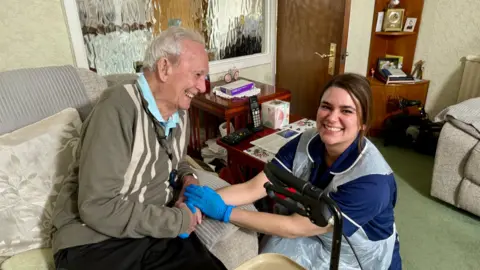
Dinesh Pushparajan, who is from India, works at a care home in Bedford, and says long-term uncertainty for overseas care workers affects both the carers and the people they look after.
He believes asylum debates in the UK have impacted public perception of legal migration.
"We are contributing to the economy… they are taking a hit on us, which is not right," he says.
 STEVE HUBBARD/BBC
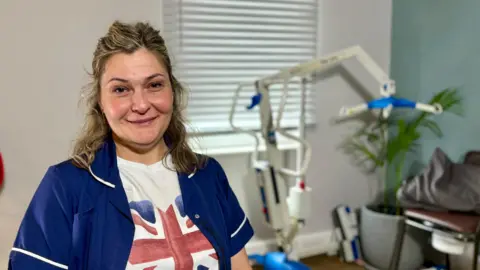
Oana Caspreac, 38, who is from Romania and is a director of care at Prime Care, says she is not affected by possible changes to immigration rules as she settled in Britain before Brexit, but she worries about younger staff.
"I don't feel welcome in this country anymore," she says.
She believes public debate has created misinformation around immigration.
"Sponsorship care workers did not come in on boats or lorries. They went through a process," she says.
She adds home care staff are increasingly relied upon by the NHS, but the uncertainty of future rules makes workforce planning more difficult.
"We have to do much more with less. We don't know how to support staff when we don't know what will happen.
"Making them fear their existence in this country is not the key," she adds.
 STEVE HUBBARD/BBC
A government spokesperson says it ended overseas recruitment for care workers because of "unacceptable levels of abuse and exploitation", with a 2025 Unison report finding that many people from overseas paid fees to unscrupulous care agencies who promised jobs that never materialised.
The government says it wants to boost UK recruitment with a new higher minimum wage for care staff. While the level has not been set, Skills for Care, which represents and supports the adult social care workforce, says £500m has been earmarked to introduce it in 2028.
The Home Office says a decision on permanent residency for overseas staff would be made once responses from a consultation process, which closed in February, are analysed.
The Conservative Party agrees overseas care workers who are already in the UK should wait 10 years for permanent residency.
Reform UK advocates a stricter policy that care staff remain on temporary visas indefinitely.
The Green Party and Liberal Democrats say they want current settlement rules to remain unchanged.
Do you have a story suggestion for Beds, Herts or Bucks? Contact us below.
Follow Beds, Herts and Bucks news on BBC Sounds, Facebook, Instagram and X.
