Farmers and millers adapting to early harvest

 Kate Bradbrook/BBC
Farmers and flour producers say they are adapting to the challenges of dealing with the earliest harvest for 50 years.
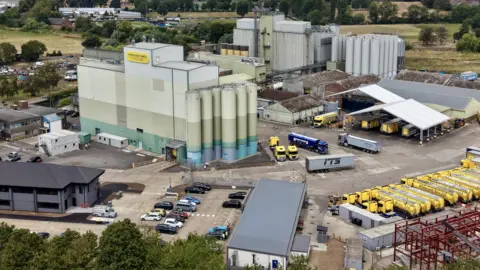
Whitworth Bros, a fourth-generation independent flour miller based in Wellingborough, Northamptonshire, said it was working to understand the impact of the hot weather on the soil because current yields were down.
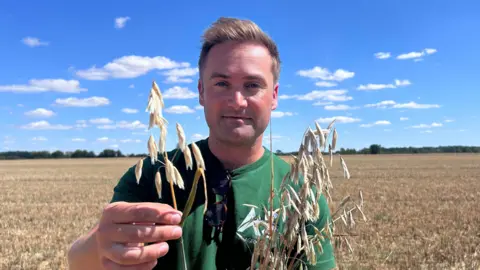
Tristan Ashby, a farmer based in Lutton, also said the recent dry spell meant the business was looking at long-term solutions.
"Every decision is based on how can we get the soil health to improve over a five-year period, 10-year period, 15-year period," he said.
 Ant Saddington/BBC
Ashby, a fourth-generation farmer whose family has grown winter wheat, barley, oilseed rape and oats in Northamptonshire for more than 100 years, said they had coped with a number of extremes in the last six years.
"The 2020 and 2024 harvest was incredibly wet, 25 and 26 are now droughts - so it's the extreme weather one way or the other that's the difficult challenge at the moment," he said.
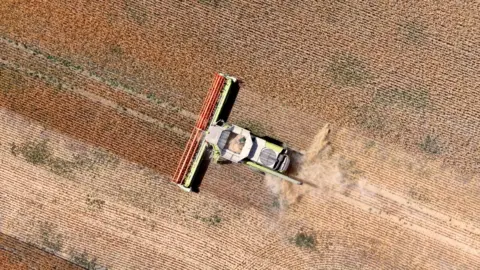
"I've never started harvest as early as this year and certainly we have never finished this early.
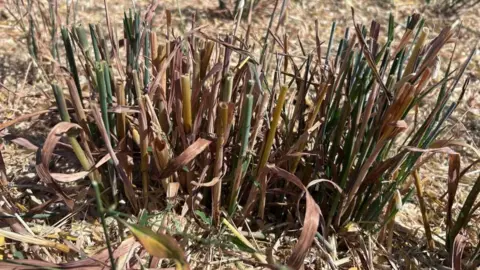
"The crops have just died. Everything, grass, lawns, fields, everything is burnt to a crisp."
 Kate Bradbrook/BBC
Ashby said crop yields were down by 20% for the third year in a row, meaning it had made a loss during that time.
"The grain's too dry going in the shed, so we're losing yield again with the lack of moisture and it's difficult to look after hot grain in store, it can start to spoil," he added.
He said a lot of rain was needed to soften the ground to "build that soil level up again".
"The key is balancing this need to remain viable in the short term with improving your main asset for the medium and long term, and that's just the soil," he said.
"Farmers have always looked after their soil, but I don't think they've ever been forced to do it in the way that we are now."
 Kate Bradbrook/BBC
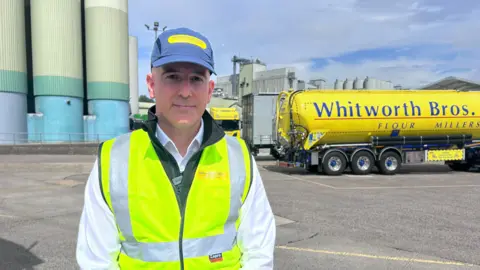
Neil Fyfe, the managing director of Whitworth Bros, said: "We need to keep a very close eye on the quality that's coming in.
"A general trend might mean that the wheat that comes into the mill is smaller.
"It's very important to us that farmers can keep supplying high quality wheat into this mill for the next 140 years and for future generations.
"That means that we need to work much closer to understand what the impact on agricultural practices is - and demands on the soil in particular - and that's where we're working really closely with a rooted soil scheme.
"Better to understand what are the factors and the behaviours that are happening now that can ultimately ensure the health of that soil not just in the next two or three years but for future generations."
 Kate Bradbrook/BBC
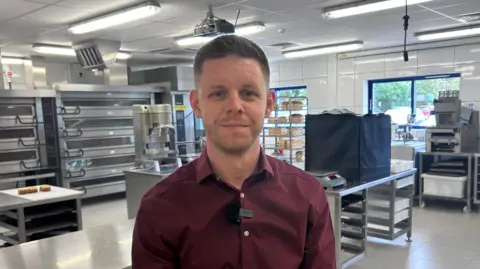
Simon Curran, head of technical bakery and innovation at Whitworth Bros, said the company tests all the wheat that comes in to maintain quality.
"We are seeing that the grains are slightly harder, so the teams will make the necessary adjustments to ensure that extraction rates and that the finished flour quality is what our customers would expect."
He said it meant more power would be used to grind the harder grains, but "we've got very advanced mills that the guys can work and tweak as they please".
 Ant Saddington/BBC
Do you have a story suggestion for Northamptonshire? Contact us below.
Follow Northamptonshire news on BBC Sounds, Facebook, Instagram and X.
