'My no-graze cows' welfare compares to any herd'
A farmer who uses a zero-grazing system says the welfare of his cows is as good as those in any other herds.
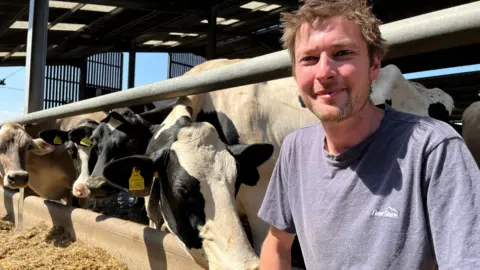
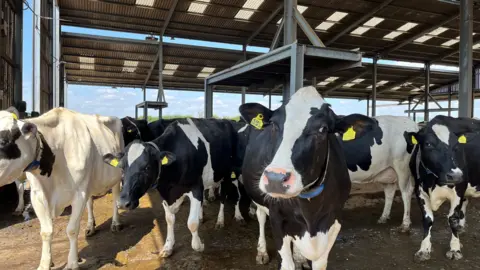
Joe Carter farms in Wiltshire and has about 300 dairy cows which do not go out into fields to graze, something which is recommended by the RSPCA but is not a legal requirement. Instead, they stay year-round in open-air barns with outdoor "loafing areas" they can choose to use.
Vet Chris Warren, from The George Veterinary Group, which looks after almost 100 dairy farms, including Carter's, said a third of the farms he deals with operate in the same way.
"When a good environment is provided, these cows have better health and welfare metrics than cows who graze," he said.
"That's not to say that grazing is bad at all, of course it's not, it is about what suits every system," added Warren.
How does it work?
Carter's farm has several barns which have open sides and also bays for the cows to lie down in - which they do for several hours a day.
There are enough for all the cows to do so at once and the bedding is sand, which Carter said was "really good for cows".
"It's comfy and it's hygienic because it's inert so bacteria can't live in it," he added.
Brushes are attached to walls for the animals to use to scratch as well.

Cows are 'elite athletes'
Feed is placed round the sides of the barn, with slots for each cow to eat from.
The farm keeps track of everything the cattle are fed, including using mixers to get the right balance, and also consult a nutritionist.
"These cows, although they may not look it, they are essentially elite athletes," said Warren.
"The amount of calories they need to ingest to produce the milk that we need them to - and that they are genetically programmed to do - we need to be really controlled with their diet."
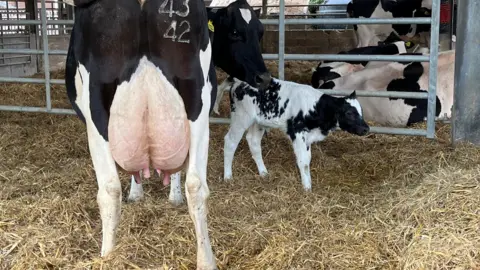
There is calving all year round, but artificial insemination means the farm can now sex select and ensure they get mostly females. Dairy farms cannot do as much with males, so fewer young bulls end up slaughtered with this method.
"The progression in genetics and breeding over the last 20 years has really progressed dairy cows a lot here," said Carter.
Why farm like this?
Carter said they were still grazing the cattle in the summer about 15 years ago, but the animals would come in during winter.
"They'd go out after milking and just turn around and wait by the gate wanting to come back in.
"I think they've got the comfort, the shade, the water, the feed [and] all their luxuries inside, so the cows made the decision as much as we did."
The RSPCA recommends cows have access to the outdoors "for at least four hours a day during the summer and for about 110 days a year".
The grazing is for milk to get a RSPCA assured label, not a legal requirement.
It also recommends cow brushes, vet care plans and extra care for cows when they have just given birth, something both systems can have.
It advises that indoor spaces are important for welfare too, such as if a cow is pregnant, in poor health or if there is poor weather. It adds that cattle being indoors all the time can risk conditions like lameness and mastitis.
However, Warren said it was about "adapting to the modern dairy cow and the demands that they have".
Carter said: "I think the public perception is that cows should be grazing. We obviously house our cows, they have got access to outside loafing area, but I'd put my cows' welfare and health up against anyone's."
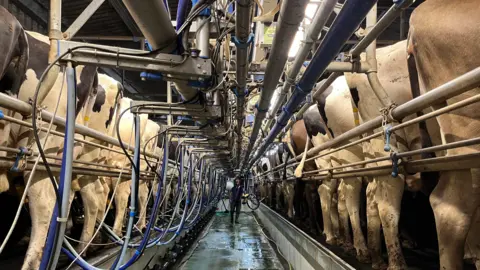
Despite the high output of milk from his herd, like many farmers, Carter said he has found milk prices very changeable.
At the moment, he says he is losing about 8p for each litre of milk, which is selling at 35p.
"It's quite a tough year. I think we've hit the bottom of that and we will see prices start to incline now," he added.
Follow BBC Wiltshire on Facebook, X and Instagram. Send your story ideas to us on email or via WhatsApp on 0800 313 4630.
