Rescued turtles to be released in the Azores

 Simon Cotter / This is Influential
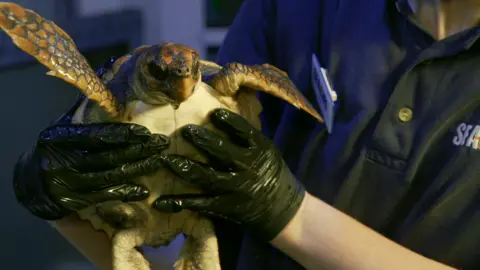
A rare turtle that was flown to the UK after being rescued in Jersey has been transported to the Azores, along with two others, where they will be released later.
The loggerhead turtle, named Crush by her rescuers, was found lifeless on a beach on 19 January following Storm Goretti.
Malnourished and suffering from hypothermia, she was flown to Southampton and transferred to Weymouth Sea Life centre where she has been cared for by experts.
After a period back in quarantine, Crush has been flown 1,500 miles (2,500km) to the Azores, along with fellow loggerheads Eden and Tiree who were rescued on the west coast of Scotland in 2025.
Eden was found on a beach at Troon in October and has been cared for at Brighton Sea Life, while Tiree - named after the island where she was found in November - was cared for alongside Crush in Weymouth.
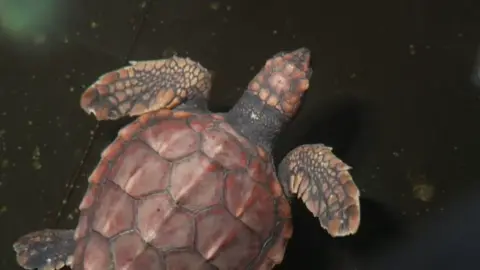
Throughout Crush's rehabilitation, the team at Weymouth remained in constant contact with vets at International Zoo Veterinary Group (IZVG) to monitor her health.
Kico Iraola, curator at Sea Life Weymouth, said: "Both Tiree and Crush were very poorly little turtles when they came to us here at Weymouth.
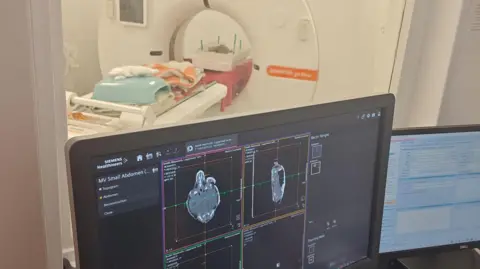
"We initially raised their temperature to bring them out of cold shock and they underwent a series of routine blood tests, X-rays and CT scans before being deemed fit for release.
"We have really enjoyed seeing them grow and come back to full health and now to embark on the next stage of their adventure."
Sea Life Brighton has the UK's first permanent rehabilitation centre dedicated exclusively to sea turtle recovery.
Joe Williams, curator at Sea Life Brighton, said: "Though it's sad to wave Eden goodbye, we feel full of joy for her to leave us and continue growing up, and to be part of this vulnerable species' conservation efforts."
 Sea Life Weymouth
Crush's recovery has also been supported by Jersey marine charity Littlefeet Environmental, which has provided a satellite transmitter to track her after her release.
Chairman Andrew Farmer said: "This will allow us to fill vital data gaps on sea turtle migratory corridors in the North Atlantic."
When Crush was found by a dog walker, she was cold-stunned - a hypothermia-like condition that causes the turtle's body to shut down.
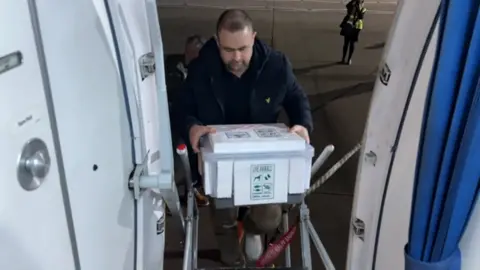
She was initially cared for by New Era Veterinary Hospital in Jersey, including two weeks at clinical director Peter Hawarth's family home, before he flew to Southampton, carrying her in a box.
Loggerhead turtles can be found in the subtropical waters off north Africa and it is believed Crush was swept north by storms and currents.
Others have been found in Sussex, Suffolk and as far north as Tyree in Scotland.
The species is classed as "vulnerable" on the IUCN Red List. There are an estimated 2,000 breeding females worldwide and out of every 1,000 hatchlings, on average, only one makes it to adulthood.
It is not known if Crush is female but rescuers called her "she" because, like other females, she has a larger tail.
