Farmer fears running out of water amid dry spell

 BBC
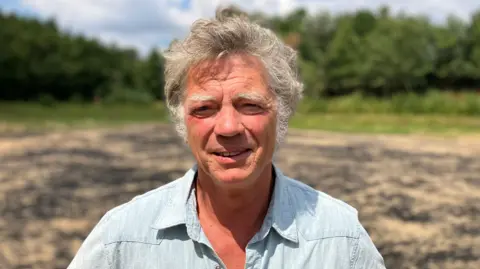
BBCThe head of an organic vegetable box company has said staff would have to choose which plants to water and which to let die "within weeks".
Guy Singh-Watson of Riverford Organic Farmers in Buckfastleigh, Devon, called for it to be easier and faster to get the permissions needed to install on-farm water storage, such as irrigation ponds.
Drought was declared in Devon, Cornwall and the Isles of Scilly on Tuesday and the Met Office said extreme weather was becoming the new normal for the UK.
The government said it was making it easier for farmers and rural businesses to build the infrastructure they need.
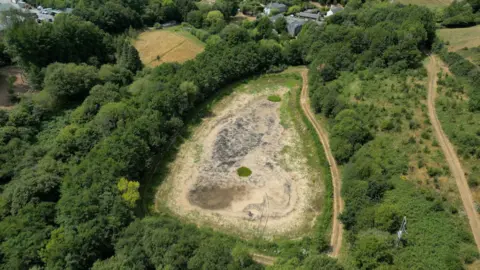
"We're running out of water," said Singh-Watson, who founded the company about 30 years ago.
"You can't grow shallow-rooting, quick-growing salad crops like spinach, rocket, and mizuna in today's climate without irrigation.
"If we want these crops grown in the UK, we need reservoirs on farms and it's got to be cheaper and quicker to get the necessary permits."
He said three of the four on-farm reservoirs had now run dry, with plans for a fifth still "years off".
"Planning permission went through reasonably quickly, but getting the necessary abstraction licences from the Environment Agency has proved to be very exacting, very expensive and very slow," he added.
The government said it was committed to strong domestic food production and ensuring agricultural water supplies remained secure to allow this.
 Riverford
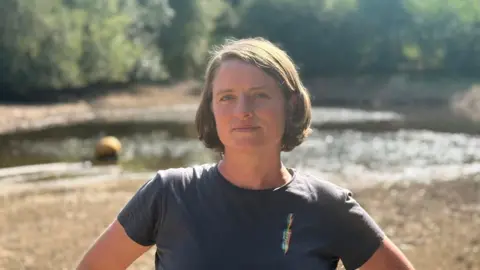
Harriett Bell, regenerative farming lead at Riverford, said: "It's going to be make or break for farmers.
"Farmers need water available for their crops but also their livestock.
"Lots of our suppliers in Devon and the South West don't have reservoirs as they've never had to irrigate before.
"We're quite a big business and we're struggling with the cost and the admin, so you can imagine how challenging that would be for a family farm that is just one or two people."
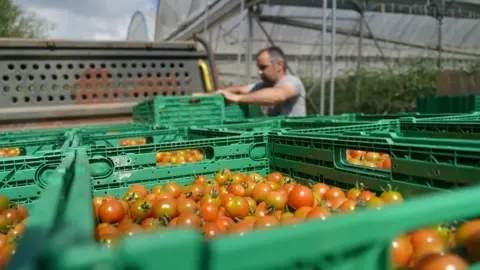
"They're really thirsty," said Ed Scott, as he walked along the rows of plants being grown for Riverford across three acres (1.2 hectares) of polytunnels in south Devon.
He said the plants need about a quarter of a million litres of water a week and are expected to produce about 50,000kg (110,000lb) of tomatoes between July and September and one third of a million mini-cucumbers.
"They're summer crops, so we need an awful lot of water," the polytunnel operations manager added.
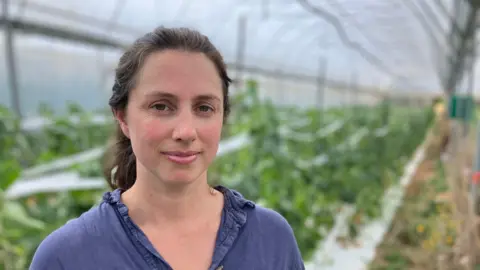
Riverford sustainability researcher Anna David said: "As our climate continues to change, we're going to have increasing heat stress on plants and increasing water stress on the farm."
"Water isn't the abundant thing it used to be," she added.
She said soil moisture and conditions inside one of the polytunnels was being monitored as part of a trial to help "take away the guess work" about watering and to help manage growing conditions more effectively.
The researcher said the trial had already led to a drop in water consumption.
Water resources planning
The Department for the Environment and Rural Affairs (Defra) said steps were being taken to strengthen the sector's role in water resources planning, with farmers and growers forming water abstractor groups and undertaking screening studies to identify local resource options.
As part of that, it said over the past two years, 33 projects involving more than 170 farms have been completed.
Defra also said that updated on-farm reservoir guidance had recently been published, with support from the Environment Agency and project partners.
'Too slow and complex'
Anne Maidment from the Country, Land and Business Association (CLA) in the South West said on farm reservoirs were not being built fast enough to meet the scale of need.
She said: "Allowing more on farm reservoirs will help benefit everyone in the long run, when it comes to these long, hot spells."
Maidment said the CLA was not calling for less environmental protection but for a system that was "simpler and more straight forward".
"We know that if we had better water storage, we could secure better food production, help the environment and crucially we could help farmers adapt to climate change," she added.
A government spokesperson said it was making making it easier for farmers and rural businesses "to build the infrastructure they need" though changes to the National Planning Policy Framework.
They added the government was also making it easier to use existing permitted development rights through clearer guidance and was working with the Environment Agency to speed up the provision of abstraction licences for farm reservoir projects.
A spokesperson for the Department of Energy Security and Net Zero said it had "set a world-leading target to reduce emissions by at least 81% by 2035" and added there had been "over £100bn private investment announced for clean energy in the UK".
Correction 31 July 2026: In the original story the weight of the tomatoes was incorrectly converted between two metric measures - tonnes and kilograms - and now has been converted from metric to imperial.
Follow BBC Devon on X, Facebook and Instagram. Send your story ideas to spotlight@bbc.co.uk.
