'I want my daughters to see the great side of farming'

 PX Farms
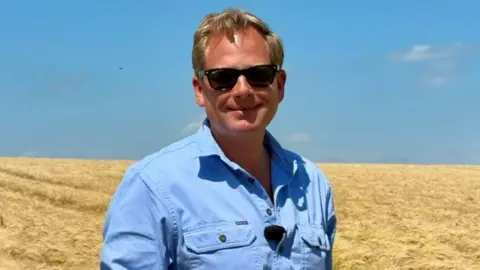
A farmer has told how he has gained thousands of online followers after turning to social media to inspire his three young daughters.
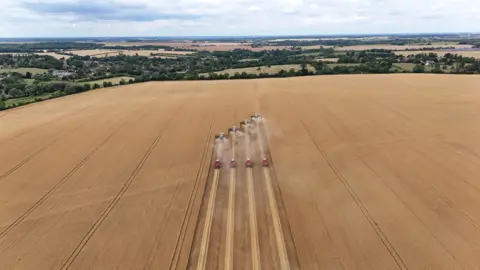
James Peck's business is based in Dry Drayton on the outskirts of Cambridge, and he farms about 12,500 acres (about 5,000 hectares) in Cambridgeshire, Bedfordshire, Hertfordshire and Lincolnshire.
While his grandfather and father also farmed, Peck said he was concerned by the negativity he thought his older two daughters, 13 and 12, faced when they told people they were keen to join the industry.
"I was deeply frustrated by this," said Peck, 50, who also has a three-year-old daughter. "I wanted to be able to show them that actually there's a great side to farming."
Speaking to the BBC for Farmwatch, Peck said one of the impetuses was when he took part in an Anglia Ruskin University Help to Grow course in Peterborough.
There, he spoke to a videographer who encouraged him to film life on his farm.
"I said, 'Nobody's really interested in it'. Anyway... we did one [and] it did 12,000 views," said Peck, who now produces two videos a week.
"We started... two years ago, and we're now doing 7.5 to eight million views a month.
"Because of the scale of the farm, there's actually quite a lot of different parts to it. There's always something happening, even through the winter."
 PX Farms
Peck also credits Jeremy Clarkson's fly-on-the-wall TV series that documents his Diddly Squat farm as a major influence in launching his own PX Farms social media channels across Facebook, Instagram, TikTok, YouTube and X.
"Originally, when I went to school events and things I was the only farmer there, and it was a bit of a conversation killer, but Clarkson's Farm came out... and suddenly I had people coming up to me wanting to talk to me about farming," said Peck.
"Farming had almost become a closed book and nobody was really seeing where we'd progressed from – other than the nursery rhymes and books people would see as children, which is a time lock of the 1950s."
Similar to Clarkson, Peck's arable farming business has diversified into a number of areas including haulage, grain storage, lettings, house building and, of course, media.
Consequently, it means cameraman Tom Cussell always has plenty of places to point his lens as stories unfold across the land.
Peck said the ways the farm operated often needed explanation - and people were always interested to learn about the inner workings.
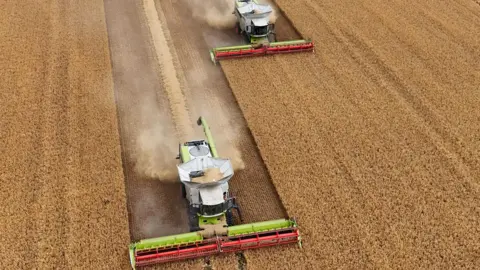
On Wednesday, he explained how he had to go out with the combine harvesters at 06:00 BST to pick beans before the sun affected the harvesting.
If the vehicles went out later in the day, the beans would split too easily from the dried out pods and end up on the ground instead of inside the machine.
Peck said the extreme heat could mean that half of the potential crop yield would be spoiled if he did not change the harvest time.
 PX Farms
He said he was also keen to share what he had learned with his industry colleagues and to explore alternatives to the ways things had traditionally been done.
But he was keen to stress that "it's not that we know everything... some of these things will suit some people and some won't".
Initially, Peck was reticent to go online to give an insight into his business as he felt people might not be able to relate to the successes and he felt wary of any potential criticism, but he said he now believed it was the right thing to do.
He said each video normally received about 1,400 social media comments and he'd received a total of only 12 "really negative" ones over the two years.
"I was very nervous about doing this because of the negativity aspect, but I really want the industry to do well and want new people to come in.
"I want to show it is a vibrant, exciting thing."
Do you have a story suggestion for Cambridgeshire? Contact us below.
Follow Cambridgeshire news on BBC Sounds, Facebook, Instagram and X.
