Miller helps save watermill for the second time

 JOANNA TAYLOR/BBC
An 85-year-old miller said it was "very important" to save the watermill he has volunteered at for 40 years after it was threatened with closure for a second time.
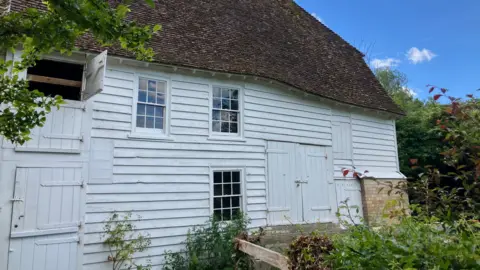
Martin Fordham recently helped raise £20,000 towards essential repairs at Hinxton Watermill in Cambridgeshire, enabling visitors to continue watching the 17th Century mill in action.
It came after he successfully campaigned to stop the mill from being demolished in the 1980s, after it fell into disrepair.
The Cambridge Past, Present and Future Society (CPPF) bought the mill in 1984, after it ceased operations in 1955, and turned it into a working museum.
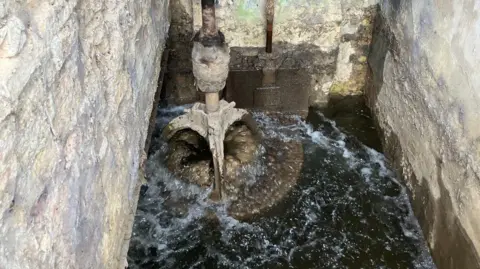
The charity spearheaded recent fundraising efforts, which meant erosion to the brickwork around the mill's partially submerged turbine could be repaired.
A bridge over an adjacent mill pond will also be fixed. Without these works, the mill could not continue opening safely to the public, the charity said.
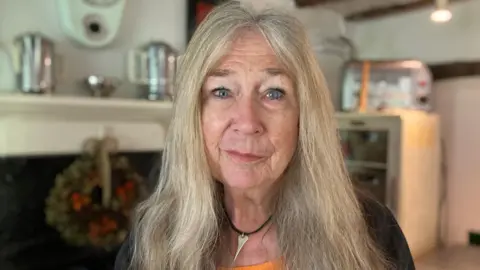
Susan Elliott, a CPPF volunteer who lives in the mill house attached to the building, said the response to the charity's fundraising appeal was "absolutely incredible".
 JOANNA TAYLOR/BBC
Donations rolled in from villagers and visitors, she said, while money was also raised through tea and coffee mornings at the mill and by a local pub.
Fordham demonstrated the mill in action for visitors while his wife, Joyce, prepared refreshments, she added.
"If anyone wants a good reason [to save the mill], you only have to look at the children's faces when it suddenly clicks that there's no switch; there's no computer," Elliott said.
"There's no game that's better than watching the river doing all the work."
 JOANNA TAYLOR/BBC
Fordham said the mill is frequently visited by young families and elderly people, but engaging people "in the middle", such as young professionals and early retirees, was a challenge.
He hoped to recruit a new miller to run the machinery after he stopped being able to operate the river's sluice gates himself last year.
 JOANNA TAYLOR/BBC
The mill fell into disuse for about 25 years before plans emerged to pull it down in the late 1970s.
Fordham said he helped negotiate the mill's sale to the Cambridge Preservation Society, which later became CPPF.
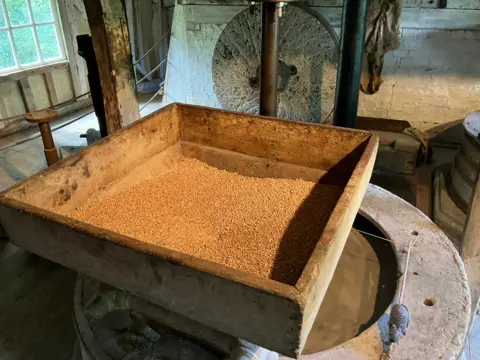
Visitors can still watch flour being produced at the museum, but cannot eat it for health and safety reasons. It is instead used in cattle licks.
 JOANNA TAYLOR/BBC
Elliott said the mill helps young people understand how renewable energy works.
"Water, wind and other forms of power are becoming much more important to the up-and-coming generations, and that is probably the most important reason for keeping it open," she said.
She added that a CPPF study suggested that enough water runs through the mill's main sluice gate to power five houses for a full year, but that "huge investment" would be needed to offer this to the National Grid.
The turbine powering the mill was pioneering technology in the early 1900s.
It replaced the traditional waterwheel, which was destroyed in the 19th Century.
The mill is open to the public to visit on Sundays between May and October.
Do you have a story suggestion for Cambridgeshire? Contact us below.
Follow Cambridgeshire news on BBC Sounds, Facebook, Instagram and X.
