Springfield: The beloved birthplace of Route 66

 Serenity Strull/ Getty Images
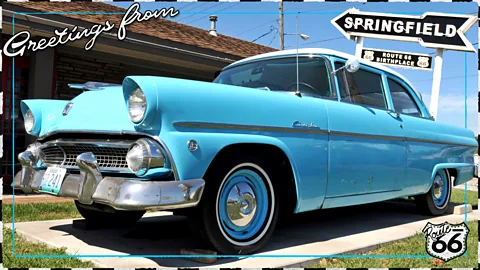
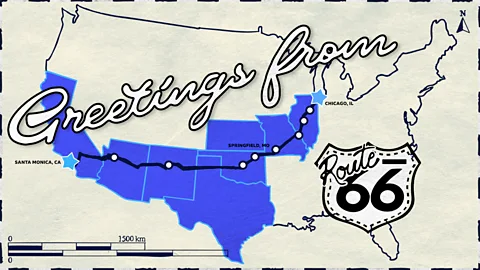
Chicago and Santa Monica might be Route 66's iconic endpoints, but Springfield is where the legendary name was born.
There's little in this unassuming corner in downtown Springfield, Missouri, to suggest that it's where one of the US's greatest road stories began. There's no grand monument or notable sign. In fact, you need to look carefully to spot the modest plaque marking the site of the long-demolished Colonial Hotel, where, in 1926, a group of highway officials convened in order to name the brand-new Chicago-to-Los Angeles highway.
A century on, the resulting two-digit moniker has become synonymous with American road culture.
The number fight that created a legend
To understand why Springfield matters, you have to go back to the creation of the US Numbered Highway System in the mid-1920s. Federal and state officials were trying to replace a confusing patchwork of named auto trails – routes with grand titles like the Lincoln Highway and the National Old Trails Road – with a standardised national network. The proposed Chicago-to-LA road, which would run through Springfield, was important: it would connect the Midwest to the Southwest and California, linking big cities, farming regions and small-town main streets across the country. Crucially, the new route would be marked with a number, not a name; part of a broader push to make cross-country driving easier to follow.
The trouble was the number. Cyrus Avery, the Oklahoma highway commissioner and one of the route's chief backers, originally wanted the road to be called US 60, a zero-ending designation that would have marked it as a major east-west highway. But Kentucky interests wanted that number for a different route that would run from coastal Virginia west to Springfield. As a consolation prize, the Chicago-to-Los Angeles route was offered US 62. Avery hated it as the number lacked the status of a transcontinental route.
 Serenity Strull/ BBC
With the numbering dispute holding up the wider federal plan, Avery met on 30 April 1926 with Missouri highway official B H Piepmeier and others at Springfield's Colonial Hotel. Looking over the remaining options, the group settled on 66, an unassigned number they found more memorable and appealing than 62.
A telegram was quickly sent from Springfield to the Bureau of Public Roads in Washington DC. It read: "Regarding Chicago Los Angeles Road if California, Arizona, New Mexico and Illinois will accept sixty-six instead of sixty we are inclined to agree to this change. We prefer sixty-six to sixty-two."
The designation was approved on 11 November 1926 as part of the national highway map, and a legend was born.
Springfield's Route 66 essentials
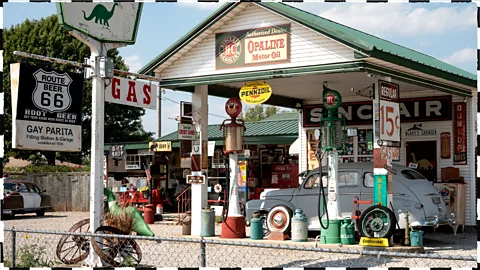
What to do: Start at the History Museum on the Square to learn more about Springfield's role in the naming of Route 66. Don't miss Guy Mace's private collection of classic cars at the Route 66 Car Museum that brings Springfield's roadside story to life. Gary's Gay Parita is a recreated service station west of Springfield, is a living monument to the road’s heyday.
Where to stay: Check into the Rail Haven Motel, now a Best Western, which opened in 1938 at the corner of St Louis Street and Glenstone Avenue. If you can, book the memorabilia-lined Elvis room with its bed frame modelled to look like a sharp-tailed Cadillac trunk.
100 years of the Mother Road
Once Route 66 was officially designated, Springfield began to profit from the steady stream of motorists heading west or returning east, and the city's roadside culture blossomed.
The highway would go on to carry very different meanings in American life. In John Steinbeck's 1939 novel The Grapes of Wrath, it was memorably dubbed the "Mother Road", carrying Dust Bowl migrants west in search of work in California. In the post-war years, Bobby Troup's 1946 song (Get Your Kicks on) Route 66 captured a newfound optimism, recasting the road as a symbol of leisure, freedom and roadside Americana.
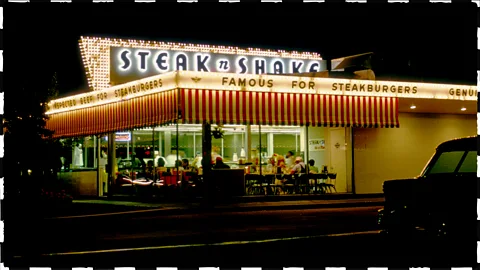
Springfield's original hope that the road would bring cash-splashing travellers paid off, with bumper-to-bumper traffic lining the route and a string of mom-and-pop petrol stations, diners and motor courts rising to serve people on the move.
"Route 66 brought a parade of all these cars through Springfield," says 83-year-old Springfield native Guy Mace, whose Route 66 Car Museum on West College Street features classic vehicles dating from 1907 to 1980.
 Getty Images
The centenary spotlight
During its official lifetime, Route 66 was re-routed, dissected and extended, and eventually bypassed by newer, faster interstates. Tracing the original road today can often require some sleuthing. But not so in Springfield, where substantial stretches remain clearly marked and in daily use – offering one of the clearest glimpses of how the road once moved through town.
"It's pretty much untouched here," says Mace, though he adds that it took the city to realise the road still had economic value. "Finally, in the last 10 to 15 years they took notice," he said.
The US National Route 66 Centennial Commission has designated Springfield as the host city for the national celebration kick-off on 30 April 2026, marking 100 years since the pivotal telegram was sent. The full day of festivities will include a concert, car show, parade and the Artsfest Telegraph Ball, a nod to that 1926 missive.
More on Route 66 at 100:
And, as every year, Springfield honours the Mother Road with the annual Birthplace of Route 66 Festival.
"It draws around 60 to 70,000 people each year now," says Mace. "That's a lot for little old Springfield."
Due to the town's planned centennial celebrations, this year's edition (7-8 August) is expected to be even bigger than usual, with hundreds of cars and motorcycles, and multiple music stages and a parade.
 Getty Images
For travellers, though, Springfield's retro appeal lies in what it has not done. Unlike bigger cities that have repeatedly rebuilt and rebranded themselves, Springfield has held onto much of the architecture and some of the businesses that recall the road's heyday.
Downtown, for instance, the Gillioz Theatre opened just before Route 66's official launch and remains in use today. Across town on West College Street, travellers can visit Mace's car museum and then walk across the car park for lunch at the College Street Café, a classic diner dating to the 1950s that still serves up homemade pie and draws a loyal local crowd. Nearby, visitors can check into the Rockwood Motor Court, opened on College Street in 1929 with six cabins and a gas station, and widely regarded as the oldest still operating motor court on Route 66.
Around 22 miles (35 km) west of Springfield, Gary's Gay Parita – a recreated Sinclair service station on Route 66 – has become one of the best loved stops on this stretch of road. It is now run by Barbara Turner, whose family rebuilt it as a tribute to Route 66's heyday.
For Turner, that mix of preservation and affection is exactly what draws visitors. "We ask people why they visit Springfield and they say nostalgia," she says. "We save stuff. The big cities don't keep the old stuff. One visitor saw me dusting down the place and said, 'Don't dust it too much… that's what we want to see'."
Mace puts it more bluntly: "It's pure Americana: Disneyland is not Americana. This is."
--
If you liked this story, sign up for The Essential List newsletter – a handpicked selection of features, videos and can't-miss news, delivered to your inbox twice a week.
