Hempleman-Adams crosses Atlantic in gas balloon

 Johnny Green/PA
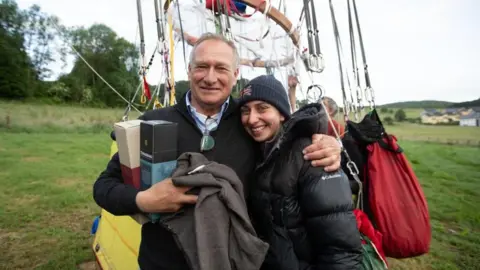
A British woman has become the first ever to cross the Atlantic in a hydrogen gas balloon.
Alicia Hempleman-Adams, from near Bath, set off from Maine in the US late on Wednesday and landed in Luxembourg on Sunday with her teammates Bert Padelt and Peter Cuneo.
Hempleman-Adams, 36, who grew up in Box in Wiltshire, took the spot on the crew of her father David - who has completed the flight twice before.
"A few times we had to call in and say we need a rescue on standby because we weren't sure how the next few hours were going to pan out," she said.
Hempleman-Adams already holds other female airship world records and is the youngest person to have reached the North Pole when she was flown there to meet her father aged eight.
"It was something I had wanted to do, but it was a real passion project for Bert," she said, after planning the flight across the Atlantic Ocean with her father for years.
"Last year I joined the team and we had an attempt where we had to land before we reached the ocean so we decided to give it another go this year," she said.
 Johnny Green/PA
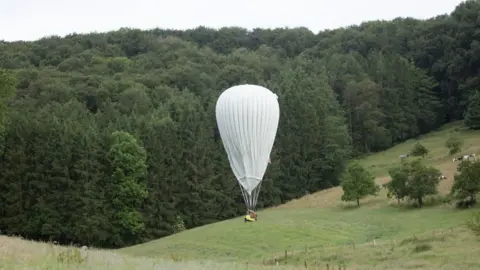
Hydrogen balloons, which have a gas cell filled with hydrogen that is lighter than air and sand ballasts, are more suited to longer flights than hot air balloons.
Hempleman-Adams said the crew, who were in an open basket, had to deal with rain and temperatures at night as low as -30C.
Their balloon reached heights of 25,000 ft and hit top speeds of 100kmh (62 mph)
'It threw something at us every few hours'
The explorer said they barely slept over the four-day flight, taking it turns to get a few hours of rest in the bunk seat.
She paid tribute to the team of meteorologists on the ground warning them of what weather was head.
"It threw something at us every couple of hours. There were things that didn't quite go to plan but we dealt with them one-by-one," she said.
At times, she thought they might have to land in the sea and they also weren't sure how things were going to pan out off the coast of Ireland.
"Coming into Europe, we weren't sure if we going to have enough ballast to hit land again."
She was welcomed by her father who was there when the crew landed.
Follow BBC Bristol on Facebook, X and Instagram. Send your story ideas to us on email or via WhatsApp on 0800 313 4630.
