'One in, one out' deal returns 4% of migrants

 PA Media
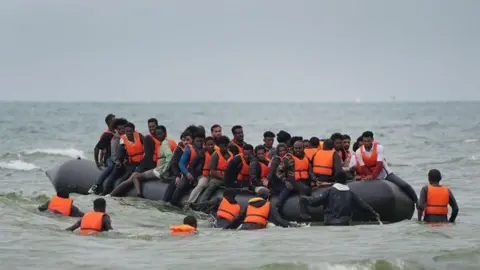
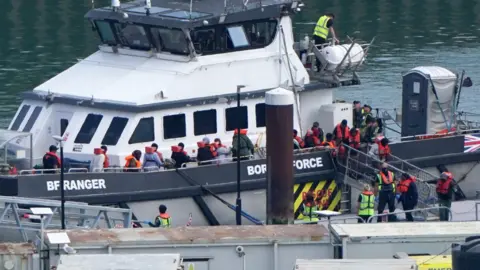
About 4% of migrants arriving in Dover on small boats are being sent back under the government's "one in, one out" agreement with France, Home Office figures have shown.
The latest figures have come exactly a year since the scheme with France began.
The deal allows the UK to send some small-boat arrivals back to France, while agreeing to take the same number of people from France believed to have a legitimate claim to come to Britain.
Government figures for the period from 4 August, 2025, to 30 June, 2026, reveal 1,087 people have been returned to France as part of the programme. During that period, 27,920 migrants arrived in the UK on small boats.
Figures said 1,117 people had been transferred to the UK under the scheme.
The scheme is designed to deter people from making the dangerous journey across the Channel.
The deal had been temporary, running up to June 2026, but has been extended until autumn, the government said.
More than 150 migrants were rescued earlier after the boat they were using to cross the Channel caught fire.
French authorities said 157 people were rescued and taken to Boulogne-sur-Mer, with no reports of anyone being injured.
'Enhanced surveillance'
Dr Mihnea Cuibus, senior researcher at the University of Oxford's migration observatory, said it was "still very much a pilot scheme", and the returns figure remained "relatively low".
However, he said it was encouraging to see the scheme had been extended and the number of people being returned had gone up steadily.
The point of the scheme was to try to deter people from getting on a boat, he said, but added there was no "magic figure where this starts having an effect".
Tris Osborne, Chatham and Aylesford Labour MP, said: "This is not the only thing we've negotiated with France.
"We've got enhanced surveillance. We've got new drones and helicopters with camera systems."
He said there had been a 50% reduction in crossings since January and, working with France, the UK had stopped 60% of crossings, while "significant numbers" of gang leaders were being arrested.
Osborne said the Home Office figures were "part of a wider picture", adding: "We're seeing early signs of success."
After the rescue earlier, he said one incident or death on what was a dangerous stretch of water was "one too many", adding: "We have a moral, as well as political and social obligation to challenge these gangs robustly."
 PA Media
A Home Office statement said: "Anyone looking to return to the UK after being removed under the UK-France agreement is wasting their time and money – and will be removed again."
A spokesperson said: "We have removed more than 1,000 illegal migrants from British soil.
"Hundreds of enforcement actions, including arrests, investigations, and sanctions have been pursued against migrant smuggling networks since the election, and we've returned or deported almost 70,000 illegal migrants."
The Home Office has not said how many people returned to France under the scheme have been detected illegally returning to the UK.
Follow BBC Kent on Facebook, X, and on Instagram and listen to BBC Radio Kent on Sounds. Send your story ideas to southeasttoday@bbc.co.uk or WhatsApp us on 08081 002250.
