Adder bite leaves couple fearing for dog's life

 BBC
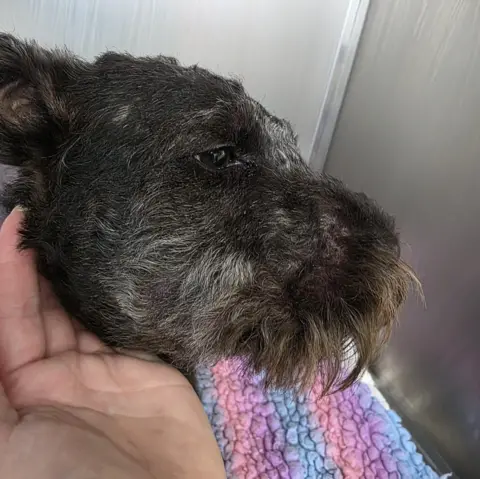
BBCDog owners are being warned about venomous adders after a terrier was bitten on the face, leaving her owners fearing she would not make it through the night.
Jet was on holiday with owners Jonathan and Anita Matthews in Ravenscar, North Yorkshire, when she "let out a really high-pitched scream" and her face swelled up.
"The way we carried her into the vet, I'm thinking the worst and it was just horrible," said Jonathan, from Retford, Nottinghamshire.
Josh Smith, the Bridlington-based vet who successfully treated Jet, said although adder bites were rarely fatal, owners should take immediate action if their pets were attacked.
Adders are the country's only native venomous snake. Experts say they are endangered and generally only bite defensively.
Jonathan said they initially thought Jet had been bitten by a grass snake.
"Then after about an hour we noticed that Jet had gone into a bit of a shock, with swelling around her face and her legs and body, so it was time to get her to a vet's as quickly as we possibly could," he added.
 Phillip Norton/BBC
The couple spent a restless night awaiting news from the surgery.
Smith, who runs the Aldgate Veterinary Practice, said the terrier "was quite unwell for a period of time".
"Facial bites are a real worry because they can obviously cause quite a lot of really bad swelling associated with the bite that can cause obstruction to airways," he said.
"The venom itself affects pretty much all organ systems, so you can see kidney issues, liver issues. We saw blood abnormalities."
Jet showed signs of improvement a few days after an injection with antivenom. She spent almost a week at the surgery and is now recovering at home.
 Supplied
Smith advised dog owners not to "try messing with the wound" or sucking out the venom.
"Some people might have seen [information] about placing tourniquets to stop venom spread," he added. "That doesn't help at all.
"The best thing to do, if you can, is carry your dog back to the car and then seek veterinary attention immediately."
Adders are found in about 40 areas around the UK, particularly in grassland and woodland.
 Phillip Norton/BBC
Kevin James, from the Lincolnshire Wildlife Trust, said it was feared that 90% of the adder population would be extinct within a decade due to disturbance by the public.
He said: "If people get too close, if they're disturbed, they slither off into the undergrowth and then they come back again.
"But this continued disturbance means they're losing condition, they're being stressed out and they're relying on their fat reserves.
"They're slowly starving to death and the majority of the general public don't realise what damage they're doing."
James, who is based in the Woodhall Spa area, advised people to avoid disturbing wildlife and keep dogs on a lead when around adders.
"They'll only bite someone if you accidentally stand on them or if you've got a dog off a lead," he added. "It's a last resort."
Elspeth Ingleby, a senior ecologist at North York Moors National Park, said adders were active most of the time during warm weather.
"With more people out and about, walking near their habitats, we are probably more likely to come across them, which is why it's so important dog walkers are aware of them," she said.
