Orange Order has never 'shied away' from Drumcree mediation

 BBC
BBCThe Orange Order has never "shied away" from mediation, the Portadown District Master has said, after a residents' group called for an international mediator to try to resolve the Drumcree parade dispute.
Nigel Dawson was speaking after meeting the Parades Commission on Wednesday.
The five-person commission must decide whether to allow the Orange Order to march from Drumcree church in Portadown along the mainly nationalist Garvaghy Road on Sunday.
It is one of the most contentious parade routes in Northern Ireland.
The Parades Commission has been holding a series of meetings as it weighs up whether to allow the march to go ahead.
 Pacemaker
Portadown Deputy District Master Alistair Power said the commission "listened intently" to the Orange Order at the final round of meetings on Wednesday.
A decision on whether or not to re-route the planned march may not be announced until Friday.
Meanwhile, Secretary of State Sir Chris Bryant has appointed Sir John O'Hara KC to lead an independent review of the Parades Commission.
The review will examine the commission's decision-making processes and organisational governance.
Bryant said it was important to "restore and maintain" confidence in how decisions are reached.
On Tuesday Garvaghy Road Residents Coalition spokesperson Breandán Mac Cionnaith described the current mediation process on offer as "flawed".
A Belfast-based organisation TIDES Mediation NI was appointed last week by the Parades Commission.
In a statement they said "if any party is not comfortable with the mediators, that has to be respected and understood".
The Orange Order has accepted their offer to begin engagement.
At a press conference on Wednesday, Dawson said he had "met with the mediation company identified and put in place by the Parades Commission yesterday afternoon and we made our position quite clear that we were ready to go with mediation".
"I'm waiting on the phone call from them that they wish to engage further with us," he said, adding that in 28 years they had not "shied away from mediation from any source".
Speaking about Wednesday's meeting with the commission Alistair Power said the Orange Order delegation made its "continued position clear".
"The commission has no credibility across any section of our community.
"The position we have set out is very simple - this is a legal question, and when you properly apply the legal tests the outcome should be inevitable."
The Democratic Unionist Party (DUP) leader Gavin Robinson said his party had a "positive engagement" with the Parades Commission and that he hoped they make the "right decision".
"The choice is clear for the Parades Commission. Do they apply the law, do they restore some level of confidence, do they look at the human rights obligations they are under and approve this application or do they succumb to the sad and tired and negative approach, which seems to me that the intolerance of others is paramount in their process."
Traditional Unionist Voice (TUV) leader Jim Allister, speaking after meeting, said there was "no legal basis whatsoever" to restrict the parade.
He said the commission had "one opportunity to do the right thing" and that the application should be decided according to public law.
Allister said if permission was refused, he had "no doubt" the decision would be challenged in the High Court.
 Pacemaker
The commission has been having separate talks with the Orange Order and a number of political parties including Sinn Féin and the DUP.
Sinn Féin president Mary Lou McDonald, speaking before meeting the Parades Commission, said the dispute had been settled 28 years ago and "cannot and should not be reopened".
She said it was the "considered and definitive wish" of the Garvaghy Road community that there be no Orange Order march through the area.
McDonald said the "only fair and just outcome" would be a continuation of the existing position.
On Tuesday, discussions were held with the Alliance Party and the Social Democratic and Labour Party (SDLP), as well as the residents coalition.
The commissioners also spoke to a delegation from the Loyalist Communities Council (LCC), whose members include representatives of loyalist paramilitary groups.
Afterwards, a spokesperson "restated their position that there would be no violence or public disorder emanating from any of the loyalist organisations" as a result of the Drumcree dispute.
Both sides in the dispute have been offered a mediation process to try to find a solution.
At the start of this month, the order announced plans for a "limited" parade at Drumcree.
Instead of 400 people and two bands taking part, only 60 members would march along the Garvaghy Road in silence on Sunday 27 September.
The parade is due to start at 13:00 BST at Drumcree church on Sunday and finish at Carleton Street in Portadown town centre by 14:30.
The Police Service of Northern Ireland (PSNI) has activated mutual aid arrangements to support "contingency planning for a policing operation" on Sunday.
Mutual aid is an arrangement where law enforcement agencies share personnel, equipment and resources across jurisdictional boundaries during major events, emergencies or staff shortages.
When did the Drumcree dispute begin?
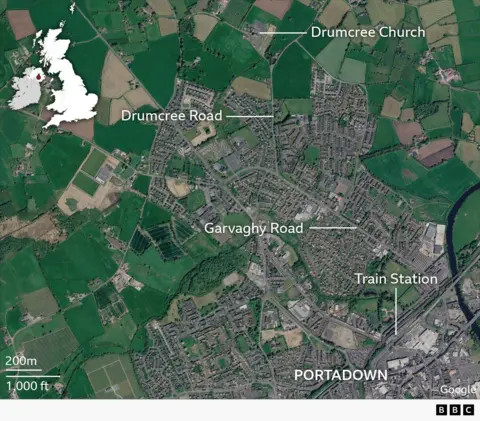
The Drumcree parade dispute began in the mid-1990s and it almost derailed the peace process at the time.
Violence related to the dispute resulted in riots, roadblocks and murders.
When the Orange Order was prevented by police from walking down the route in July 1995 there was a tense stand-off. It was the same for the next three years.
The Parades Commission began operating in 1998 to regulate parades and try to defuse tension around marches.
Its decision not to allow a march down the Garvaghy Road that summer has been challenged by the order for the past three decades.
