Review of legal framework launched in wake of Eleanor Donaldson trial

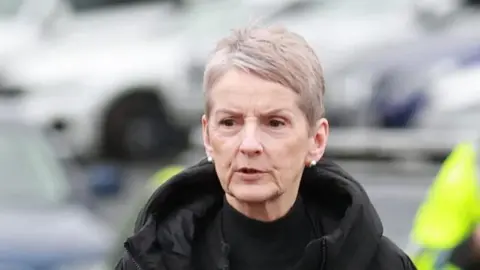 PA Media
Stormont's justice and health ministers have launched a joint review of the legal framework on trials of the facts in the wake of the Donaldson trial, BBC News NI understands.
That's according to a letter from the Department of Justice's assembly liaison officer.
Eleanor Donaldson, wife of convicted sex offender Jeffrey Donaldson, had faced a trial of the facts after being found unfit for a conventional trial on mental health grounds.
The ministers will appoint an external reviewer with the review aiming to launch in late October and conclude by the end of February 2027.
The letter to Stormont's justice committee said the move came in the wake of "public concern and interest" on trials of the facts, and that work would now take place on the terms of reference of the review.
Both the Department of Justice and the Department of Health have been contacted for comment.
What is a trial of the facts?
A trial of the facts is an option that is open to prosecutors if a court determines that a person is unfit to stand trial and criminal proceedings cannot go ahead.
It takes the place of a criminal trial and is used to determine whether an accused committed the acts alleged.
It cannot result in a conviction, but if the court is not satisfied that the accused committed the acts alleged, then he/she will be acquitted.
The procedure is allowed for in legislation by Article 49A of the Mental Health (Northern Ireland) Order 1986.
The mechanism is not used often but one high-profile example was in the trial of former IRA leader Ivor Bell in 2019.
What happens during a trial of the facts?
In some ways, it is similar to a normal criminal trial - the prosecution puts its evidence against the defendant before a judge and jury in a courtroom.
However, perhaps the key difference, is that the accused does not play a part in proceedings, and does not even need to be in court.
That was the case with Eleanor Donaldson, who was not present on any day of the four-week trial in which evidence was heard against her and her husband.
However, in a trial of the facts the accused will be represented by a legal team and their lawyers can question the witnesses, challenge the evidence and make legal submissions on their behalf.
Ian Turkington KC represented Eleanor Donaldson during her trial of the facts, cross-examining witnesses and issuing closing remarks on behalf of his client towards the end of the trial.
Then there is the major differences in what the outcome can be in a trial of the facts.
Instead of being asked to return a verdict of guilty or not guilty, the jury are asked to decide whether or not the accused committed the offence with which they were charged.
The focus is on what they are alleged to have physically done - not their state of mind at the time.
In a normal criminal trial, a jury would be invited to decide whether or not a defendant had the mental faculties required to be guilty of the offence as well.
The standard of proof remains the same - a jury must be sure beyond all reasonable doubt that the accused committed the acts alleged.
The accused cannot be convicted but they can be acquitted if the jury decide they didn't commit the acts alleged.
