'National crisis' warning over fridge collections

 BBC
BBCThe suspension of waste collections of fridges and freezers is turning into a national crisis, according to one council official.
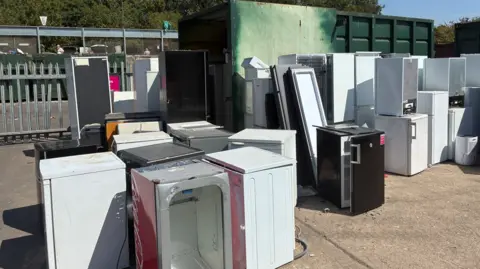
Warwickshire County Council has followed other local authorities across the country in halting the collections at its recycling centres, due to a backlog.
There is a national shortage of space at disposal sites and earlier this month, the government said it was working to "manage the impact" of the suspensions.
"This is a national issue. [I] hesitate to say national crisis, but it's becoming a national crisis now," Warwickshire's head of waste management, Andrew Pau, said.
"Virtually every local authority in the country is in the same position with a backlog of fridges and these backlogs are actually like expanding and increasing."
Recent weather had caused a backlog of appliances waiting to be collected by specialist waste firms and facilities that process fridges could not run "so quickly in the hot temperatures", the council said.
More fridges were also breaking down of late, according to the authority.
Across the county it was estimated there were more than 1,000 fridges and freezers in storage at recycling centres.
The county council urged residents to store, recycle or get retailers to take them away, rather than bringing them to their local tip.
Refrigeration is treated as a hazardous waste and must be processed in specialist centres and their Stratford-upon-Avon recycling centre at Burton Farm has about 150 fridges and freezers waiting for collection.
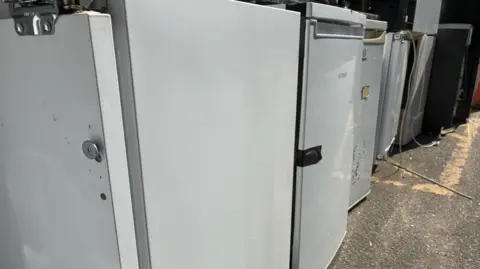
This month, it emerged tips in Bradford were turning away fridges and freezers due to a shortage of space at processing facilities, while council fridge and freezer waste collections were suspended in Nottinghamshire.
The Environmental Services Association (ESA), the trade body representing UK waste operators, said there were a small number of specialist facilities across the country, compared to conventional waste management.
ESA executive director Jacob Hayler added that there have been a number of serious fires and commercial closures of these facilities over the past year.
Pau said currently there was "a national capacity issue".
"There are only a certain number of reprocessors in the country and they can't cope with the number of fridges that are coming through the system at the moment," he said.

The council's head of waste management added that fridges that have worked "perfectly fine in this country for a number of years are actually finding it very difficult to operate in this hot temperature".
"They're working harder," Pau added.
"So we're having more fridges break down... [that] need repair or disposal.
"But also the remaining fridge factories, if you like, that process fridges, they're having to run at a slower rate than they normally run."
The Environment Agency agreed to allow temporary storage at existing and new authorised facilities until April 2027, but local authorities are concerned rogue traders could rip off householders and then fly-tip.
"If your fridge is taken away by somebody and fly-tipped, you are still liable for that fridge. You still could be prosecuted," Pau said.
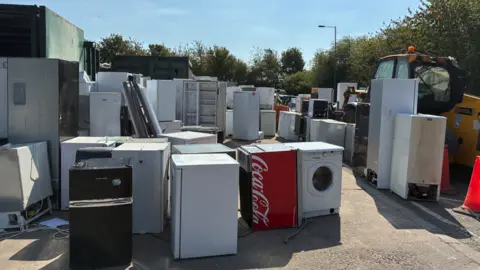
The Department for Environment, Food & Rural Affairs said about 142,000 tonnes of cooling devices were recycled last year, which equates to around three million appliances.
The government department stated it had relaxed storage rules for local authorities and anticipated the situation to ease when the hot weather disappears.
Follow BBC Coventry & Warwickshire on BBC Sounds, Facebook, X and Instagram.
