CCTV removed from accessible toilets over concerns

 BBC
BBCCCTV cameras have been removed from inside accessible public toilet cubicles in Devon after concerns people could be recorded while the facilities were in use.
Teignmouth Town Council installed 22 cameras in a new seafront toilet block to prevent vandalism.
The cameras were deactivated when the door was fully shut on the accessible cubicles, but concerns were raised about them recording children going to the toilet when parents held the door ajar so they did not lock themselves in.
The council said it fully recognised and understood the concerns, and it was committed to balancing privacy with the need for safety. Cameras remain in the block's hallways.
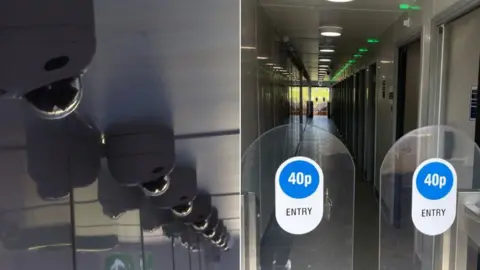
The majority of cameras in the block are on the ceiling in a communal corridor facing the doors of individual cubicles to identify who goes in.
They can film the toilet itself when the door is open to record any vandalism and its possible perpatrator.
When cubicle doors are closed, cameras cannot view inside.
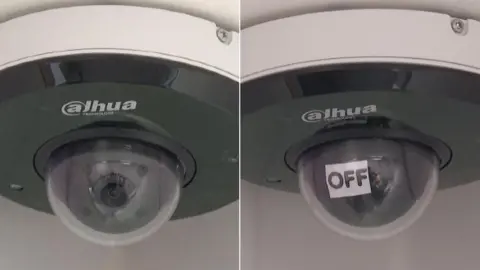
In the accessible toilets, the camera rotated towards the wall when the door was closed, so it did point into the cubicle in use. The camera also displayed a sign saying "off".

Natasha Mallen, from Teignmouth, chose to use the new disabled toilets at the Den because they did not have a camera facing the external doors, which she kept ajar so her children did not lock themselves in.
But she did not realise there was a camera inside the cubicle that only deactivated when the door was fully closed.
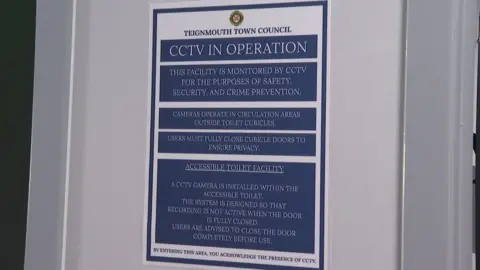
Mallen said she did not see any signs warning her that there was CCTV inside the accessible cubicle.
She said: "One of my children has SEN [special educational needs] and wanted his own privacy. I gave it to him and he's now been recorded.
"I couldn't take them both into one tiny cubicle, they're too small."
The children's grandmother, Cheryl Brown, said she wanted the position of all the cameras changed, including the ones in communal areas.
She said: "If you don't shut the door, you can still see who's on the toilet."
Teignmouth Town Council spent £1.2m on refurbishing toilets around the town after Teignbridge District Council had considered closing some of them.
Conservative councillor Joan Atkins said the cameras were installed because vandalism was costing the town £10,000 a year and they could not get "adequate identification information" to prosecute.
The council carried out a data protection impact assessment prior to the installation but Atkins said usage was "proving that, perhaps, that wasn't adequate, so anything that's come our way we've addressed promptly with apologies".
The council said footage was not continuously monitored and was automatically deleted after 30 days unless it was required to support an investigation.
Any review of recordings was carried out only by authorised staff with both an enhanced DBS [Disclosure and Barring Service] check and police clearance, it added.

Amber Badley, CEO of Firebird Data Protection Agency in Exeter, advises schools, companies and public bodies on data protection and said there was no specific law against installing CCTV in toilets.
However, organisations must be able to prove that installation complies with general data protection regulations (GDPR) and Article 8 of the European Convention on Human Rights: the right respect for their private life, she said.
Badley also said she had not seen the data protection impact assessment by the council and was not involved in the installation of the CCTV.
But she said, in general terms before installing CCTV: "Organisations must first establish whether there is a lawful reason for processing those images and, secondly, determine whether the activity is fair and proportionate when balanced with the problem at hand, such as preventing vandalism or other crimes."
She added: "The Information Commissioner's Office (the ICO) has referred to the use of surveillance systems in public toilets in their guidance, and states it should only be used in the most exceptional circumstances and to address very serious concerns."
Teignmouth Town Council said it "fully recognises and understands the concerns" and was "committed to balancing privacy with the need for safety".
It said it had retained cameras in the hallways as they played "a pivotal role in tackling persistent issues of vandalism and drug use".
It added: "We want to reassure the community that all CCTV systems are carefully positioned to enhance safety while maintaining respect for personal privacy.
"Our aim is to provide a welcoming, secure environment for all users, and we will continue to review our approach in light of ongoing feedback."
Follow BBC Devon on X, Facebook and Instagram. Send your story ideas to spotlight@bbc.co.uk.
