'My genius great uncle designed the most beautiful aircraft ever built'

 John Fairhall/BBC
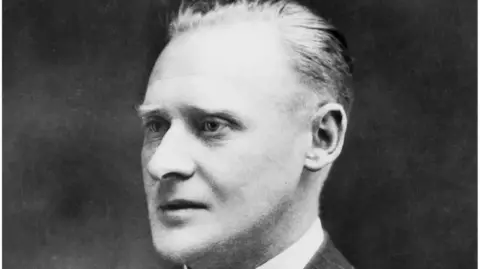
The great-nephew of the man behind the Spitfire has said he was a "genius who designed the most beautiful aircraft ever built".
Julian Mitchell said, during a visit to the Battle of Britain Air Show at IWM Duxford, Cambridgeshire, that being related to Reginald (RJ) Mitchell was "incredible".
He attended the special event, taking place on Saturday and Sunday, to mark the 90th anniversary of the maiden flight of the Spitfire.
Its first prototype, the K5054, took to the skies for the first time on 5 March 1936.
 John Fairhall/BBC
The fighter plane commissioned to combat the Luftwaffe at the beginning of the Battle of Britain was RJ Mitchell's exact design, which had a Rolls-Royce Merlin engine.
Mitchell continued to refine the design until his death from cancer in 1937, aged 42.
Julian said: "He was a driven man but a quiet man, but clearly a genius; he designed the most beautiful aircraft ever built.
"I'm so proud of it."
 Getty Images
He added: "Being related to such a famous man who did so much in such a short period of life is incredible.
"What is so incredible is he is still relevant today, and so is the Spitfire.
"It speaks of victory; businesses are still named after it. It is synonymous with our country and great things."
 John Fairhall/BBC
More than 18 Spitfires, including earlier Mk 1 variants and later models, and Hurricanes were on static display and in the air during the two-day event, Duxford said.
There was also a display by the Red Arrows at 14: 00 BST on Saturday and an appearance by the Bréguet Br.1050 Alizé from France.
 John Fairhall/BBC
John Romain, who attended to fly a Spitfire, said the craft was "a beautiful aeroplane, albeit... a lethal fighting machine".
"People love the sight of it, they love the sound of it, and it's just grown into people's hearts," he added.
"It looks great, it flies great, and it sounds great. It's important to remember that time, [but] also to celebrate the engineering."
He said events were "very important" to share the plane's story with the public and he was "proud of flying aeroplanes like this".
"When you look out at that elliptical wing, especially on a trip to the White Cliffs of Dover, or over the sea, you're imagining what the youngsters in the 1940s were seeing, because that's exactly the picture they saw," he added.
"Most pilots would aspire to it - there's a few of us who are very lucky to be able to do it."
Do you have a story suggestion for Cambridgeshire? Contact us below.
Follow Cambridgeshire news on BBC Sounds, Facebook, Instagram and X.
