'My whirlwind daughter is now in remission'

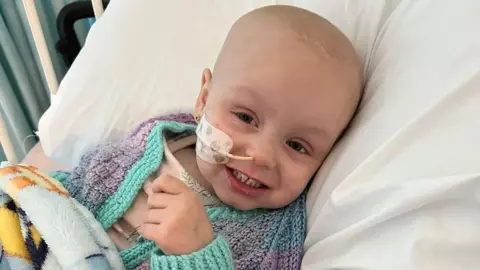 Supplied
Being told by doctors that her daughter Nancy would die from brain cancer was devastating for mum Gemma.
"It felt like the ground had come away from underneath me," she recalls.
Nancy, of Castle Donington in Leicestershire, was just a year old when specialists found she had an incurable growth on her brain.
But after life-saving surgery, the three-year-old is now "a whirlwind", and her cancer is in remission, says Gemma, who wants to raise awareness among other parents about the symptoms to spot.
In September 2023, Nancy's symptoms started with a prolonged period of vomiting.
Doctors suspected she had a stomach bug, or an allergy to antibiotics she was given to treat tonsillitis.
But over six weeks, Nancy's condition worsened, and she started to suffer tremors in her arms, with Gemma and dad Sam pushing doctors at the Royal Derby Hospital for scans.
Gemma says recognising symptoms - such as vomiting, loss of appetite, tremors, gaps in speech, a child reporting changes in their vision, and headaches - could point towards the possibility of a tumour.
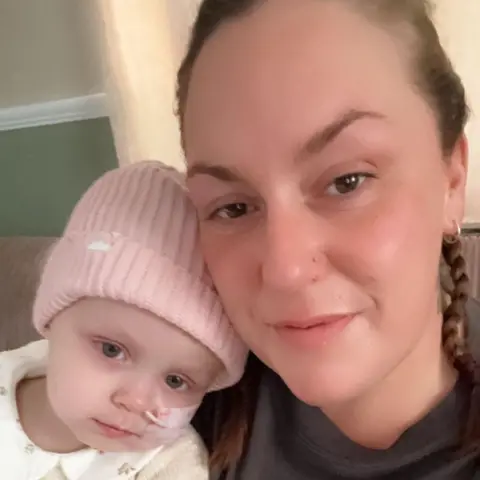 Supplied
Gemma says: "When she started getting tremors in her arms, I knew something was really wrong.
"I took her to A&E, and they said she's just dehydrated. I said 'I'm not having that, I'm not leaving, you need to do something'."
After magnetic resonance imaging (MRI) tests, medics discovered a large tumour on Nancy's left frontal lobe.
"Never in a million years did I think it was a tumour," says Gemma. "It was devastating. Everything just stopped.
"They said that the tumour had taken over the left side of her brain and that she would die, so they needed to make her comfortable.
"As a parent, hearing that, it's still hard to process now, and I do try not to think about it."
 Supplied
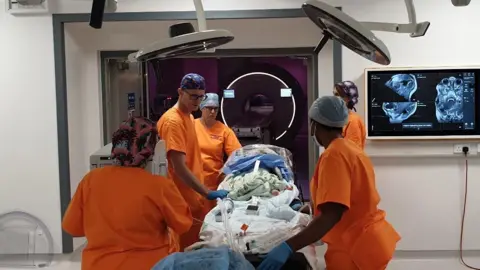
Nancy was transferred to Nottingham's Queen's Medical Centre (QMC), where specialists developed a surgical plan for what was found to be a high-grade ependymoma - a rare type of brain cancer - that was sitting on her brain.
It meant surgeons had to remove the tumour in two stages, amid fears its position could affect her mobility.
Gemma says: "The whole thing's a blur. I remember them saying: 'No, we can do something, we're going to get her into surgery'."
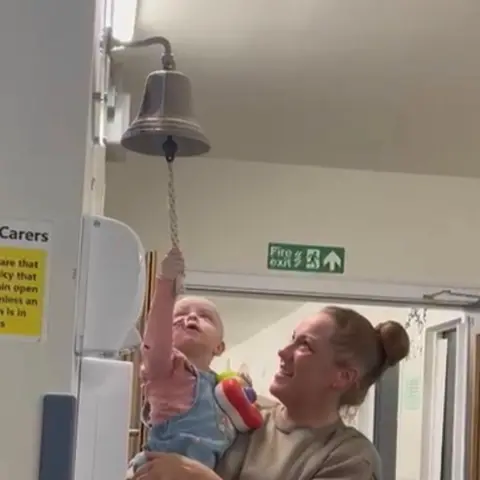
Nancy began an intensive course of chemotherapy in December 2023 at the QMC, and in January 2025 was in remission and continues to attend regular follow-up scans to monitor her condition.
Gemma says: "She's a whirlwind - she's three years old, so you can imagine."
 Supplied
Throughout May, Gemma is taking on Brain Tumour Research's 200k In May Your Way challenge.
During sections of the challenge, she will be joined by Nancy and her brother Mickey.
Nancy says: "You try and cover 200 kilometres walking, running, however you want to.
"It's pretty amazing Nancy being able to come, showing off her warrior battle scar on her head."
Ashley McWilliams, community development manager at Brain Tumour Research, says: "Nancy's story highlights how easily the symptoms of brain tumours in children can be mistaken for more common illnesses, leading to delays in diagnosis.
"The strength shown by Nancy and her family is truly inspiring, and their determination to raise awareness and funds will help drive the research needed to improve outcomes for patients."
Listen to BBC Radio Leicester on Sounds and follow BBC Leicester on Facebook, on X, or on Instagram. Send your story ideas to eastmidsnews@bbc.co.uk or via WhatsApp on 0808 100 2210.
