Where to view the solar eclipse in the East Midlands

 PA Media
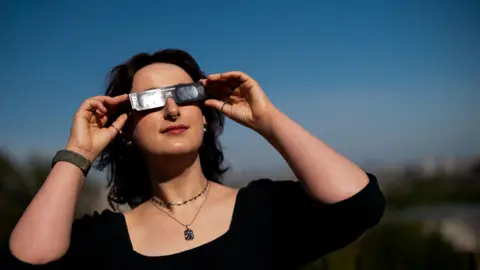
Eyes will be trained to the skies on Wednesday when the Sun and Moon align for a dramatic partial eclipse.
Depending on your vantage point, across the UK between 90% and 96% of the Sun will be slowly obscured by the passage of the Moon, between about 18:00 and 20:15 BST.
The eclipse - when the Moon passes between the Earth and Sun, blocking its light - is the fullest since 1999's total eclipse.
And while there will be lesser eclipses in the coming years, including one next August, the next total solar eclipse will not take place until 23 September 2090, according to Leicester's National Space Centre - and the East Midlands has some spectacular spots to view it from.
Derbyshire
To the south of the county, Rosliston Astronomy Group will be on hand from 17:00 to help visitors to Rosliston Forestry Centre to view the eclipse safely with specialist solar observing equipment.
To the north, the Peak District has, unsurprisingly, some great spots to view the skies from. Their elevation will assist prospective viewers with the Sun lying lower to the west in the evening.
The Peak District National Park Authority, Nottingham Trent University and the Science and Technology Facilities Council has designated three Dark Sky Discovery Sites which have panoramic views, car park access and interpretation panels for after dark.
These are Surprise View, off the A6187 near Hathersage, Parsley Hay off the A515 near Hartington, and Minninglow off the A5102 at Pikehall.
All are also great spots to view the ongoing Perseids meteor shower, which is currently peaking, once darkness falls later on Wednesday.
The StarDisc at Stoney Wood, Wirksworth, is also a great elevated vantage point on the edge of the Peaks.
Nottinghamshire
The Iron Giant, Bennerley Viaduct, has recently unveiled a visitor centre and cafe, which will be opening late to welcome visitors on Wednesday, and the former railway route's platform gives a nice viewpoint.
Cafe manager Jordan Hazell told the BBC: "We're going to open 5pm until 8pm, it's the first time we've done things in the evening. We're going to be doing local Derbyshire pie and peas in takeaway containers for people to walk up to the viaduct to watch the eclipse.
"I'm excited and looking forward to watching it. It has great views."
Other spots with great views include Silverhill Wood near Teversall, and Gedling Country Park.
Southwell Minster is currently hosting the Helios Sun sculpture, but the Wednesday tickets are sold out, while Sherwood Observatory is going to be closed to the public too - but for a good reason.
Dr Steve Wallace, chair of the observatory, said: "Our members put on a lot of effort volunteering to make the place tick over, so as a treat we've actually closed to the public during the eclipse and we're having a members event."
Leicestershire
Leicestershire's country parks provide some great panoramic views to see the Sun and Moon align.
Beacon Hill rises over the Charnwood countryside, while to the east of the county - where some of the darkest skies in Leicestershire are to be found - Burrough Hill and its scenic toposcope are a great vantage point.
The National Space Centre's event, and the Great Central Railway's fish and eclipse steam train, are now fully booked, however.
What time is the eclipse?
The further north you are, the sooner the eclipse will start, and the further west you are, the closer to the line of totality you will be.
In the East Midlands, it will start first in the north of the region, with the eclipse - according to online projections - due to begin in Glossop, Derbyshire, at about 18:13, hitting 91.3% totality at 19:10 and ending at 20:03.
Derby and Nottingham are due to start to see the Moon's passage at 18:14, and will peak at about 91% totality at about 19:11 and end at 20:04.
Leicestershire and Rutland are due to see signs from 18:15, peak at 19:11 and end at 20:04, with 91.1% coverage in Leicester.
How to watch safely
The National Space Centre is hosting an expert-led event to help people witness it safely.
A spokesperson said: "With the next comparable eclipse not expected until 2090, opportunities like this come along only once in a generation.
"Looking directly at the Sun during an eclipse can cause permanent eye damage, making it essential to observe the event safely."
Dr Wallace, from Sherwood Observatory, said despite it feeling "like a heavy cloudy day", there would be "intense brightness in the bit of Sun you can see".
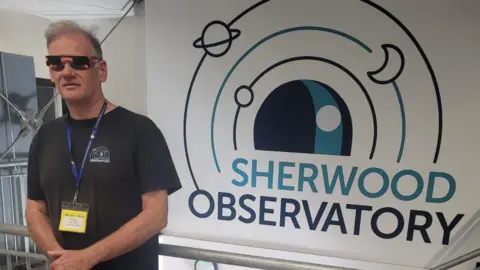
He said to never try to look at the Sun, even during an eclipse, using binoculars or telescopes.
"Get some heavily-tinted solar eclipse glasses," he said. "Or make a pinhole camera."
The government is advising people to either use indirect viewing methods or wear genuine eclipse glasses.
Safe options include:
- A pinhole viewer, which you could make at home
- Viewing the Sun's image projected through a colander or the gaps between tree leaves
- Projecting the Sun's image on to a sheet of paper using a pinhole projector
What are eclipse glasses?
It is not safe to just view the partial eclipse through regular sunglasses.
The right glasses should have the international safety standard ISO 12312-2 printed on them, the UK Health Security Agency (UKHSA) has advised, and the lenses should not be scratched, torn or damaged.
It has also advised buying a new pair rather than using ones from 1999, and to take caution when it comes to glasses being sold online - although most retailers are either sold out or will not now arrive in time for the celestial bodies lining up.
Whatever you do, don't look directly at the Sun.
What is the weather forecast?
BBC East Midlands weather forecaster Gillian Brown said conditions for viewing the eclipse in the region would be "ideal".
Forecasts show it will be sunny and clear - at least until the Moon passes over - with zero chance of rain and temperatures rising to about 31C (88F).
Additional reporting by Ben Mellor
Listen to BBC Radio Derby on Sounds and follow BBC Derby on Facebook, on X, or on Instagram. Send your story ideas to eastmidsnews@bbc.co.uk or via WhatsApp on 0808 100 2210.
