Hospitals face growing challenges from heatwaves

 BBC
BBCHeatwaves have created a number of challenges for the NHS throughout the summer.
On Thursday, the Royal College of Nursing said its members were collapsing on shift and patients were "suffering" in facilities "not fit for humans".
Across Nottingham University Hospitals NHS Trust (NUH), there has been a rise in patients presenting with heat-related health issues, with those people also more likely to be admitted to wards, and a critical incident was also declared earlier in the summer.
As temperatures soar and records tumble, keeping staff safe while they look after patients has led to additional pressures.
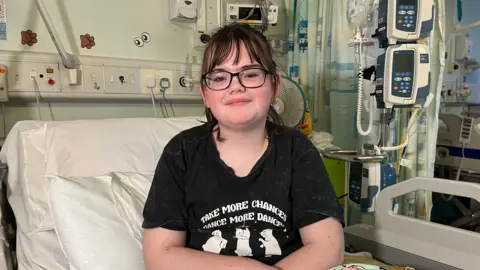
April, 13, has total intestinal Hirschsprung's disease, which means she can only eat and drink certain amounts in a day.
She said the warm weather has made it more difficult than usual to cope.
"If I have an ice pop, it's like 100ml of liquid, then I'm only allowed 400ml of water, so it's not great," she said.
"I tend to be more thirsty when it's hot, but I try and stay in front of the fan as much as I can, and that seems to help."
Karen Aucott, a consultant paediatrician at Queen's Medical Centre, said the heat had a variety of effects on how staff could carry on looking after patients.
While some patients have been able to enjoy the rooftop gardens, others have needed extra monitoring, while other departments struggled to cope.
"Down in outpatients clinics we did have a period where it was so hot down there the air conditioning couldn't keep up," she said.
"When that broke, it was dangerous levels of heat down there, and we had to either move clinics or cancel some clinical appointments, which obviously has an impact on patient care.
"For the staff working down there [it] was a really unbearable environment to be in at times, and on the wards as well it can really get quite hot.
"We're trying to get as many fans and portable air conditioning units on the wards, but obviously we aren't set up for that in this country - we haven't got that system in place as an automatic at the moment, and it's a big hospital to have to find for fans and air conditioning units for all of the wards around."
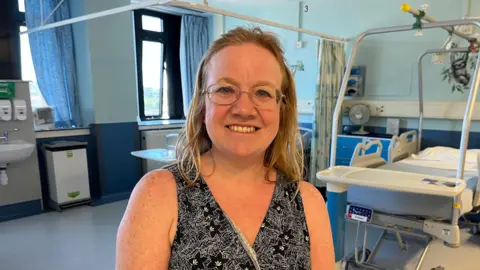
Emily Brookes, NUH's net zero lead, said the heatwave has been "quite complicated" for the trust to deal with, and means it has to adapt its approach to help people be more comfortable.
She said she has been carrying out a "thermal audit" to help inform a new plan on handling higher temperatures.
"Historically, when we're talking about climate change adaptation, we've mainly been looking at how do we cope with winter pressures, and now we're struggling a lot more with heatwaves. It's becoming more of a recurring factor," she said.
"One of the main things we've been trying to do is go back through the last five or six years of data that we've got of heat complaints from our staff and patients to really try and identify where the problem areas are on-site.
"I know as well, anecdotally, there are lots of other pressures that come from heatwaves - more patients have to come on-site, staff struggle a lot more, especially if they've got very busy roles where they don't have the time to stop for a hydration break.
"Just getting away from the heat can be quite difficult, and that can really build and mount."
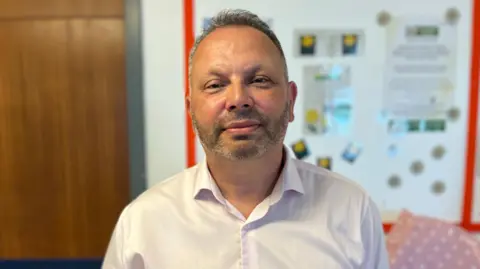
Duane McLean, deputy chief operating officer at NUH, said it has been "a particularly challenging summer" for staff, and thanked them for going "over and above" in difficult conditions.
"The heat pressures this year have been unprecedented, [and] that has raised a set of challenges that are quite unusual, for the NHS broadly but particularly for our organisation," he said.
"We've seen increased demand coming through our emergency departments, particularly around certain cohorts such as the elderly population [and] the younger populations.
"We've also seen challenges that our estate has given rise to, in terms of how our operating theatres, for example, are able to cope with the additional heat pressures - they're engineered to work in certain temperature ranges, and these extreme heat conditions have presented some challenges for us."
As the high heat continues, McLean said the trust will have to adapt to temperatures potentially reaching similar levels in future.
"I expect that we're really going to have to start to do some planning in the same way that we do for winter," he said.
Listen to BBC Radio Nottingham on Sounds and follow BBC Nottingham on Facebook, on X, or on Instagram. Send your story ideas to eastmidsnews@bbc.co.uk or via WhatsApp on 0808 100 2210.
