The 'ugly golf ball' which won people's hearts

 Julian Cartwright
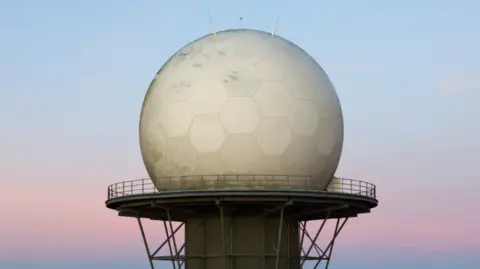
It is a part of the south Shropshire skyline that has become embedded in the minds of local people - a huge golf ball-like structure perched on top of a tower on Titterstone Clee Hill.
The radome is part of a station from National Air Traffic Services (NATS) and is in the process of being decommissioned under a project to update technology.
Some describe looking at it from their home every day for decades, for others, it transports them back to their childhood.
One woman on social media described it as the local equivalent of the Hollywood sign.
I've been taking a look back at the "iconic" golf ball's past, as well as what's happening to the site now.
The radome is one of NATS' remote radar sites, which provide continuous radar coverage for aircraft flying in UK airspace.
 The Birmingham Post
Radar activity on Clee Hill has been around for decades.
The Royal Air Force set up a radar station there during World War Two, and details about that are few and far between.
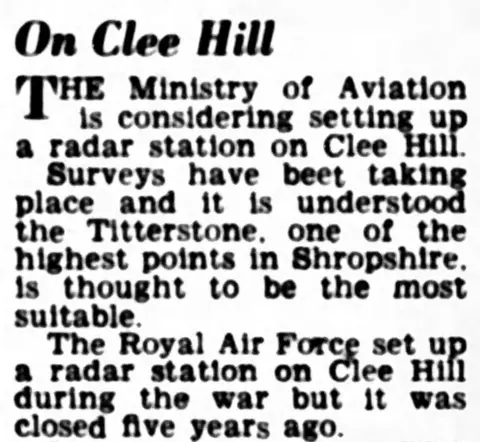
It shut in 1957, and by 1961 the Ministry of Aviation was considering setting up a radar station of its own - after a series of surveys to work out the best location.
There are plenty of quirky stories about the golf ball from the time.
In 1975, jacketing for the radar equipment was approved by South Shropshire District Council, but the committee specifically asked that the coverings of the radar scanners should be painted blue-grey to tone in better with the sky.
In early 1978, one of the radars blew off in gales - and the equipment was replaced at the end of that year.
Complaints and concerns
 Jane Watkins
The radar station was not universally popular.
Station staff received warning letters in 1981 because of "high speed passes" happening on a road leading up to the site.
It was said that research by Shropshire County Council's highways department found that the majority of traffic using the road in question was associated with the radar station.
In 1983, a concerned reader wrote to a local newspaper about their worry that the station could be a target for a nuclear attack, alongside other places in the county like Copthorne Barracks and RAF Tern Hill.
Years later, in 1995, a councillor said people living on Clee Hill were suffering from "aircraft anger" rather than road rage, because of a build-up of low-flying aircraft in the area.
It was said that aircraft were trying to "get under the radar".
Local people were reportedly "frightened to death", and a complaint was made to the MoD on behalf of Caynham, Clee Hill and Coreley.
 Worcester News
The radar obviously became a part of the landscape - it is impossible to miss - but that didn't mean everyone enjoyed its aesthetics.
It was described in less than complimentary ways in several rambling columns in local newspapers over the years.
It was described as giving the hill an "aura of Bond film gimmickery [sic]" in 1981.
More than a decade later, in November 1992, a column described the summit as being "crowned by the ugly radar".
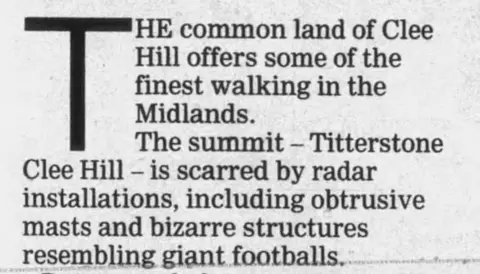
In August 2008, the summit of the hill was described as being "scarred by radar installations, including obtrusive masts and bizarre structures resembling giant footballs".
 Lee Newman
It is unclear when public opinion began to change about how the radar looked.
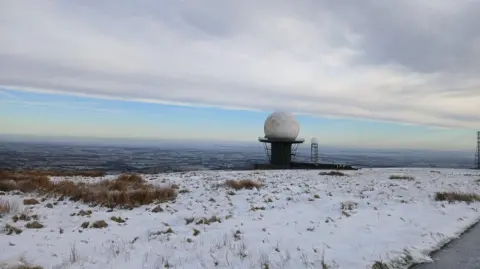
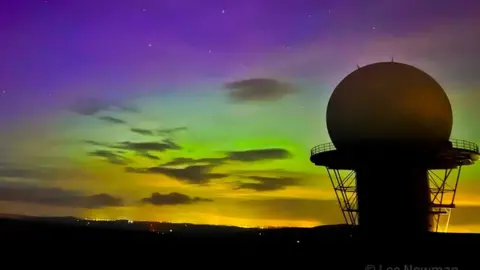
The main golf ball structure, alongside a smaller model nearby which is used by the Met Office, is often captured by professional photographers, walkers and local people.
Photos show its commanding presence set against the backdrop of sunsets, snowfall and even the Northern Lights, or looking mysterious and eerie while cloaked in black-and-white filters.
What is clear, though, is that people see a strange sort of beauty in the golf ball, and feel comforted by its long-standing presence.
This was made clear on social media when work on the site started in mid-2026.
It followed the announcement a year ago that the golf ball would be removed and replaced with another one nearby.
One person suggested that the golf ball structure should be kept as a landmark.
Others called it "iconic" and described their sadness that it would be taken down.
"This was part of my childhood I always look for it. So sad," one commenter said.
"It has been our favourite view for 13 years and I am so sad that it will soon alter when the 'golf ball' comes down!" another added.
"What maintenance does it need if it has been decommissioned? Spray a bit of Wet and Forget on it every year or two years and it will be fine," read another.
What happens now?
 Julian Cartwright
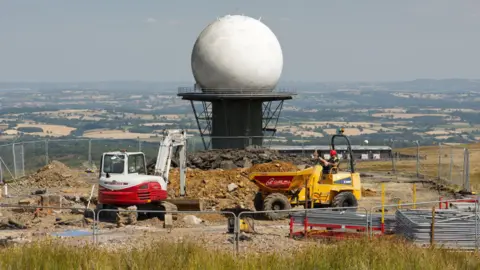
NATS said that while preliminary construction work had begun on the replacement radar, the existing station would continue operating as normal until spring 2028.
The site is integral to NATS' service obligations under the Civil Aviation Authority (CAA) - so it is important that radars there are operational at all times.
Plans revealed the current radar, which has a diameter of 16m (52.5ft) would be decommissioned, but the platform below it, the tower underneath that and an equipment building would remain.
The new radar will be about 180m (590.5ft) from the current site on existing foundations where there has previously been a tower.
So, although it is the end of the road for the golf ball that has been standing guard on the summit for more than half a century, something new will be born in its place - a reminder of how vital the radar system on Clee Hill has been, and will be, for years to come.
Follow BBC Shropshire on BBC Sounds, Facebook, X and Instagram.
