Hospital doctors to strike in dispute over pay

 Getty Images
Hospital doctors in Northern Ireland have voted in favour of industrial action, in a dispute over pay.
The British Medical Association (BMA) balloted its members over a four-week period after doctors' leaders rejected a recommended 3.5% pay uplift from an independent pay body.
Two separate 24-hour walk outs will take place on Thursday 25 and Monday 29 June but emergency and critical care will not be affected. Planned operations and procedures will be postponed.
Health Minister Mike Nesbitt said he was "disappointed at the outcome of the ballot".
He said he remained committed to "implementing this year's pay award" but added that he was "currently unable to do so" in the absence of an agreed budget.
There had been hope that Stormont could agree a multi-year budget in January for the first time in more than 10 years, but that did not happen.
Nesbitt added that the recommended 3.5% uplift was "higher than that which has been recommended for other healthcare professionals".
 PA Media
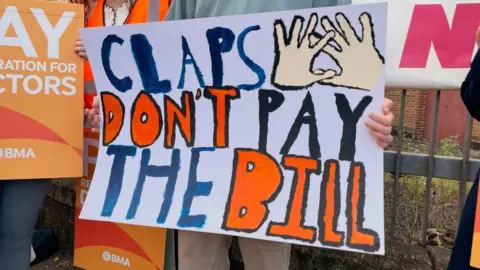
Resident doctors and consultants were balloted about pay, with 92% of resident doctors voting yes and 79% of consultants voting for strike action.
The result of the ballot of SAS doctors (specialist, associate specialist and specialty doctors) will be known on Friday 12 June.

Dr David Farren, chair of BMA Northern Ireland consultants committee, said the result "sends a very clear message that concerns about pay erosion, workload and the future of the profession are widely shared across the workforce, across all grades of hospital doctor".
"No one who voted in this ballot took this decision lightly; we know that from our conversations with members, but it's a clear indication from the doctors who actually deliver the health service in Northern Ireland exactly how serious the situation has become."
Speaking to BBC Radio Ulster's Evening Extra programme, Farren added that doctors' pay in Northern Ireland was lower than in other parts of the United Kingdom and "considerably behind" Wales and the Republic of Ireland.
He said that any pay uplift had been below inflation since 2008.
Nesbitt said the Department of Health would continue to engage with health unions but the financial constraints meant there was "no room for movement" beyond the 3.5% recommended by the Doctors' and Dentists' Pay Review Body.
"In recent months, we have seen progress with respect to our elective waiting lists," he added.
"This has only been possible through the hard work, dedication and commitment of the doctors and other health care professionals working across our HSC.
"A decision to take strike action at this time puts all those hard-won gains at risk."
