Sikh group calls for inquiry into Henry Nowak death

 PA Media
The government should hold a public inquiry into the "failures" surrounding the death of Henry Nowak, a Sikh lobby group has said.
The 18-year-old student was killed in Southampton by Vickrum Digwa, 23, in December 2025, using a knife he said he carried as part of his Sikh religion.
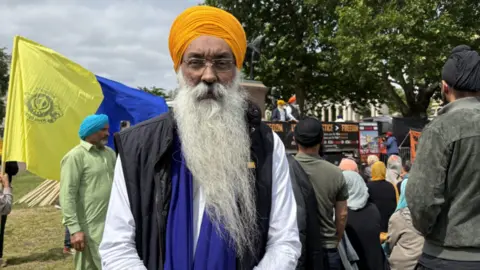
Dabinderjit Singh, the Sikh Federation's chief executive of political engagement, has written to Home Secretary Shabana Mahmood, Justice Secretary David Lammy and Attorney General Richard Hermer.
Singh said misinformation about the murder weapon had been "highly damaging" to Sikhs.
It comes after bodycam footage, released by Hampshire police with permission from Nowak's family, showed him repeatedly telling police officers "I can't breathe" as he lay dying in handcuffs after being stabbed by Digwa.
A jury inquest is set to be held next year investigating the broader circumstances of the death.
Under current legislation, a practising Sikh may wear a small blade, known as a kirpan, close to the body but drawing it in an act of aggression is illegal.
Section 139 of the Criminal Justice Act 1988, states that it shall be a defence for a person charged with having an article with blade or point in public place to prove that they had the article with them for religious reasons.
This legislation also applies to anyone wearing it as part of national dress, such as a sgian dubh blade worn as part of Scottish Highland dress.
If the item is used in an act of violence then it is deemed an offensive weapon.
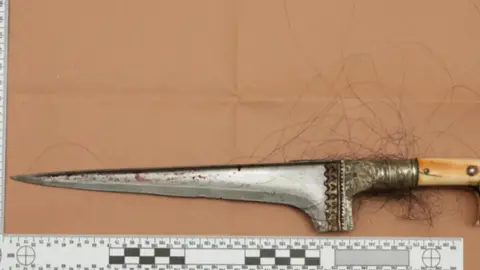
While Digwa was wearing a small kirpan knife, his second blade, described by the trial judge as "a large Sikh dagger", was used as the murder weapon.
The Southampton-based Sikh Federation had previously said that blade was not a kirpan and in a statement the Network of Sikh Organisations agreed, describing it instead as a "Persian blade known as a pesh-kabz – designed to go through chainmail," that Digwa wore "as part of a Nihang (warrior-sect) subculture".
The Crown Prosecution Service said that Digwa chose to carry two ceremonial knives and that "the judge's finding of fact made clear that he agreed" with its assessment that it was a kirpan that Digwa chose to use.
Speaking to the BBC, Singh said there have been "at least a dozen" stories of Sikhs in Southampton receiving physical or verbal abuse following the case.
"People can't do their daily jobs, school children at school are being harassed," he said.
"In the court they said 'Digwa said it was his Kirpan.' Well he was a liar - he's a liar and he's a murderer."
He added that the Sikh community had been "pushed under a bus" and they are calling for a "judge-led public enquiry", which he believes will help to contain some of the anger directed at Sikhs.
Singh said he was expecting a response from the government "within a matter of days".
The letter written by Singh called the Independent Office for Police Conduct's (IOPC) investigation into Hampshire police "entirely insufficient".
As well as the IOPC investigation, the National Police Chiefs' Council (NPCC) announced it would review anti-racism guidance – which advises police to treat ethnic minorities differently to get them better outcomes – that some have blamed for the actions of the officers who arrested Nowak.
"While criminal justice has been served against the perpetrator, the wider systemic failures exposed by this case demand immediate, independent and transparent investigation," Singh wrote.
He said the conduct of police officers and cultural issues during the trial were among "failures" and "serious questions" remained about whether Nowak's death was preventable.
"A wider inquiry must establish why this critical intelligence failed to inform the responding officers' risk assessments, and whether systemic biases contributed to the immediate criminalisation of a dying victim," he wrote.
During the sentencing hearing, Judge William Mousley KC said the pathology evidence had shown that Nowak would not have survived, "however quickly he received first aid, CPR or expert medical treatment".
A full inquest into the death of Nowak is due to open at Winchester Coroner's Court with a jury on 20 September 2027.
It will look at whether any "act or omission by a police officer" caused or contributed to his death.
Hampshire coroner Jason Pegg said at the inquest opening that while the crown court trial and conviction of Nowak's killer, Digwa, had largely established "how" the teenager died, he needed to be satisfied there was "sufficient reason" to explore his death further.
He decided there was.
His justifications included the "significant scrutiny and comment" and public interest after the details of Nowak's death were revealed and the fact he had been arrested and was "in the custody of the state" when he died.
He also concluded the "right to life" legal obligations in Article 2 of the Human Rights Act had been triggered in this case.
He stressed it was important Nowak's family be able to scrutinise the events of that night and participate in any proceedings and an inquest would allow such scrutiny - for them and the public.
The issue of a coroner's duty to "identify risks to life" was also mentioned, so potential future deaths could be prevented.
Hampshire's chief constable Alexis Boon has previously apologised to Nowak family, telling them "I'm so sorry you've had to go through this".
He also said that he would not pre-judge the outcome of the IOPC investigation into the circumstances of the police response.
The IOPC has been contacted for comment.
 Crown Prosecution Service
"Under the Offensive Weapons Act 2019 and its July 2022 statutory guidance, a kirpan is clearly defined and understood to feature a curved blade," Singh's letter said.
"The prosecution and police possessed the weapon for over six months; they knew, or ought to have known, that the blade of the weapon was straight, not of Sikh origin, and could not be a kirpan.
"By allowing a convicted murderer's false characterisation of the weapon to stand unchallenged in open court, the justice system facilitated a highly damaging wave of misinformation."
Thousands of Sikhs marched in London on Sunday, marking the 42nd anniversary of the storming of the Golden Temple in Amritsar, India, in which hundreds of people were killed.
The march took place in the wake of violent protests in reaction to the murder of Nowak.
Singh said at the march that attacks on Sikhs had taken place "up and down the country" every day since Digwa was given a life sentence with a minimum term of 21 years in prison.
Judge William Mousley KC told Southampton Crown Court at the sentencing on 1 June that Digwa had brought "shame" upon his family and his religion.
The BBC has asked the Home Office if a public inquiry will be held.
