Tamworth pigs introduced to rewild nature reserve

 Charlie Burrell/PA Wire
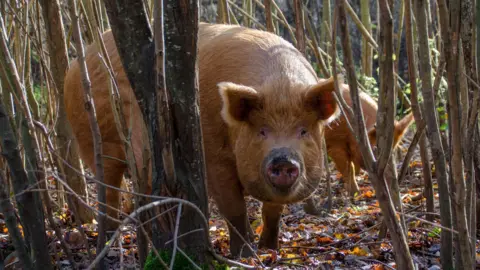
A nature reserve plans to introduce Tamworth pigs to simulate the presence of wild boar in order to help the recovery of several bird species.
RSPB Saltholme, in Teesside, is home to yellow wagtails, skylarks and short-eared owls and it is hoped the pigs will help them by preparing ground and spreading seeds.
The rewilding is part of a four-year project which will see Teesside University student Edward Hearn study habitat changes at the reserve as part of a studentship he won in honour of the work of Teesside bird lover James Denis Summers-Smith.
Reserve senior manager Chris Francis said he hoped the project would be the beginning of "a lifelong career in conservation" for Hearn.
Drone surveys will be analysed by Hearn as part of the project and he will also study stuctured surveys of plants, insects and birdlife.
The aim of the work is to make the soil more suitable for delicate wildflowers and native species such as Bird's-foot Trefoil, Common Rock-Rose and Bee Orchid.
'Song of skylarks'
A date has not been set for when the Tamworth pigs will be introduced at the reserve but it is expected to be within the next year.
"Sadly, many bird species are in decline and I hope this study will help local wildlife on Teesside as well as offer guidance for best practice across the UK," said Hearn, 26.
"If, in several years' time, red-listed yellow wagtails are starting to recover, more short-eared owls are hunting for shrews, voles and mice over Saltholme and the skies are alive with the song of skylarks, I will be immensely proud of our work here."
The RSPB said it hoped that bringing Tamworth pigs to Saltholme would replicate what wild boar would have been doing hundreds of years ago, treading and rooting in the ground for food which spreads seeds on which the birds depend.
Senior lecturer in ecology at Teesside University Ambroise Baker said: "Summers-Smith was keen to give young scientists the opportunity to make a difference through research and this studentship reflects that vision perfectly.
"It is also a fantastic opportunity for the university and the RSPB to work closely together, delivering applied science that contributes to the nature positive agenda."
