'When your child is dying you shouldn't have to beg for help'

 Family handout
Lila Dripps-Weir was just two years old when she died in May.
Lila was severely disabled and her parents say they spent their daughter's entire life fighting for support for her life-limiting condition.
She had a rare inherited metabolic disorder called Pyruvate dehydrogenase deficiency (PDH), which affected how her body could break down food and drink.
Her parents want age restrictions on services like wheelchair-accessible vehicles and continence products for children, who are dependent on them, removed.
The Department for Communities (DfC) said it "recognises the significant challenges faced by families caring for children with complex and life-limiting conditions".

Lila also had severe hydrocephalus, epilepsy and was registered blind and deaf.
Her mum, Hayley Dripp, described her as "a very happy little girl... the strongest person I've ever met in my life... courageous and had a smile that would light up a room".
But she said: "You just hit one wall after another.
"No matter how many medical support letters I had, no matter the long list of diagnoses she had, age was always a factor. They didn't look at her safety."
Lila's dad Robert Weir added: "When your child is dying, you shouldn't have to beg to get help that she's entitled to."
 Family handout
One of the main problems the Cookstown family experienced was taking Lila out in the car, which had a huge impact on family life and their ability to attend hospital appointments.
In Northern Ireland, a child cannot qualify for the higher rate mobility component of Disability Living Allowance (DLA) - which is required for the Motability Scheme - until they reach three years of age as it depends on a child's ability to walk.
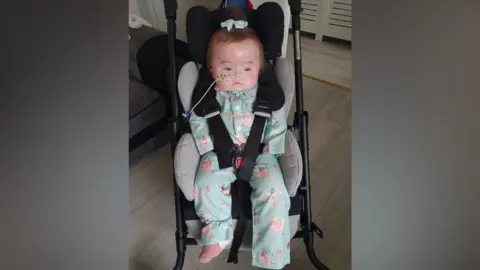
Lila could not roll, sit, or stand and, according to a paediatric physiotherapist, was completely dependent for all care.
She received a specialised buggy, but the family still needed a wheelchair-accessible vehicle to transport her and the buggy.
Hayley said this was "denied" to Lila "due to her age, not clinical need".
Robert said not having a safe vehicle to transport his daughter in was "terrible" and he had to sit in the back of the car and hold Lila's head up "just so she could breathe".
A charity which helps disabled children did step in to assist and provided the family with a wheelchair-accessible vehicle, just before Lila's second birthday. Her father said that was a "lifeline".
"She was able to be safe and she got the life that she deserved eventually because she was fit to get out of the house," her mother said.
Lila's third birthday would have been on 1 August.
The family spent what turned out to be Lila's final weeks of life filling in forms so she did not miss the deadline for applying for mobility DLA before her third birthday.
Hayley said she felt her daughter was not "entitled to basic human rights that other kids are entitled to because she was born different".
"I would like the departments to work with healthcare professionals and look at diagnosis and clinical need and the expert opinions of medical professionals rather than age and a birthday," she said.
 Family handout
In a statement, the Department for Communities (DfC) said that "as with other social security benefits, parity is maintained with the Department for Work and Pensions" and it is not aware of any plans to review the age restrictions that apply to the mobility.
The DfC said the minister would be happy to meet the family to hear their concerns first hand and that he would also raise the matter with the UK government.

The fight for continence products
But Lila's parents had another battle trying to get her continence products.
Hayley said her daughter was not entitled to them because of her age, but before Lila's death she was using the biggest size of nappy available to buy.
"Although she was young, Lila was over 21 kg before she passed away," she said.
"I started to worry about what we were going to do when these nappies didn't fit her anymore.
"We reached out to multiple healthcare professionals. They were trying to fight the battle with us. We couldn't get an assessment because she wasn't of age.
"It was another added pressure."
According to Bladder and Bowel UK, continence products will only be provided to children who are at least five years old and have been fully assessed and then supported for at least six months with a programme to develop skills for toilet training.
But toilet training was impossible for Lila.
Linda Dillon, who sits on Stormont's health committee, said families with children who have complex and life-limiting conditions should not have to spend precious time fighting for services.
"These small practical needs that families have; being able to access nappies, being able to get a car that issuitable for your child, those are very, very small things that I think that we could have some flexibility around.
"I think the health minister and the communities minister could very quickly move to change the age restrictions and that would be a massive help to families."
'I feel robbed'
 Family handout
Robert said he feels "robbed" of time with his "special" daughter. Time that was spent researching, making calls, sending emails, and asking for support, but not getting anywhere.
"We'll never stop fighting in her name to help other people and other children," he said.
"They can't be shoved to the back and forgot about. We'll do everything we can to make sure that doesn't happen."
Hayley said Lila's death has left "a massive void" in their lives.
"Lila deserved a life with dignity and support that she needed and if we can do anything in her name to help other children get dignity and support that they need based on their clinical needs, then we've done something to honour her," she said.
