'I am still alive': Indian activist on hunger strike for 26 days loses 11kg

 Hindustan Times via Getty Images
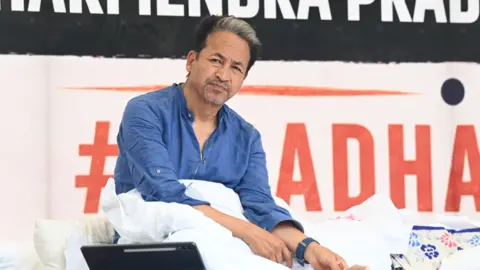
Indian activist Sonam Wangchuk, who has been on hunger strike for 26 days in support of the Cockroach Janta Party (CJP), says he has lost 11kg (24lb) but is "still alive".
Popularly known as "Sonam sir", Wangchuk has been the main draw at the youth-led movement seeking education reforms and the resignation of Education Minister Dharmendra Pradhan.
He was forcibly removed from the CJP's protest venue at Delhi's Jantar Mantar site on Saturday and taken to hospital where he continues his fast.
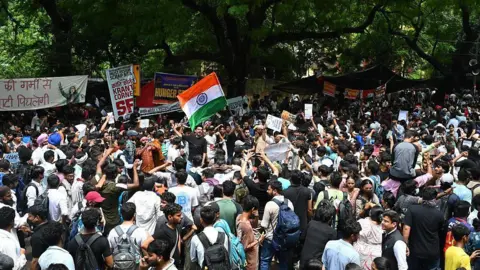
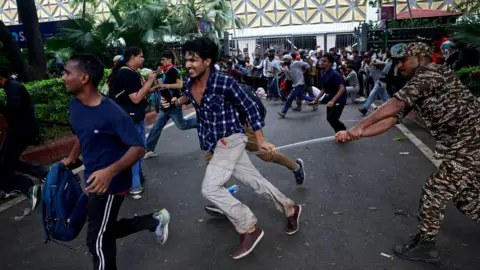
Meanwhile, thousands continue to turn up at the protest venue even after the brutal police crackdown on Monday's march to parliament which left scores of protesters and police injured.
 Hindustan Times via Getty Images
The violence has stirred public anger and galvanised India's opposition, posing a challenge for Prime Minister Narendra Modi's government.
Modi has not commented directly on the protests or engaged with the protesters, but on Thursday, he posted a statement on X that is being seen as an attempt to reach out to students who have been frustrated with repeated exam paper leaks.
"Nothing is more important than the welfare and future of our youth," he wrote.
"We have decided to set up fast-track courts to ensure swift and stringent punishment for those involved in paper leaks... This continues our series of steps for safeguarding the interests of students... Those who try to harm the future of our youth will not be spared."
A CJP spokesperson, however, said the real questions to be addressed were why paper leaks happen and who benefits from it.
"You are applying medicine after an injury, but our struggle asks why the injury has to happen," Ashutosh Ranka said in a video on X, indicating that the protesters would not back down until their demands were met.
While Wangchuk is not at the protest site any longer, many of the placards and posters have slogans about his fast and drawings of him.
Before being taken to hospital, he endured 21 days in Delhi's scorching summer heat on nothing but salt and water.
In a statement on Wednesday, Medanta Hospital, Gurugram, said the activist was admitted to the ICU.
"He is being treated by a multidisciplinary team of doctors. At present, he is stable, oriented, and his vital signs are within accepted parameters. All treatment being administered to him is in accordance with his informed consent."
On Wednesday, CJP founder Abhijeet Dipke, dozens of opposition MPs, activists and celebrities renewed their request to him to call off his hunger strike.
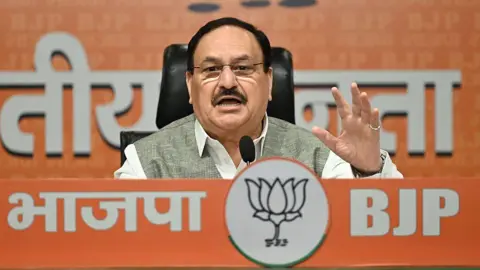
Health Minister JP Nadda, who had visited the activist at the hospital on Tuesday night, said he had also requested him to stop fasting.
"We inquired about his health and wellbeing. We also requested him to break his fast, join the mainstream, and guide the children in the right direction," he said, adding that the government was open to discuss the issues raised by Wangchuk.
But Wangchuk has refused all entreaties.
 Hindustan Times via Getty Images
In a three-minute video statement from his hospital bed on Wednesday night, the activist said: "Many leaders, including ministers from the ruling party, have appealed to me to end my fast. I want to do that too because my work is important to me."
But, he said, he would not end his hunger strike unless the government gave him an assurance that no force or retaliatory action would be used against students.
"If I receive that assurance soon, I will end my hunger strike today. If not, I will unfortunately have to continue," he said.
The activist said he wanted "to salute all the students who conducted themselves with remarkable restraint" during Monday's crackdown on the CJP.
"Despite being lathi-charged [beaten with sticks], they did not retaliate. Seeing the brutal action against them, I decided to continue my hunger strike," he said.
Wangchuk's statement and an earlier letter to federal ministers he met on Tuesday night omitted any mention of Pradhan's resignation, but the CJP insisted the demand remained non-negotiable.
"The peaceful protest at Jantar Mantar will continue until Pradhan resigns," Dipke told his supporters. "We will not let Sonam sir's hunger strike go in vain. We will not let the brutal assault on students go in vain," he added.
Students blame Pradhan for repeated leaks of major public exams, most recently the medical entrance test, and say he must take moral responsibility and resign.
Pradhan has not commented on the resignation demand but has criticised the opposition Congress party for "shamelessly [exploiting] students as political tools to manufacture disruption".
On Monday, tens of thousands walked through central Delhi after the CJP called for a march to parliament as its monsoon session opened.
Scores of protesters were injured as police used force to disperse the crowds, bringing condemnation from opposition parties and human rights groups.
Police said 60 protesters and 118 police personnel were injured, but the CJP put the number of demonstrators hurt at 150. By Thursday, at least 300 people - protesters and police - had been admitted to hospital, senior officials and medics told the BBC. Most of those needing medical attention were demonstrators, they said.
Human Rights Watch said the security forces had used "excessive force" against protesters in Delhi.
"Prime Minister Narendra Modi's administration should promptly and impartially investigate unnecessary and excessive use of force, allow peaceful protests and stop suspending mobile internet services, which put people at added risk," its report said.
BBC reporters at the scene on Monday saw police using batons and tear gas against the crowds. The violence was also captured in video footage.
Police arrested protesters, most of whom have since been released on bail.
Officers also dismantled the stage and makeshift tents at the protest site, but demonstrators have refused to leave, maintaining a round-the-clock sit-in under heavy police and paramilitary deployment.
The authorities have closed 16 metro stations in central Delhi since Wednesday, without saying why. Protesters say it is meant to stop people reaching Jantar Mantar.
 Reuters
A satirical political movement, the CJP was inspired by remarks made earlier this year by India's chief justice, who used the word "cockroach" to describe unemployed young people turning to journalism and activism. After the comments sparked outrage, he said he had been referring only to those with "fake and bogus degrees".
Monday's huge turnout showed that the CJP, though not a registered political party, has evolved into a movement capable of drawing tens of thousands onto the streets.
On Tuesday, several opposition leaders, including Congress MP Rahul Gandhi, staged a protest outside Modi's residence. Videos showing police dragging Gandhi away sparked widespread outrage.
