I feared my stalker would kill me, says survivor

 PA Media
A woman who feared she would be killed by her stalker has described how she struggled to persuade police to take her safeguarding concerns seriously.
To protect her identity, the BBC has agreed to refer to the 40-year-old from south Lancashire as Sara. She said she was harassed by someone she met at work for several months in 2024.
During the last five years, recorded annual stalking cases in the county increased by more than 2,000 to 5,756 in the 12 months to April.
Lancashire Constabulary said: "We have rolled out refresher training to officers across the force in this area and are always striving to improve the service we offer to victims and how we investigate their complaints."
Of the 44 police forces in England and Wales, Lancashire has the sixth highest number of cases.
In 2021 there were 3,340 offences recorded.
Sara said she met her stalker through her work as a support worker.
"They repeatedly turned up at my work, being aggressive, and threatening to harm themselves," she said.
"They found out I used to commute to work, so they would loiter near the train station.
"It was especially alarming and unsettling because I live and work in two different counties, so they went to extra efforts to really cause me harm and distress."
The mother-of-three said the experience was terrifying and she had to take time off of work due to the stress it caused.
She also bought a car to avoid her stalker at the railway station.
"It was all consuming," she said. "It changes how you think and how safe you feel. It affected my relationship with my husband, with my children.
"I had to change routines, and I limited where I went. There was a significant amount of time when I didn't actually leave the house.
"I had to lie to my children about why we couldn't go out."
Sara said she felt her stalker was unpredictable, and she was "always scared of what they were capable of".
Because the stalking happened across two counties - Lancashire and Greater Manchester - Sara felt as if she slipped between the net of two police forces.
She said police did not adequately take responsibility for her safeguarding, something she described as "isolating".
"I felt like it was my responsibility to make sure that police were contacting the witnesses and taking statements and obtaining CCTV before it was recorded over," Sara said.
"I felt like there were a lot of barriers to be treated as a victim."
Sara said this helplessness led to recurring nightmares and flashbacks, and she now has PTSD caused by her ordeal.
She was supported by the national stalking charity Paladin, which described her experiences as a "murder in slow motion".
"There was that really intense, heightened fear that I am going to die," Sara explained.
"The fear is really compounded by the feeling that there's a lack of immediate action from the agencies meant to protect you."
Eventually, the case went to court, where Sara secured a restraining order against her stalker.
She said more needed to be done to make sure victims do not fall through the net.
"There needs to be stronger co-ordination between different forces," said Sara. "It's about acting early to prevent escalation, and recognising the impact on victims of stalking. It can have a devastating impact on your physical and psychological being.
"There should be more support mechanisms in place for victims, as well as programmes to tackle stalking behaviours to reduce the risk of reoffending."
'Devastating impact'
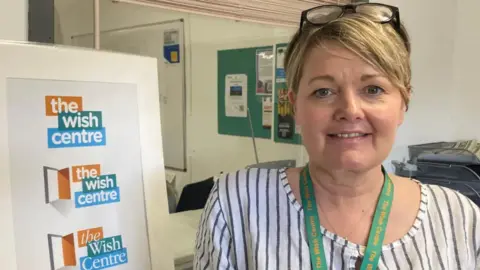
Rebekah Wilson is the training and advocacy manager at the Wish Centre, a Blackburn-based domestic abuse service.
She said awareness about organisations helping victims of stalking in Lancashire was increasing.
"People who wouldn't have reported previously perhaps have realised that there is help out there now, that there are agencies such as Paladin specifically created to deal with the issue of stalking and that places such as the Wish Centre have specialist workers," she said.
Wilson said organisations helping victims conduct risk assessments, pulling together agencies including the police and probation service to create victim safety plans.
A Lancashire Constabulary spokesperson said: "We know the devastating impact this crime has on victims in damaging their feelings of safety and self-confidence.
"We work closely with complainants, as well as other partner agencies and charities to protect victims, review cases and investigate incidents thoroughly.
"In addition, each policing division has a dedicated stalking and harassment point of contact who is a specialist detective who reviews some cases and is available for advice if officers require it.
"We are committed to protecting women and girls from all forms of harm, and we will do everything in our power to put perpetrators before the courts - no matter who they are."
Greater Manchester Police has been approached for comment.
Listen to the best of BBC Radio Lancashire on Sounds and follow BBC Lancashire on Facebook, X and Instagram. You can also send story ideas via Whatsapp to 0808 100 2230.
