Ocean sunfish washes up on popular beach

 Gray's Art
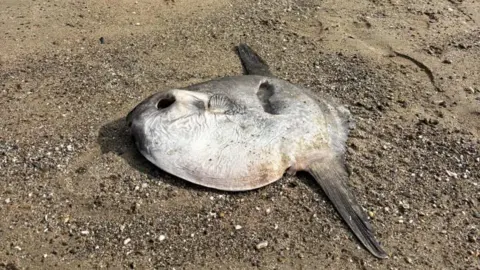
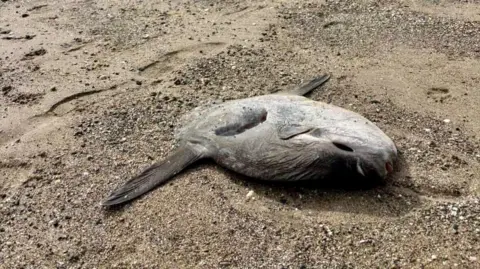
An ocean sunfish has washed up on a popular beach in north Wales.
Gray Eaton, a Cheshire artist and photographer, captured a picture of the fish on Traeth Trwyn y Fach, in Abersoch, Gwynedd, and shows its flat, circular shape making it look like a giant swimming head.
It is the second largest bony fish on the planet and visits UK seas during the summer months to feast on jellyfish, according to the Wildlife Trust, but this one did not survive.
Experts said it was common to see ocean sunfish on Welsh coastlines in the summer, but added that there had been a spike in sightings following the recent heatwaves.
The ocean sunfish is listed as vulnerable on the IUCN Red List but there is limited regional data, meaning overall populations remain unknown.
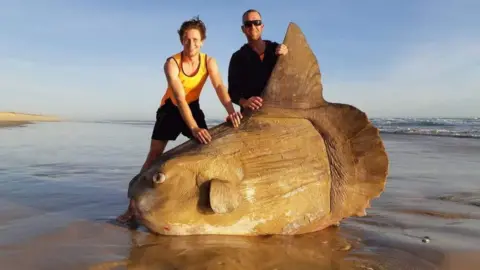
Sizes of sunfish can vary depending on species. The Museum of New Zealand said the little oblong sunfish only grows to "about 1m long and about 6kg".
The other five species can become much bigger growing to over 3m long and their maximum weights have always been estimated as their size makes them very hard to weigh accurately.
 Gray's Art
Ocean sunfish are found across tropical and temperate waters and they have been recorded swimming across the length of the Atlantic near countries ranging from Iceland to Chile, according to the Wildlife Trust.
Mat Westfield, Wales strandings co-ordinator at Marine Environmental Monitoring (MEM), said the incident was reported but it was unfortunately too late to analyse why it had washed ashore.
"We have to collect it when its still fresh because, once it starts decomposing, all the information is lost," he added.
Westfield said they have seen incidents like this rise around Welsh and Cornish waters this summer as a result of the heatwaves that have blighted the UK in recent weeks.
He added: "We seem to be getting a lot of sightings of sunfish by the various tour operators and fishing vessels."
Despite this, he stressed it was most common to see ocean sunfish in the summer months, as they hunt food.
Westfield said he had also seen more reports of jellyfish sightings in recent months, which the sunfish primarily feeds on.
 Jacob Jones
Westfield said it was "really difficult" to assess the impact as a result of climate change, but we are seeing a "change of species within the ocean".
"Ten years ago, short-beaked common dolphins were very rarely seen in the waters around the Welsh coastline.
"Now they're one of the most common cetacean we find."
He said the rising water temperature is influencing this with species favouring colder water moving further north.
What the long-term impact of this on species populations is "really difficult" to say at this stage, according to Westfield.
He said the best option if you find an animal washed ashore is to call the rescue hotline to contact the British Dives Marine Life Rescue.
"They will be able to give you advice on the phone and get a marine medics to come to the location."
