Russia scales back Moscow Victory Day parade, blaming threat from Ukraine

 Reuters
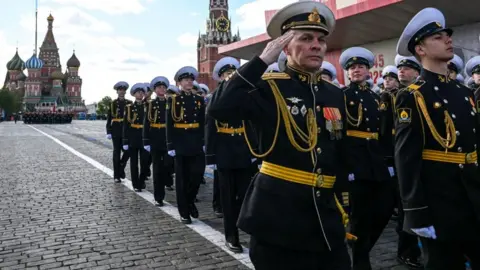
Russia's Victory Day parade in Moscow on 9 May will be scaled back this year because of a "terrorist threat" from Ukraine, the Kremlin has said.
"All measures are being taken to minimise the danger," said President Vladimir Putin's spokesman Dmitry Peskov.
Russia's military explained that the annual commemorations of Soviet victory over Nazi Germany in World War Two would not feature military vehicles or cadets due to the "current operational situation".
Ukraine has recently intensified its strikes deep inside Russia, more than four years into Russia's full-scale invasion. Kyiv says it is hitting legitimate military targets, and in turn accuses Moscow of attacking civilians in Ukraine.
Peskov told reporters on Wednesday that "the Kyiv regime, which is losing ground on the battlefield every day, has now launched into full-scale terrorist activity".
"Therefore, given this terrorist threat, all measures are, of course, being taken to minimise the danger," he said, stressing that the parade would still be held on the Red Square.
Putin revived the old Soviet practice of parading heavy military hardware in Red Square in 2008 to demonstrate Russia's "growing defence capability".
Last year, more than 20 world leaders were in Moscow for lavish commemorations of the 80th anniversary of the Nazi defeat in 1945 which included an array of modern armoury, including tanks and drones.
In its statement late on Tuesday, the Russian defence ministry said this year's parade would include representatives of all branches of Russia's armed forces and a colourful fly-past. However, it made clear that "cadets from Suvorov military schools, Nakhimov [naval] schools, and cadet corps, as well as a column of military equipment will not participate in the military parade this year".
Footage would also be shown on national TV, it said, of Russian military personnel "carrying out tasks in the special military operation zone" - a reference to how Moscow officially terms its invasion.
Russia has been changing traditional parade formats in recent years - but it is the first time since the invasion of Ukraine that armoured columns will not be rolling on the Red Square.
First reports that this year's event would be scaled down emerged on social media earlier this month, with several pro-Kremlin military bloggers writing about a growing threat of Ukrainian long-range aerial attacks.
"Imagine, 'Parade, stand at attention', and then a missile threat is announced. It would be a significant blow in terms of media coverage, even if nothing hits," blogger Ilya Tumanov was quoted as saying by Russian media.
Several other pro-war commentators noted there had been none of the usual rehearsals that involve massive road closures in central Moscow.
Meanwhile, a telecoms source told BBC Russian that "more powerful" restrictions on mobile communications would be imposed in Moscow on 5, 7 and 9 May. Mobile internet services were severely disrupted in the centre of Moscow in March, in what authorities linked to security reasons.
Many Russian and foreign analysts agree that victory in World War Two - known in Russia as the Great Patriotic War - remains for President Putin the main historical narrative binding the country together.
Ukraine has not publicly commented on Peskov's accusations, although a senior Ukrainian official last week ruled out any attack on the Victory Day parade in Moscow.
"Nobody is attacking civilians and civilian infrastructure," said Mykhailo Podoliak, an adviser to Ukrainian President Volodymyr Zelensky's office.
He pointed out that there would be many ordinary civilians in Moscow watching the event.
Moscow - Russia's best protected city - has in recent weeks witnessed several Ukrainian drone attacks, with the Russian military regularly reporting that most of the projectiles are being shot down.
 Veniamin Kondratyev / Reuters
Ukraine has also significantly increased its strikes on key energy facilities deep inside Russia. Kyiv says they are legitimate targets, as they allow Moscow to continue its war effort.
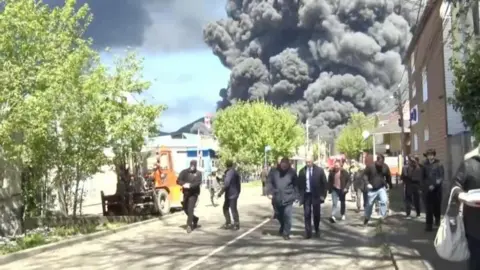
Clouds of smoke were visible near the city of Perm in the Urals on Wednesday, some 1,500km (930 miles) from the Ukrainian border, after what Ukrainian officials said was a drone strike on an oil pumping station, while the local governor referred to it as an industrial facility.
That attack came 24 hours after a major Russian oil refinery in the Black Sea port of Tuapse was hit for the third time this month.
Earlier strikes in the past two weeks at the Tuapse refinery caused a big oil spill in the sea and residents reported "black" rain falling on the city and leaving an oily residue everywhere.
