Flesh-eating bug made my skin look like roadkill

 MARTIN GILES/BBC
Caroline Fonjock says she would be dead were it not for the quick actions of NHS medics.
Feeling under the weather, the 45-year-old social worker noticed what she believed was a boil in her upper groin.
She initially thought she had a routine urinary infection, but within 36 hours she was in and out of consciousness and vomiting what she describes as "black tar".
Doctors later told Caroline, who lives near Haverhill, Suffolk, that the "boil" was in fact necrotising fasciitis – a rare infection that destroys tissue beneath the skin.
She needed emergency surgery to survive.
Five years on, her case is helping researchers in Cambridge improve how the condition is identified and treated.
 Family photograph
Caroline has type 2 diabetes and a history of infections but says the speed of this one was "just phenomenal".
"I've had illnesses before but with all of them I felt in control," she says.
"With this, I didn't."
In April 2021, during the Covid pandemic, her condition rapidly worsened.
What she initially thought was a small boil began to "track" up her leg, feeling like a "hardened tube".
At Addenbrooke's Hospital, Cambridge, a consultant told her she needed immediate surgery and multiple skin grafts and could need to spend up to a year in hospital.
"My response was, 'No, no, no – I've got babies at home,'" she says.
But she was told going home was not an option.
"She said 'If you don't do this, you'll be dead by morning,'" she recalls, adding that the consultant "held my hand and I shed some tears".
In what she describes as a "terrifying" operation, surgeons removed a large part of her leg to stop the infection spreading.
Later, when she saw images of the damage, she says she could "only describe it as looking like roadkill".
But doctors were ultimately able to save her leg – something she calls "astounding".
Caroline spent two weeks in intensive care in a coma, during which time she says her body went into "survival mode" and multiple organs began to fail.
 MARTIN GILES/BBC
Her husband Lionel says he had never heard of necrotising fasciitis before.
After searching online and speaking to medics, he realised how serious it was.
He then faced the task of telling their daughters.
"It was the most difficult thing to kind of break to them… and say to them 'It's a possibility mum might not come back home".
He recalls one of his daughters asking: "What are we going to do?"
"I said, 'We are going to pull together and support each other.'"
When Caroline came round, she had a tracheotomy and could not speak. She had also lost her fine motor skills.
Her friend brought in a whiteboard so she could communicate, but she struggled.
"I was so desperately in distress. I couldn't write," she says.
"It was a really terrifying moment."
She had to learn to walk again after her muscles deteriorated. Five years on, she says her recovery has been long but she is grateful to be alive.
"I'm lucky to have my leg and I'm lucky to have my life," she says.
"But to be able to walk and play with my children and niece and nephew again is amazing."
 MARTIN GILES/BBC
What is necrotising fasciitis?
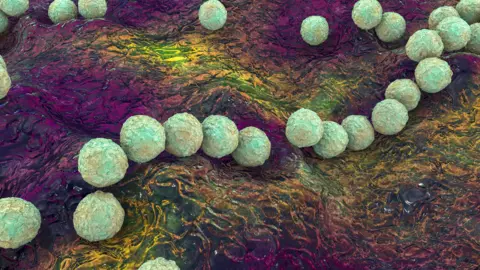
Necrotising fasciitis is a rare but severe bacterial infection that destroys tissue beneath the skin.
It can resemble cellulitis but spreads rapidly and requires urgent hospital treatment.
The infection usually enters through a break in the skin, although there is not always an obvious cause. Caroline says she does not know how she contracted it.
People with weakened immune systems or conditions such as diabetes are at higher risk.
According to the NHS, warning signs include severe pain, redness, blisters, changes in skin colour and vomiting.
 Getty Images
Caroline is one of 87 patients included in a 10-year study at Addenbrooke's, covering cases between January 2015 and March 2025.
Researchers found age and underlying conditions, such as heart or kidney disease, increase the risk of death.
They also found that while high white blood cell counts are usually a warning sign, in serious infection a low count can signal the immune system is becoming overwhelmed.
The study, published in the Journal of Plastic, Reconstructive and Aesthetic Surgery, aims to improve early recognition of the condition.
Plastic and reconstructive surgeon Charles Loh said: "Necrotising fasciitis is a very serious condition. It has a one in four chance of death within 30 days.
"It progresses rapidly. Patients become gravely ill, often require organ support in intensive care, and it takes a major toll on the body."
 Family photograph
Caroline says she feels fortunate to live close to Addenbrooke's and that she will always be grateful for the care she received.
"I absolutely cherish the NHS and the emergency care that we have," she says.
"They pinpointed so quickly what was wrong and how sick I was, and that meant I survived.
"To this day I don't know how they did it."
Do you have a story suggestion for Cambridgeshire? Contact us below.
Follow East of England news on X, Instagram and Facebook: BBC Beds, Herts & Bucks, BBC Cambridgeshire, BBC Essex, BBC Norfolk, BBC Northamptonshire or BBC Suffolk.
