Abattoir owner 'furious' over illegal charges

 BBC
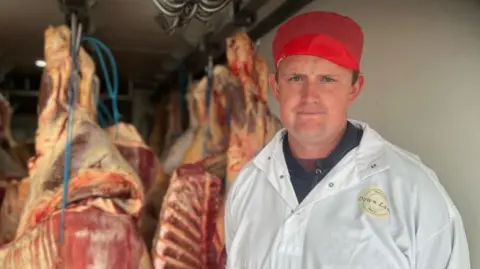
BBCThe owner of one of the last remaining abattoirs in south-east England says he is "furious" after a court ruled the food regulator had been over-charging for hygiene and animal welfare checks.
Luke Smith, who runs Down Land Traditional Meats - a small operation near Henfield, West Sussex, says he believes he has been overcharged 10s of thousands of pounds by the Food Standards Agency (FSA).
Abattoir owners pay the FSA for inspections, checks and other procedures, but earlier this month the High Court ruled the FSA had charged abattoirs for activities it was not entitled to.
The FSA said it was "disappointed" with the ruling and said it had acted "in good faith" when calculating its charges.
"Overcharging has had a significant impact on our business," Smith said.
"This is a very, very tight-margin business anyway. It's costing us a fortune to run this plant as it does any abattoir.
"I'm absolutely furious because, at the end of the day, we have to do everything they say. Failure to do any of their tasks can result in fines or even imprisonment," he said.
"It's about time they were brought to justice."
The judgement from the High Court ruled the FSA had been "unlawfully" charging abattoirs too much, and it had not been transparent enough about what it was charging for.
The ruling came after a 24% annual increase in the FSA's charges to abattoirs, and a subsequent High Court legal challenge by the Association of Independent Meat Suppliers (Aims).
Financial pressures have seen a number of small abattoirs go out of business in the South East.
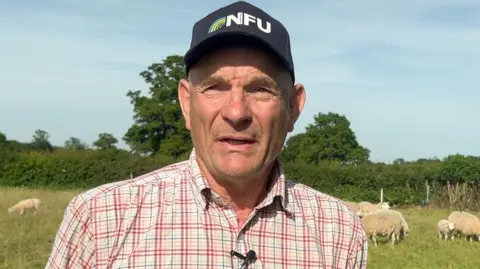
Many farmers who are reliant on those abattoirs which remain say they want to see more support for the sector.
Andrew Compton, a sheep farmer from Redhill, Surrey, who uses Smith's abattoir, says losing it would be "catastrophic".
Compton says for some abattoirs, the high court ruling comes "too late".
"The damage has been done," he said,
"The forms of redress to that overcharging still remain unclear.
"I think there will be abattoirs that have fallen by the wayside, since the advent of this ruling that are not retrievable, so the damage is done."
Aims' veterinary director Peter Hewson says "immediate action" is needed "to address the dire situation medium-sized slaughterhouses find themselves in following the increase in charges this year".
Hewson says: "Any delay will result in businesses closing as a direct result of FSA's unlawful charges."
It may be many months before the abattoirs are reimbursed by the FSA - a bill that could run into millions of pounds.
Safety 'non-negotiable'
Katie Pettifer, chief executive of the FSA, said: "We acted in good faith in calculating our charge rates and in presenting the information we publish about them, and are seeking leave to appeal the judgment.
"We know businesses will want clarity on what this means in practice, and we will provide further information as quickly as the legal process allows.
"Food safety is non-negotiable. Our official vets and meat hygiene inspectors do essential work every day that protects public health, upholds animal welfare and underpins the £11.3bn meat industry. That will not change."
A government spokesperson said: "The Department for Environment Food and Rural Affairs (Defra) is working collaboratively with the sector to help alleviate pressures on abattoirs by addressing key priorities."
They said this included administrative and regulatory simplification, labour challenges and maximising the value of animal by-products.
Defra was not involved in the court ruling against the FSA.
Follow BBC Sussex on Facebook, X, and Instagram and listen to BBC Radio Sussex on Sounds. Send your story ideas to southeasttoday@bbc.co.uk or WhatsApp us on 08081 002250.
