'Signs of life' seen at site of heathland fire

 PA Media
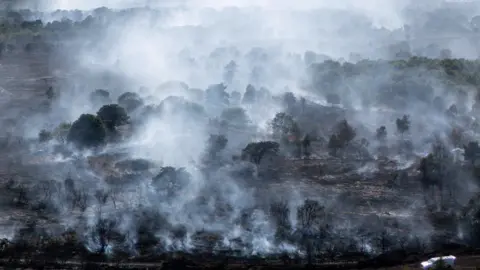
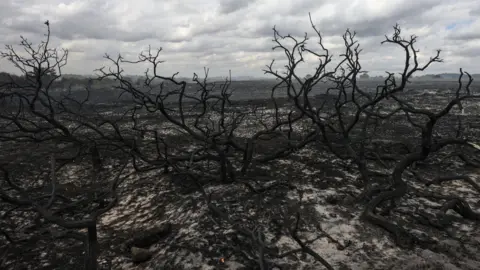
"Signs of life" have already been spotted in among the blackened remains of a Suffolk heathland damaged by a wildfire, the National Trust has said.
The fire at Dunwich engulfed 371 acres of land (150 hectares) at its height - equivalent to the size of 210 football pitches - affecting Dunwich Heath, which is owned by the National Trust, and nearby RSPB Minsmere.
Andy Beer, the trust's chief operating officer, said the heathland had suffered "extensive damage".
"One of our team who was on site [on Saturday], was still observing signs of life already in and amongst the burnt landscape, so we hope some of the species who live there will have managed to escape," he said.
Talking to BBC Radio 5 Live, Beer added: "Obviously, we would have lost many things, but we hope in the spring next year we will see where we are in the terms of recovery... but it is a bit too early to tell for that.
"We have faith in nature's dealings in these problems."
 Suffolk Fire and Rescue Service
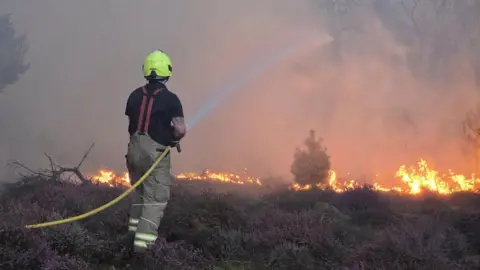
More than 100 firefighters have been battling the blaze after it started at about 17:00 BST on Wednesday.
The "large-scale, wind-driven" fire was declared a major incident on Thursday morning, due to the size and complexity of the blaze.
More on the wildfire at Dunwich:
"I mean, nature is remarkably resilient so we are hoping for recovery, but we will really only know when our team get on the site to have a look," Beer said.
"Heathlands at this time of year are so gorgeous normally, there is purple heather and the smell of coconut... so it is just heartbreaking to see it all black and burnt."
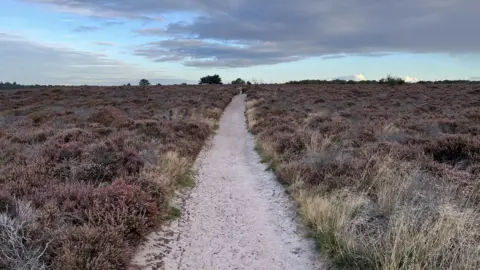
The National Trust site contains heathland, wetland and woodland, and is home to species such as the Dartford warbler, nightjar, woodlark, antlion and adders.
The trust said in 2024, 25 pairs of Dartford warblers were recorded, with that number increasing to 29 in 2025. The bird is an amber list species in the UK, meaning it is scarce and of conservation concern.
"Dunwich is a really much-loved place and is incredibly important for wildlife, as these lowland heathlands are really not very common at all, so you get some very specialist plants, animals and insects," Beer added.
He said the trust was looking at how to better "manage" the land in case a similar incident happened.
Beer said: "Although we cannot speculate about the cause of this fire, I can't help but feel it is our fault as we have made the climate warmer, that is what human beings have done, and scientists did warn... so it is kind of our fault."
 PA Media
A fundraiser was launched by the trust to help the habitats "recover and thrive in a changing climate".
Beer said: "We have been so touched by the hundreds and hundreds of donations to support the cost of recovering the site.
"Even though it has been an incredibly difficult incident, it is so heart-warming seeing the way people pull together in a crisis, and we cannot thank the emergency services enough for what they have done."
Do you have a story suggestion for Suffolk? Contact us below.
Follow Suffolk news on BBC Sounds, Facebook, Instagram and X.
