How can we adapt buildings to cope with heatwaves?

 Getty Images
As the UK grapples with its third heatwave of the summer, businesses and organisations are beginning to look at how to prepare for a hotter future.
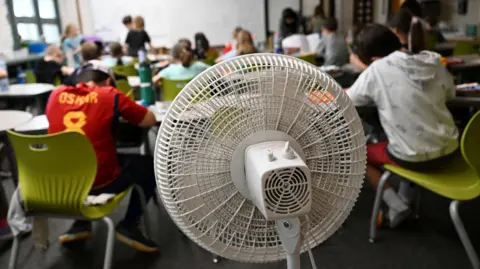
A red weather warning for extreme heat in June forced hundreds of schools to close across the West.
This year's hot dry summer follows a consistent pattern of above-average temperatures that are forcing some to consider how they may need to adapt in the years to come.
Steve Chalke, founder of the Oasis Charitable Trust, which runs 10 schools in Bristol, said: "Our school buildings in England aren't set up for heat, they're set up for the cold, they're not set up to keep the sun and the heat out."
"As global warming takes its impact on us in years to come, we've got to rethink all of that," he added.
"In the long-term there needs to be a strategy to equip buildings so that they aren't prone to a sudden rise in temperature."
All of Bristol's Oasis schools were forced to close during the June heatwave - including their only fully air-conditioned one - as staff were forced to stay home when their own children's schools closed.
"The solutions that we contemplate as we look at increasing bouts of hot weather in the summers through the future need to be town or city wide, one school can't act alone," said Chalke.
"It's not just about what's happening in other schools, its about the transport system, the roadways, the whole infrastructure of a city allows a school to safely open."
Chalke said that schools will need air conditioning in the coming years, but added there are other adaptations that can be made:
"Shades in the windows, perhaps wooden ones on the outside, because once the sun hits the glass it heats up the room," he said.
"[We can also] set up classrooms where desks aren't right near the windows but are away from them, these are things that I think are important."
Improving resilience
The demand for air conditioning in the UK has skyrocketed in recent weeks, with some installers saying they are struggling to meet the need.
Air conditioning units can effectively cool a room quickly but are costly to install and run when electricity costs are high.
There are other ways to keep buildings cool, but experts say that making buildings more climate resilient is necessary to meet the challenge.
 Getty Images
"Resilience is about designing buildings that remain safe, comfortable and efficient as our climate changes," said Emma Howard Boyd, Chair of the independent National Heat Risk Commission at the London School of Economics.
"Air conditioning has a role to play, particularly in hospitals, care homes and other settings where people are at greatest risk," she added
"But for many homes, we should first maximise passive cooling measures such as better insulation, external shading, natural ventilation, reflective roofs and more trees and green spaces.
"These approaches can keep homes cooler while reducing energy demand and helping to keep household bills down."
 Albotherm
Some are working on new ways to keep the cool temperatures in and the heat out.
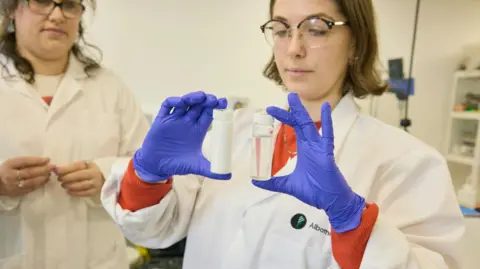
Albotherm is a company set up by two students who met at the University of Bristol. It develops heat-activated coatings and films for glass that can help prevent overheating by tinting to white when the outside temperature reaches a set amount.
"As soon as the temperature reaches a certain point the tint will turn on and from that point it will reflect the excess heat and reduce the solar gain coming in to a building," said Molly Allington, CEO and co-founder of Albotherm.
"With test samples, we have seen about a six-degree cooling effect on the heat that's coming through the glass," she added.
 Albotherm
Albotherm believe that techniques like window-tinting can offer a cost-effective and environmentally friendly way to help tackle the effects of climate change:
"We wanted to do something to help the environment and the product is designed to be able to cool without any energy," said Allington.
"A lot of commercial buildings are already having air conditioning installed and I think from a financial and environmental perspective we can cut a lot of energy used by those conditioners," she added.
A Government spokesperson said: "Climate change is a universal issue, and we are taking action to understand the potential impact on all areas of life, including education so we can prevent disruption to learning.
"We design new schools to stay cool through effective ventilation and shading and are investing to make schools more resilient to a changing climate - including through a £710 million Renewal and Retrofit Programme and almost £20 billion to rebuild over 750 schools.
"That's on top of wider action including investing in clean power, ensuring new residential buildings are designed to minimise unwanted heat and launching the Local Authority Climate Service to provide local to support adaptation planning."
Follow BBC Bristol on Facebook, X and Instagram. Send your story ideas to us on email or via WhatsApp on 0800 313 4630.
