With no laws on heat in schools, are pupils and teachers at risk?

 Getty Images
School communities are raising concerns about the welfare of children and staff as a red warning for a heatwave is issued for parts of the UK.
In France, more than 800 schools have shut due to the heat, but it is rare for British schools to close for that reason.
The BBC has heard reports of teachers and pupils passing out and exam halls reaching temperatures of 33C (91F) in recent years.
"My daughter Amelia has a condition meaning she can't regulate her body temperature – she was going unresponsive in the classroom last summer," says Bedfordshire mum Victoria Everitt.
But even children without Amelia's condition can struggle when schools get hot.
Michael Conley, head teacher of St Peter's Church of England Primary School in Rickmansworth, Hertfordshire, says: "We've had children become excessively warm, where they've become sick or ill, dysregulated or out of control. They do fall asleep."
 Ridgeway School
The Department for Education (DfE) says while there is no maximum limit for temperature in UK workplaces, including schools, it is "carefully considering" proposals to change that by the Climate Change Committee (CCC).
The CCC's latest report states: "High indoor temperatures can disrupt learning in schools by causing discomfort, reducing concentration, and increasing health risks for students and staff."
The Trades Union Congress has campaigned for a legal maximum working temperature to be introduced, while the National Education Union says a maximum indoor working temperature of 26C (79F) is appropriate.
So how does heat impact pupils' learning and welfare, and what can schools do to cool down?
 Lucio Poli
Teacher Lucio Poli recalls two particularly hot spells at Ely St John's Community Primary School, Cambridgeshire.
"In the mid-2000s, I remember passing out, and I saw children pass out, too. About three or four of them went down like a stone," he says.
"I was wearing formal clothing – that taught me not to overdress in hot weather."
Poli says his school had a very "reasonable head teacher" who allowed staff and pupils to be flexible with clothing during heatwaves.
He says teachers raised concerns in 2022 when temperatures reached 40C (104F).
"But the message from county [council] was there's no limit on maximum temperature. The priority was to keep the schools open."
Cambridgeshire County Council said while the DfE provided schools with heatwave advice, the council had also sent guidance to all schools "outlining steps to take, including a heat checklist" in 2022.
"In extreme weather conditions, [schools] would be expected to undertake a risk assessment," a spokesperson said. "Very few schools closed completely."
Poli, who leads outdoor learning, has planted trees to create more shade, but says the 1990s school building is "poorly constructed".
"Windows facing west, black tiles; you really can't keep the heat out," he says.
"Even on days in the mid-20s, the temperature can skyrocket. I genuinely dread temperatures above 30C.
"On those really hot days, there hasn't been quality learning - just coping with the weather."
The school has been contacted for comment.
 St Peter's School
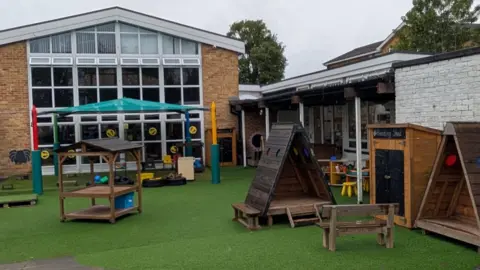
Back in Rickmansworth, Conley says he has "invested significant sums of money" to improve the building.
The school bought artificial turf to cover the black asphalt playground, which reflected heat back into the building, and has also refurbished its roof, which Conley says has made a big difference.
"We installed air conditioning in half of the school, along with solar panels," he says.
He hopes to make further changes after some classrooms hit 40C (104F) last year, becoming "unbearable".
Conley says while some children "might get headaches and become disengaged in learning", those with special educational needs "really can't cope".
"They become quite emotional, cry, become agitated, almost can't focus," he says. "We often have to move them into different classrooms to manage temperatures.
"Nationally, the government needs to seriously consider the long-term impact of the school estate – and start investing more."
 Ridgeway School
Everitt agrees that hot weather "affects many children with special needs", especially those who use wheelchairs, like Amelia.
"A lot of the children can't move themselves about to get to a cooler place," she says. "Those children won't necessarily say, 'I'm too hot, I need to cool down.' It can increase seizures; enhance behaviours."
After Amelia had several episodes last summer where she became "floppy and unresponsive", a local charity is helping Everitt to raise money for air conditioning at Ridgeway School in Kempston, Bedford.
"The staff are trying everything they can: fans, cooling towels, cold water," says Everitt. "We need a more permanent solution so the staff can manage her condition."
Head teacher Lulu Stanier-Martin says the school's building is more than 50 years old.
"Poor insulation and outdated windows mean classrooms can become uncomfortably hot, which has a direct impact on pupils' ability to learn and regulate," she says.
She is calling on the government "to prioritise investment in upgrading school buildings" so they are "safe and suitable".
 Getty Images
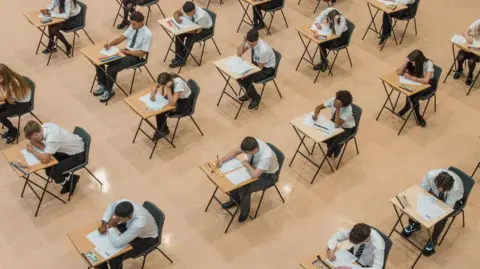
Problems from hot weather tend to coincide with the summer exam season.
One parent from Bedfordshire, who did not wish to be named, worked as a GCSE invigilator in 2023.
"Most exams took place in the school's sports hall, which becomes very hot if the sun shines on it. It's unbearable during heatwaves," she says.
"The exam officer taped over the temperature display on the digital clock, as she found the students otherwise complained.
"During one exam, I saw the hall temperature was 33C (91F)."
Architect Jenny Kendall, of Retrofit Action for Tomorrow (RAFT), a not-for-profit community interest company, says heat "can reduce cognitive performance".
"Reducing classroom temperatures from 25C to 20C (77F to 68F) significantly improved task completion time," she says.
Kendall says problems with heat "directly correlate with when pupils are expected to be at their peak with exams".
"These big sports halls are not designed as learning spaces, but for sports, so they don't have the ventilation," she adds.
 Jenny Kendall
Kendall says schools "often feel quite helpless" about managing heatwaves.
"Our buildings in this country weren't designed for the climate now and in future - unlike schools in Europe or Africa that have designed shading into their buildings," she says.
Rebecca Cooper, another architect at RAFT, says while schools might "instinctively" think of installing air conditioning, there are also "passive measures you can use strategically".
For example, trees can "really change the atmosphere and bring shade".
Cooper says she used a thermal imaging camera at a London school playground, which recorded a temperature of 50C (122F) on the tarmac and 30C (86F) under a large tree.
Cooper's other suggestions include:
- External shading, such as shutters or brise soleil
- Reducing dark floor surfaces outside the building
- Keeping building surfaces lighter to reflect heat
- Reducing internal heat – lagging hot water pipes, using LED lighting, turning off unused electrical equipment
- Ventilation by opening doors and windows in the cooler evening/morning
- Installing ceiling fans
- Moving pupils out of very hot south-facing classrooms
 Sele School
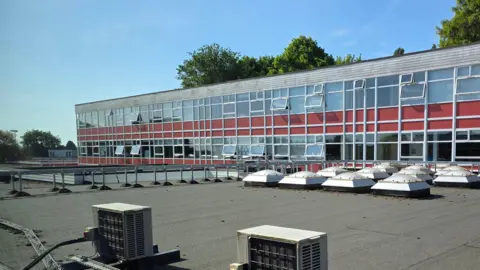
Cooper says even many schools being built this decade are not factoring in heat.
She cites a recent visit to northern France, where she says virtually every single building had external shading.
"Unless we have a cultural shift towards understanding how to mitigate heat, written into design guidance, I think we're going to build things that are not fit for purpose," she says.
The DfE said workplace regulations applied to schools and covered a wide range of health, safety and welfare issues, including temperature.
It said it welcomed the CCC's latest risk assessment, which identified flooding and overheating as a risk to education settings, and would consider its proposals.
Do you have a story suggestion for Beds, Herts or Bucks? Contact us below.
Follow Beds, Herts and Bucks news on BBC Sounds, Facebook, Instagram and X.
