Is battery power the future of the UK's rail network?

 Alstom
A near £1bn investment will see the UK's first battery-electric trains for long-distance main line services built in Derby, which Prime Minister Andy Burnham has said will "bring faster, more reliable journeys to the north".
The new trains will replace diesel power with electricity, and seek to cut journey times by up to 10 minutes between Manchester and Leeds, and up to 14 minutes between Manchester and York.
So are batteries set to drive forward a new electric future of train travel in the UK?
Alstom UK product director James O'Sullivan thinks so. He said the fleet would be a "step change" for the railways.
What has been announced?
The deal will see 29 new Adessia Stream trains built at Alstom's Litchurch Lane works in Derby for the TransPennine Express (TPE) route.
The fleet is due to be built from 2028 and enter service from the end of 2034.
The trains will run on routes between Liverpool Lime Street and Scarborough, Manchester Airport and Saltburn, and Manchester Piccadilly and Hull.
With five carriages, the trains could boost capacity by 30% across the Pennines and will run without emissions on sections of the railway that are not electrified where currently diesel engines are needed.
They will offer improved accessibility through step-free boarding and more wheelchair spaces, cycle and buggy storage, and onboard wi-fi.
 Alstom
Last week the prime minister said: "I've lost count of the number of times someone has stopped me to tell me about the train that never came.
"And when that happens, it means missed shifts, missed appointments, and missed opportunities.
"Today that starts to change. These 29 new trains will bring faster, more reliable journeys to the North, and thousands of British jobs for the next generation."
How do battery trains work?
Alstom says on electrified sections of the TPE network, the train collects electricity from the overhead electric wires using a pantograph - a mechanism which is mounted on top of the carriage and can retract on non-electrified stretches of rail.
The pantograph diverts power to both the train's traction motors and recharges its batteries.
When on a section of the network that is not electrified, the new trains will switch to battery mode to drive their motors.
According to Alstom, when the train brakes, the electric motors "work in reverse as generators, which captures braking energy", which would normally be lost as heat energy.
This will also be fed back into the on-board battery.
The manufacturer added rapid charging facilities would also be installed as part of the contract at stations in Hull, Scarborough and Saltburn.

How common are battery trains?
The Adessia Streams will be the first battery-electric models used for long-distance main line services in the UK.
In 2023, Merseyrail introduced battery-powered trains, running from the Headbolt Lane station in Kirkby.
James O'Sullivan said it was "an emerging technology" and already in use overseas.

In Japan - a country considered a world leader in the technology - battery-powered trains have been in use since 2016.
The Hitachi Rail manufactured BEC Series 819 or DENCHA (dual energy charge train), operated by JR Kyushu, was the world's first battery-powered train charged by alternating current overhead lines, when it started running on the island of Kyushu in October 2016.
Hitachi said by its fifth anniversary of running, CO2 emissions had been reduced by 2,700,000kg after the entire diesel fleet of 18 trains was phased out.
In Austria, battery overhead wire trains entered operational service in 2019.
In March this year, national railway company - Austrian Federal Railways - ordered six battery-electric trains from Stadler Rail to replace diesel trains on non-electrified routes in Lower Austria, Railway Gazette International reported.
Alstom was awarded a contract in 2020 for its Coradia Continental trains to run on the Leipzig-Chemnotz Line in Germany, and elsewhere in the country battery trains entered passenger service in Ortenau in April 2024.
Trials have also taken place in Italy, France, the US, and Australia.
How could they change rail travel in the UK?
Tiana May, principal journalist at Railway News, said battery power would help to "close the gaps" in the network.
She told the BBC: "It's expensive to put overhead lines on the whole network.
"By having the battery on the train, it means parts of the network don't have to be electrified and the train can continue under the battery power and recharge from the wires."
O'Sullivan said the new Alstom trains would have a range of about 50 miles (80km) between charges, and would charge on overhead lines and on three charging points installed at terminus stations.
He said with this method, trains were "capable of covering a number of different routes around the country".
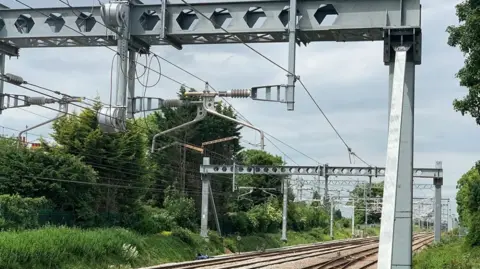
But could batteries mean that other electrification projects, such as the Midland Mainline, no longer need to progress?
 Network Rail
In 2025, the Department for Transport indefinitely paused the electrification of the line north from South Wigston in Leicestershire.
Steve Jones, East Midlands branch secretary of electrification lobby group Rail Future, said: "It doesn't really alter the fact that for a busy mainline, really what you need is electrification throughout - we still press for electrification on the middle and main line, north from Wigston, where it currently ends, to Nottingham, Derby, and Sheffield, and beyond, to Leeds and York.
"In terms of these battery plus electric hybrid trains, we see a real role for those in these Midlands on the regional services, which are entirely diesel at the moment."
An East Midlands Railway spokesperson said: "We are in very early stages about what a future regional fleet might look like - battery-powered trains are just one fleet type that is being considered."

What does this mean for Derby?
The contract to build and maintain the new fleet will support more than 350 jobs in Derby, and almost 6,000 across the UK supply chain, according to the government.
The trains, when built, will be bought by rolling stock company Rock Rail and leased to TPE.
The contract will see the government investing directly into Alstom, which had in recent years feared job losses and possible closure due to a lack of orders.
Secretary of State for Transport Heidi Alexander said the agreement was "fantastic news" for a city "that's got such a proud railway heritage".
O'Sullivan said: "It's great, and it's great for the wider region as well.
"I've been working here for 12 years. I started with the original Elizabeth Line order and to see us go from a very busy period and a quieter period to move into this contract and hopefully others in the future we should start to see that ramp up again.
"I'm looking forward to seeing the site being busy again."
Listen to BBC Radio Derby on Sounds and follow BBC Derby on Facebook, on X, or on Instagram. Send your story ideas to eastmidsnews@bbc.co.uk or via WhatsApp on 0808 100 2210.
