Braille butterfly trail highlights rare disease

 Leanne Rinne / BBC
A butterfly art trail is to be unveiled in Brighton by a braille artist to help raise awareness of a rare disease.
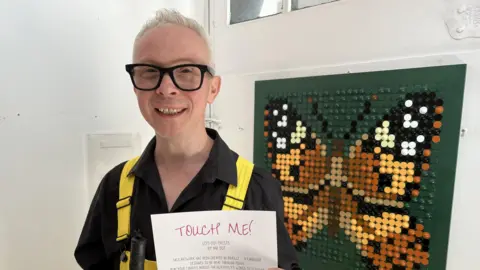
Clarke Reynolds, better known as Mr Dot, has designed one of 10 butterflies to be hidden around the city's North Laine area.
The butterflies have been installed to raise money for The Lily Foundation, a Surrey-based charity raising awareness of mitochondrial disease, with braille incorporated into the design to share about the rare condition.
Reynolds said: "The butterfly is a symbol of hope."
He added: "If my art can improve someone else's life and find a cure than what better way to do it than with a butterfly.
"If we talk about diseases then it becomes normal, and it's not hidden away like the butterfiles are."
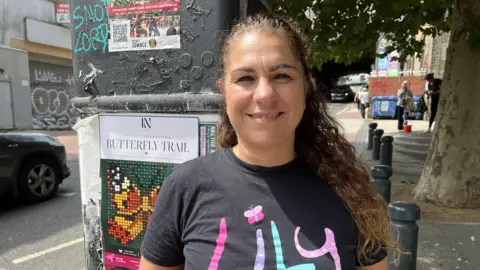
Beginning at Brighton railway station, the butterfly trail runs until 31 July and winds through North Laine, ending at the Indelible Fine Art gallery where an exhibition is being held in aid of The Lily Foundation.
 Leanne Rinne / BBC
The foundation, based in Warlingham, was set up by Liz Curtis, in honour of her daughter Lily, who died aged eight months in 2007 of mitochondrial disease.
Mitochondrial disease is a term used to describe conditions caused by faulty mitochondria and can affect different parts of the body including the brain, heart and liver.
There is currently no cure for the disease.
The Lily Foundation's aim is to raise awareness of the disease, to support families, and to ultimately find a cure for the condition, Curtis said.
She added: "Unless we start talking about it and hearing about it, that's our way forward to finding a cure.
"It's a terrible diagnosis, and the disease is very, very cruel.
"We don't want other families to be in the same position that we were in. Finding a cure is our ultimate aim."
Follow BBC Sussex on Facebook, X, and on Instagram and listen to BBC Radio Sussex on Sounds. Send your story ideas to southeasttoday@bbc.co.uk or WhatsApp us on 08081 002250.
