Parades Commission issues are 'far from resolved', DUP leader says

 PA Media
The leader of the DUP has said the issues surrounding the Parades Commission are "far from resolved", after one of the commissioners resigned over the handling of its ruling on the Orange Order's Drumcree parade.
The commission has until the end of the day to write to Secretary of State Sir Chris Bryant, to ensure him that their decision making processes are fair.
The commission has been asked to come up with a credible plan to enhance public confidence across all communities after a court case highlighted mistakes over the commission's ruling on the annual Drumcree parade.
Gavin Robinson has said Sir Chris has a responsibility to look at whether he has confidence in the parade commissioners.
One member of the Commission, Billy Gamble, who had faced the most public criticism over private comments he is alleged to have made about the parade determination, resigned on Wednesday.
"I think it was right that he did so, but the issues are far from resolved," Robinson told BBC Radio Ulster's Good Morning Ulster on Friday.
The DUP leader said he will "will await with interest to see how it is these parade commissioners believe they are going to restore confidence".
"They have shattered it, they are the ones that have failed to abide by their statutory obligations," he said.
"The secretary of state still has a responsibility to look at whether he has confidence, not whether Parades Commission has confidence with me or the unionist community, but whether he has confidence that these individuals he is paying for have the ability to do their job and there are huge question marks around that," Robinson said.
He said there needs to be a review of the legislation governing the Parades Commission.
'The people of the Garvaghy Road have watched on in horror'
 PA
PASinn Féin MP John Finucane told BBC Radio Ulster's Good Morning Ulster programme the recent events have been "hugely damaging the community relations".
"The reality is that a Parades Commission will ultimately be deciding whether the Orange Order walk down the road, whether there is a future parade - the people of the Garvaghy Road have watched on in horror has this has unfolded this week," he said.
"What I will say in a positive light is that the people that I've spoken to this week, the people who live in that community who know it best, have spoken about a complete transformation of community relations post late 1990s," Finucane said.
"People have seen the outworkings of a peace process. They have seen the outworkings of proper community relations, building infrastructure, building relationships. All of that takes time," he said.
"But it can be undone very quickly whenever there is a momentum and an appetite to reopen and pull and push and poke at some very, very difficult and deep wounds."
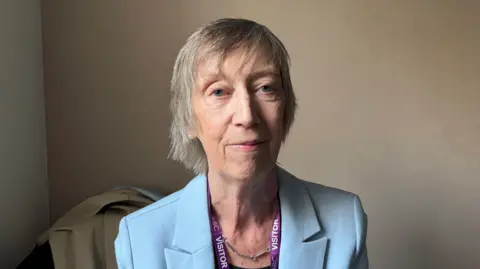
Speaking to Good Morning Ulster on Thursday before Gamble's resignation, the chair of the Parades Commission, Prof Evelyn Collins, said the commission accepted criticisms that have been made.
However, she said rather than resign they were "very committed to fulfilling our responsibilities under the legislation, to completing our terms of office and to addressing and fixing the problems that have been identified".
Collins, had said Gamble's private comments were "out of line" but had no bearing on the decision-making process.
Unionist parties and the Orange Order called for the commission to stand down, but Prof Collins said she does not intend to resign.
On Wednesday a Northern Ireland Office (NIO) spokesperson said Sir Chris expressed "serious concern over the issues highlighted" in the judgement during the meeting.
The NIO added that Sir Chris told the chair that "public confidence in the Commission has been damaged and needs to be restored".
He's asked for written assurances that the commission's decision-making processes are "fair and robust", that they act "independently and impartially" and that they have a plan to "enhance public confidence".
He has asked for a response "by close of play on Friday".
What has led to this point?
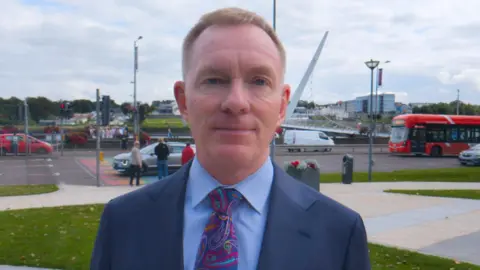
On Tuesday, the High Court quashed a decision to impose restrictions on the annual parade at Drumcree outside Portadown.
The Parades Commission had banned this year's parade from the Garvaghy Road - a move which reflected every decision it has made since 1998.
The Orange Order's Portadown District welcomed Gamble's resignation, saying it was "very unfortunate" it took him two days to do so after the "damning evidence" presented to the High Court.
"In our view, the chair must now also consider her position and take responsibility for overseeing the fiasco that has unfolded," they said.
"Portadown District confidence in this commission is shattered and we will continue to await developments and see what happens next."
 Pacemaker
Who are the Parades Commission?
The current commission was appointed from January 2024 on a three-year term.
Prof Collins is a former chair of the Equality Commission.
The others are Derek Wilson, a former banker, Billy Gamble, a former senior civil servant (who has since resigned), Nicola Rountree, a barrister, Rachel Quigley, a solicitor and Pauline Leeson, a social worker.
According to the last annual report, the chair is paid between £50,000 and £55,000 while the other commissioners earn between £20,000 and £25,000.
The chair is expected to devote one to two days per week to the work of the commission.
Commissioners are expected to devote approximately one day per week to commission business over the course of a year, with a proportionately greater commitment required April to August.
When did the Drumcree dispute begin?
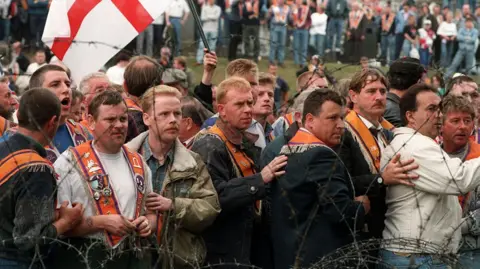
In 1998, the Parades Commission ruled that the Orange Order should not march down Portadown's Garvaghy Road on the end leg of its annual march from Drumcree Church.
It was a move that sparked some of the most serious public disorder in Northern Ireland's history and led to a decades-long parading dispute.
Stand-offs continued in subsequent years as members of the Order walked to police barricades in protest at the restrictions. Protests were also held by residents living along the Garvaghy Road.
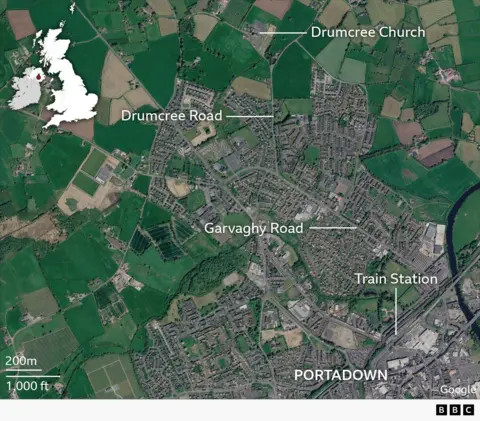
The High Court was told on Tuesday that the commission conceded the case last week and requested the court quash its determination before a full hearing.
The commission conceded a procedural error in how it dealt with the annual application for permission to walk along the Garvaghy Road.
Not all six members of the public authority had signed off on the final determination before it was issued last month.
Lawyers representing a local Orangeman claimed the commission's latest decision unlawfully breached his rights to freedom of belief, expression and peaceful assembly under the European Convention on Human Rights.
Lawyers for the applicant also argued that Garvaghy Road residents had refused talks with the Orange Order and the commission breached legislation by making it "a pre-requisite to a parade".
