The spotted lanternfly is ravaging the eastern US. Pet dogs are coming to the rescue

 Clark DeHart for Virginia Tech
Frequently found plastered across windscreens along the US's Atlantic coast, spotted lanternflies are an invasive pest and a multimillion-dollar disaster for the US's wine industry. Meet the good boys and girls of the resistance.
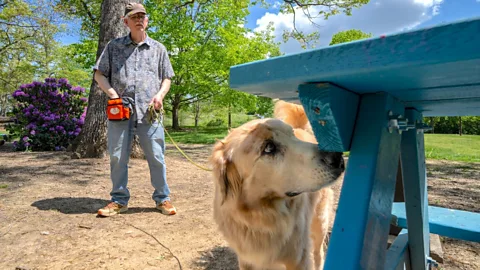
Fozzie was panting in the viscous humidity of the Virginia summer when I met him. At 11 years old, the labrador mix hardly looked like he had an important job to do.
"He was puppy-trained to be a service dog and washed out of the programme," his owner, Scott Hurst, tells me.
However, by the time I met him, Fozzie had found his calling. Nose pressed to the ground, he eagerly weaved through rows of bushes on a berry farm in Blacksburg, Virginia. Fozzie was on a mission to find the eggs of one of the most destructive invasive species propagating across the eastern United States: the spotted lanternfly.
Along the Atlantic coast, the spotted lanternfly is the inch-long (25mm) bug with scarlet underwings you might find plastered across your windscreen or flying into your face in the peak of summer.
 Getty Images
Spotted lanternflies are more than a nuisance. They're an ecological and economic scourge. With very few natural predators and a broad diet, these insects threaten vineyards, orchards, hardwood forests and urban ecosystems. In the worst-case scenario for their predicted spread through the Midwest and on towards California, they pose an existential threat to the US's wine industry.
Fozzie and his four-legged colleagues are part of the resistance. A citizen-science programme is training pet dogs on demonstration plots like this to find the eggs before they hatch so they can be destroyed. It's revealing the surprising power of pet dogs' noses, with even unconventional sniffer-dog breeds like the humble pug able to play their part.
A pest ravenous for US grapes
Native to China and Vietnam, spotted lanternflies were first detected in the United States in the 2010s, after hitching a ride on imported goods.
"Spotted lanternflies are good hitchhikers," says Julie Urban, associate research professor in entomology at Penn State University in the US. "They can hang on at high speeds."
These voracious planthoppers eat sap with a straw-like beak along their abdomens that punctures fruit and damages crops. The sap passes through their digestive tract and is excreted in the form of a sugary substance called "honeydew". This can fall onto the fruit they feed off, and cause the growth of thick, black sooty mould. This mould impacts fruit quality, ruining the vegetation.
Spotted lanternflies feed on more than 70 different species of plant found in North America. Their ravenous appetite comes at a high cost.
In Pennsylvania alone, experts estimate that spotted lanternflies already cost the state's logging and agriculture industry $50m annually (£37m), which could rise tenfold in coming years under a worst-case scenario of the insect's spread.
The biggest impact will be on the grape industry, says Urban. Spotted lanternflies feast on grapevines, causing crop losses of up to 90%.
It's an infestation that's escalated into a multi-million-dollar threat. In New York, researchers estimate that spotted lanternflies will cost the state's grape industry over $14m (£10.4m) in the first three years of invasion. In Virginia – where this team of dogs detects egg masses – uncontrolled spotted lanternflies may cost the state $324m (£242m) annually.
The Happy Pod
You can listen to Riley Farrell's report from the canine detection team in this episode of The Happy Pod.
Spotted lanternflies have infiltrated 19 US states and the District of Columbia, per the latest figures from the US Department of Agriculture. As climate change brings warmer temperatures to the country, it will exacerbate the spread of the insect.
Without proper management, spotted lanternflies are expected to spread westward and reach California sometime between 2027 and 2033. California drives 95% of all US wine exports. All in, the US grape and wine industry is worth $320bn (£238bn) annually.
 Virginia Tech
The canine squad
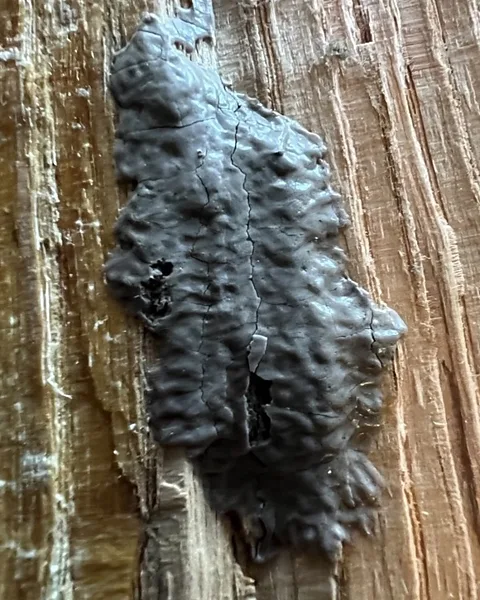
Bellows of "good boy!" echoed throughout the farm of blackberries, blueberries and raspberries nestled in the Blue Ridge Highlands, as Fozzie successfully found and signalled spotted lanternfly egg masses on the bushes, each containing 30-50 eggs.
Since 2020, dog detection has joined the arsenal of responses to the spread in the US. Spotted lanternfly egg masses are difficult for the human eye to spot, but easy for dogs to smell. Deploying trained dogs can help humans destroy lanternfly egg masses before they hatch.
Learning from South Korea
The spotted lanternfly is thought to have arrived in South Korea in 2004. Vineyards were devastated. South Korea has managed its spotted lanternfly invasion through a multi-pronged approach of insecticides, scraping egg masses and introducing natural predators. Now the US is pursuing some of the same strategies.
Professionally trained working canines are expensive and scarce. Pennsylvania, for instance, proposed a $145,000 (£108,000) budget to support its second lanternfly detection dog (Ruby, a Dutch shepherd).
Partnering with Texas Tech, this Virginia Tech programme aims to fill that gap by turning everyday pet owners into volunteer dog-handler teams, says Erica Feuerbacher, a professor of applied animal behaviour and welfare at Virginia Tech.
Feuerbacher, who runs Virginia Tech's Applied Animal Behavior & Welfare lab, had her epiphany on a hike with her pooch. "Wouldn't it be fun if I could contribute to solving environmental issues while I'm playing with my dog?"
Fun and effective, according to her team's findings. Pet dogs trained by their owners can detect lanternfly eggs with accuracy comparable to professional detection dogs. And, in dense vegetation, pet dogs outperform humans by finding up to three times more egg masses.
In fact, these dogs correctly identified spotted lanternfly egg masses 82% of the time in controlled odour-recognition tests and 61% of the time in field trials, according to a 2025 study.
"Any breed can be an olfactory detection dog," says Feuerbacher. "In fact, there's data suggesting that pugs can outperform German shepherds on some tasks."
Today, 80 volunteer dog-handler teams have passed the programme's certification test – and more than 50 teams went on to complete field trials, says Sally Dickinson, a postdoctoral researcher at Virginia Tech.
The training tests whether the dog can independently acknowledge odours and communicate with the handler, says Dickinson, who helped develop the citizen scientist model of canine detection. Dogs learn to associate the scent of egg masses with a prized reward.
"We say to the dog, 'What is your most favouritest thing in the whole wide world? I will give you that in conjunction with this odour.'"
 Virginia Tech
For those living in areas affected by lanternflies, could your dog help? It's not too far-fetched. The nationwide citizen-scientist project has expanded in reach since it started in 2021. "If we get enough of these teams together, we can have a big impact," argues Feuerbacher.
Even if you don't have a pet dog, there are ways you can help tackle the spotted lanternfly. Government agencies, like the US Department of Agriculture and severalstateextensions, have implored citizens to destroy spotted lanternflies on sight.
"If you don't kill it, you'll carry it," says Urban. "Stomping spotted lanternflies buys important time for these other solutions to improve."
--
For essential climate news and hopeful developments to your inbox, sign up to the Future Earth newsletter, while The Essential List delivers a handpicked selection of features and insights twice a week.
