'Everything has its own order and purpose': The rainforest 'farms' defying modern agriculture

 J G Soler/ Fundación Gaia Amazonas
This unique indigenous way to produce food uses no pesticides and returns plots to the rainforest after five years. What can we learn from this 4,500-year-old practice?
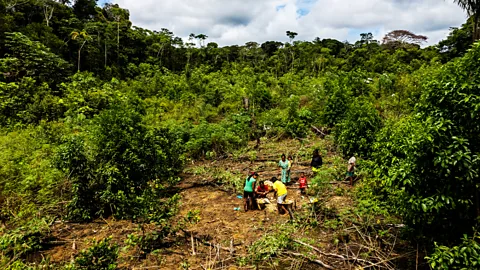
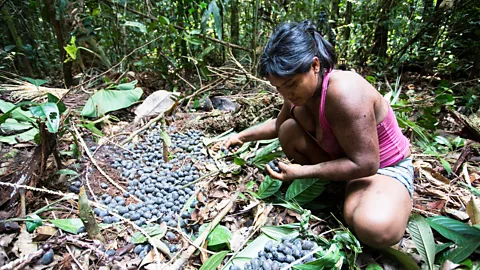
To the untrained eye, the area of the rainforest that Kelly Johanna Yucuna tends may look as if someone had carelessly thrown seeds onto the ground.
But that's far from the reality. In her small plot deep in the Colombian Amazon, everything from site selection to the location of each plant has an order and a purpose.
This is the chagra farming system, made up of small plots each no bigger than two hectares (five acres) and set up to be synchronised with the forest's ecological cycles. It's where Yucuna and the 240 families scattered across her reservation in the Jaguares del Yuruparí macro-territory get most of their food.
On chagras, wildlife thrives and carbon is locked up efficiently. Plots are returned to the forest after five or six years of use. Across the northern Amazon, systems like these have shaped indigenous life for at least 4,500 years, blending environmental, economic, social and spiritual dimensions.
There may be a lot the wider world could learn from chagras and their approach to producing food. But they are also threatened by the mining, deforestation,drug trafficking and climate change encroaching on the Amazon rainforest. The race is now on to ensure these unique sustainable farming systems – and the culture behind them – survive.
Planted universe
Chagras are deeply tied to the cosmology of indigenous groups, which are in turn based on the forest's ecological calendar of fruit, flood, fishing and hunting cycles.
"Everything has its own order and purpose within the chagra," says Juan Felipe Guhl, an anthropologist and expert in socioenvironmental issues at the Sinchi Institute in Colombia. "To have a good chagra is to know when to cut, harvest, replant, clear and maintain the whole system."
 J G Soler/ Fundación Gaia Amazonas
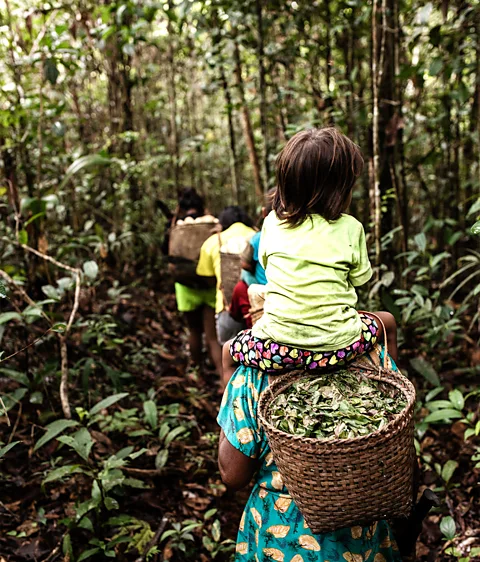
In the Miriti-Paraná reservation where Yucuna lives, each family keeps at least two or three chagras – one new, one productive and one in decline. Before planting, elders approve the selected plot and ask forest spirits, who they call superior landowners, for permission to transform the homes of animals and plants, Yucuna says. The elders ask the spirits to keep serpents away, branches over the community's heads and to make crops grow abundantly.
Afterwards comes the "socola y tumba", a collective process to clear the land involving the entire community, who arrive with axes and machetes.
While creating a chagra involves clearing some trees, communities choose these areas carefully, says César Echezuría Fernández, an independent geographer who studies chagras in Ecuador (where they are called chakras). They often prioritise removing small trees and vines, he says.
Research shows communities keep around half of the native tree species growing in chagra plots. Studies show they are considerably more biodiverse than other types of agriculture, such as monoculture cacao plantations. Chagras have also been found to store more carbon than monoculture plantations and even at levels comparable to secondary forests.
Filial bonds
After a short fallow and a controlled burn (the "quema"), women plant the chagra's first seeds.
In Miriti Paraná, chagras are usually established before June, with its first yuca (cassava), plantain and pineapple ready to harvest after a year.
Whenever she begins a new chagra, Yucuna thinks of what her mum and grandma taught her: always plant coca and the best kinds of yuca first. "Yuca represents women and coca represents men," says Yucuna. "That's why they have to go together in the heart of the plot."
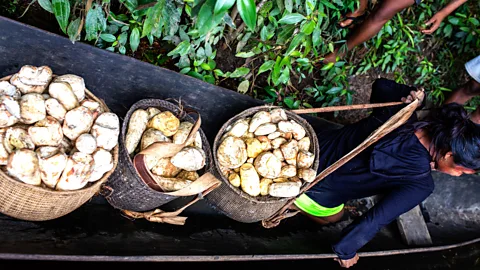
Each of the 30 indigenous groups that live in the Jaguares del Yuruparí territory grows its own selection of wild and sweet yuca species, together totalling 67 different types. "Yuca is, after all, the staple food in the Amazon," says Colombian anthropologist Marcia Chapetón, who works in Amazonian indigenous food systems for the non-profit Gaia Amazonas.
 J G Soler/ Fundación Gaia Amazonas
In some chagras, yuca represents up to 97% of planted species. Many indigenous peoples – particularly women – have almost filial relationships with the plant: "[They see yuca plants as being] my daughters, and when I eat them, I have a blood relationship with them," says Chapetón.
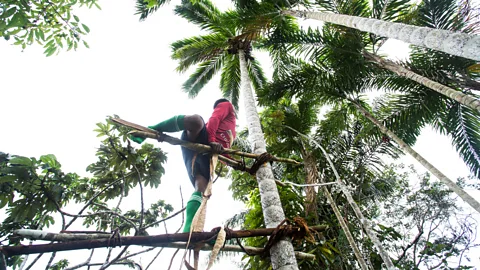
Like yuca and coca, every seed has a mythological and technological origin that determines its place in the chagra, Guhl says. On the edges, for example, pineapples and tall trees like açai act as fortresses. Gaia has counted 104 different species being cultivated in the chagras in Jaguares del Yuruparí territory, with varieties of everything from plantains, yams and sweet potatoes to chili peppers, fruit trees, tobacco and medicinal herbs.
When Yucuna goes to her family's chagra, she takes her kids with her and, like her mother, tells them the stories of the origins of each plant. "The chagra represents life, it represents women, it represents everything to us," she says.
The ethos of chagras is all about adapting to existing conditions. "Nature is not simply a… pantry, but rather another living being with which we interact," Echezuría Fernández says, contrasting this with the industrial agriculture sweeping Latin America, which frequently clears forests and relies on synthetic agrochemicals to cover vast areas with a single crop.
Cacao economy
After five or six years, a chagra is returned to the spiritual owner. Families stop planting seeds and the plot slowly becomes forest again, filled with the fruit trees previously planted and tended, says Guhl. These areas become places to harvest fruit or hunt animals that gather there to eat.
Jaguares de Yuruparí's chagras are mostly used to grow the farmers' own food, but other communities in the Amazon now rely on them economically.
 Asociación Kallari
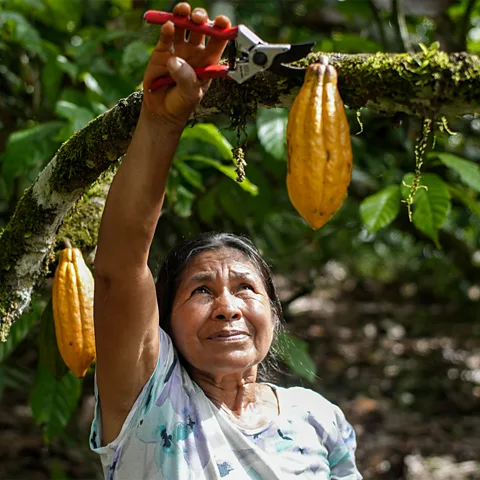
In Ecuador's Napo province, cacao, vanilla and guayusa (a caffeinated holly tree whose leaves are brewed as tea) are grown in about 24,000 hectares (59,000 acres) of chakras, sustaining hundreds of families.
Here, Amazonian chakras managed by three cooperatives have been designated by the UN as being a globally important agricultural heritage system, a denomination akin to world heritage sites but for long-lived and sustainably managed farming systems. They also generate 40-60% of the communities' income.
One of the cooperatives, Kallari, earns up to $2m (£1.5m) a year for its 740 members, with buyers paying premium prices for sustainable, fine-aroma cacao, says Paulina Espín, national director of Trias, a Belgium-based non-profit that supports the cooperative.
Still, even when harvested for profit, cacao plants in chakras usually grow alongside 80-150 other species. Families prioritise plants that provide them with food (around 70% of crops), with 10% for medicinal use and only the remainder for commercial crops.
Fighting deforestation
While any kind of farming in the Amazon may seem like a bad idea, it's worth noting that territories managed by indigenous peoples have proven one of the most effective ways of preventing tropical deforestation. Many see chagras as indivisible from the worldview that allows communities to conserve these lands.
Still, there's no concrete data on the part chagras and similar systems play in resisting deforestation or climate change. While work is now beginning to try to address this knowledge gap, it's not yet known how much land they cover in the Amazon, with limited research comparing them to other agricultural systems.
There is often confusion about what they even are. One carbon credit project in Colombia categorised chagras as "deforested areas" and promised to reduce their coverage in Jaguares del Yuruparí. They were stopped by a 2024 court ruling which found that the involved companies had failed to respect the rights of the indigenous populations.
 J G Soler/ Fundación Gaia Amazonas
"Of course, a chagra involves clearing land, but it's not indiscriminate or uncontrolled clearing; rather, it's clearing carried out to produce food, which then becomes stubble and is subsequently reforested," says Chapetón.
'Ecological mess'
Even as experts are trying to work out the environmental role of chagras play, though, they are facing huge challenges.
Gold mining has become one of the greatest threats to chagras, says Chapetón. In Jaguares del Yuruparí, it results in so much mercury contamination that Colombia's constitutional court ruled in 2025 it endangers local indigenous identity and food security.
In Ecuador's Napo province, mining is luring youth away from farming, says Ruth Cayapa, leader of the Indigenous Kichwa community and president of Kallari.
Across the region, those who don't get involved in mining are often leaving, forced out by dire economic prospects and limited access to basic rights, says Chapetón.
Climate change, which is drying out the Amazon, compounds these threats. Anecdotal evidence gathered by Gaia indicates it may already be upending ecological calendars, limiting production and increasing the amount spent buying food. Unpredictable river flows are impacting fish reproduction and availability, while game is growing scarce and shrinking in size, forcing hunters to catch more animals, Gaia found.
In chagras, meanwhile, new pests are spreading. Yucuna says that in her community irregular rains have disrupted planting and the timing of the clearing and burning. "It's an ecological mess," she says. These days, by noon the sun is so strong that "it's just impossible" to work in chagras, she adds.
Global chagras
Chagras face other strains too, from more densely populated reserves to influence by nearby urban areas. In Ecuador, the push to sell chakra products is bringing pressures, Echezuría Fernández says. In one example, a fine cocoa company was pushing a community to produce more cocoa, he says. But for chakra producers, it's normal that some beans are lost to pests, he notes. "It is part of life."
 J G Soler/ Fundación Gaia Amazonas
Protecting land rights is the most direct way to sustain chagras, Chapetón argues. Indigenous communities in Colombia have been fighting for years to implement Indigenous Territorial Entities (ITEs), a formal designation that grants them strong financial and political autonomy. In Ecuador, a standardised "chakra-produced certification" was officially recognised by the local government in 2025, says Espín.
More like this:
But many argue that the potential of chagras is far deeper than putting new, sustainable products on shelves.
Chagras challenge the way we think about much modern food production and the environmental harms we might accept in its name, from greenhouse gas emissions and biodiversity loss to soil degradation and water depletion, all of which are in turn affecting our food supplies.
Of course, it's unlikely that chagras will be able to feed large numbers of people, says Chapetón. Still, their focus on local, sustainably produced food based in culture does resonate with warnings about outsourcing food security to global supply chains outside people's control.
"What is needed," says Chapetón, "is to strengthen all local food systems so that they can produce for the people around them."
--
For essential climate news and hopeful developments to your inbox, sign up to the Future Earth newsletter, while The Essential List delivers a handpicked selection of features and insights twice a week.
