'A place of legend': The ancient engineering marvels of the world's tallest church

 Getty Images
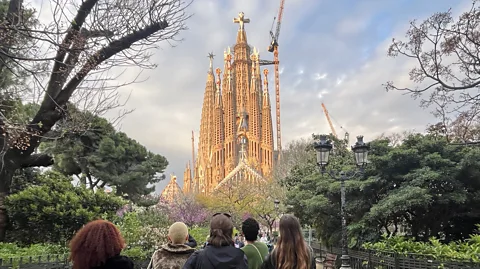
Antoni Gaudí was known as "God's architect", and the centuries-old arch design he drew on for Barcelona's Sagrada Família helps it soar higher than any other church in the world. Today, it has been perfected using modern techniques.
In June 1926, an old man in dishevelled clothing was struck down by a tram when crossing the street on his way to church. A few days later, he died in a pauper's hospital. The man was Antoni Gaudí, who would become known as "God's architect".
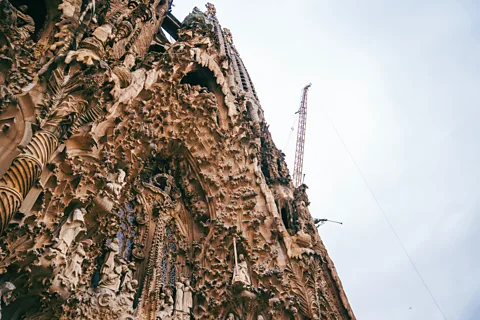
Gaudí left behind a momentous task. He died partway through the construction of Sagrada Família – an iconic, towering church in Barcelona, north-eastern Spain. From a distance, the church rises above the city skyline like a bristling organic behemoth. Up close, it seems even more like a living thing. Hypnotically detailed façades depicting biblical themes seem to grow out of the stone.
Always intended to continue long after his death, building Sagrada Família posed extraordinary challenges. Gaudí's sketches and models were obliterated during the Spanish Civil War in 1936, leaving scant material for his successors to work from. There was a time when its soaring towers were thought to be too tall for their foundations, and vulnerable to wind.
Nevertheless, 100 years on from Gaudí's death, Pope Leo XIV is visiting Sagrada Família as the central pinnacle of the church – the Tower of Jesus Christ – is inaugurated. It stands complete at 172.5m (566ft). It has earned Sagrada Família the title of tallest church in the world.
The BBC visited Sagrada Família ahead of the 100-year anniversary of Gaudí's death, to find out how these all-but-impossible towers were achieved with a combination of ancient inspiration and cutting-edge modern engineering.
 Fundació Junta Constructora del Temple Expiatori de la Sagrada Família
Ancient inspiration
As a young, immensely ambitious and devout Catholic architect, Gaudí had two aims, says Gijs van Hensbergen, an art historian and biographer of Gaudí.
"To create – first of all – a Bible in stone, which is the Sagrada Família. But also to correct all the errors of the previous styles of architecture."
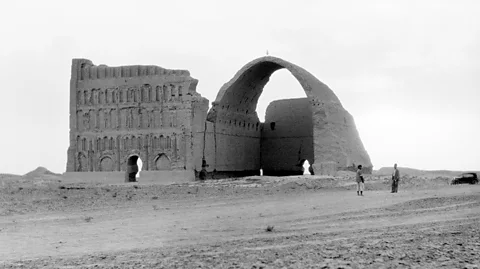
To do so, he would have to look back to one of the wonders of the ancient world, the Arch of Taq-iKisra in the ancient city of Ctesiphon in present-day Iraq. Built around the 3rd to 6th Centuries AD and standing at 30m (100ft) tall, the arch is an imposing early example of a structure called a catenary arch.
To understand the shape of a catenary arch, picture a chain held only by its two ends. It falls to create a curve. If you turn that curve upside down and build a stone arch tracing its shape, it will be extremely stable. The Arch of Taq-iKisra still stands today, and remains the largest brick arch in the world.
 Getty Images
"It was regarded as one of the seven wonders of the world," says van Hensbergen. Gaudí voraciously sought out photographs of ancient wonders like this arch. As an ambitious architect, "it's impossible that he wouldn't want to create a new wonder of the world", van Hensbergen says.
After decades of painstaking research, Gaudí was convinced that the catenary arch would help him correct what he saw as an irksome element of the cathedrals of his time.
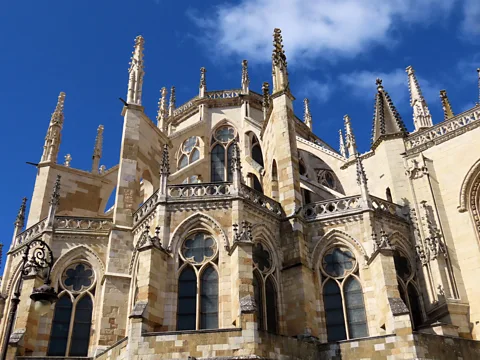
Large neo-gothic churches relied on flying buttresses – fingers of stone reaching out from the upper walls down to the lower levels – to support their elaborate vaulted roofs.
 Getty Images
Gaudí was adamant that he would not have flying buttresses on his church. He considered them "crutches" to hold up a building that couldn't support its own weight.
Instead, he turned to the catenary arch for his designs for the nave's columns, allowing it to support its own weight, as well as the building's 18 towers. "He used catenaries to help him come up with the most efficient forms," says Liam Duff, a structural engineer who leads a team working on Sagrada Família at the global engineering firm Arup.
"It is a very elegant shape and yet it does the work, it supports itself," says van Hensbergen.
The economical shape of the catenary arch also appealed to Gaudí's first desire: to create a bible in stone.
"He was clearly somebody who was mathematically fascinated, but it was always because it was the work of the Creator," says van Hensbergen. Gaudí believed that gravity and the catenary arch were divine inventions. "That, for him would have made it a wonderful leitmotif, as it were, nodding to God as the great architect."
 Getty Images
As Gaudí's knowledge of structures and forces developed, he became more confident to remove vaults and arches that weren't structurally necessary from the basilica.
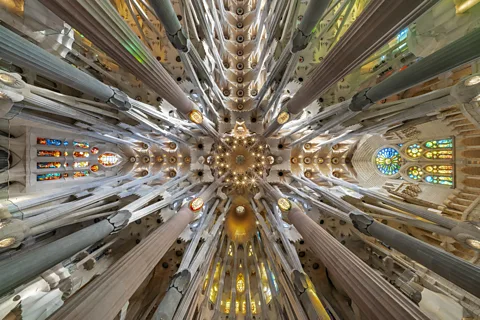
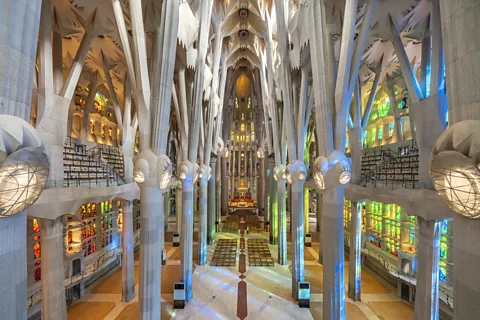
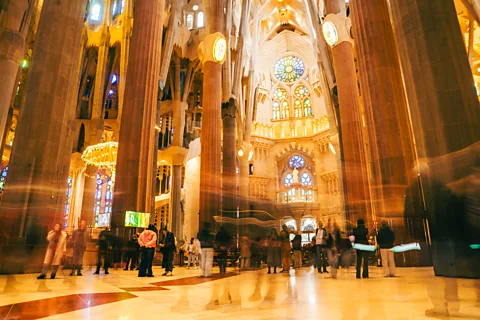
Gaudí's final iteration did away with all but the most essential supports. He used stripped-back branching columns inside the nave, the central space inside the church. Taking inspiration from nature, these resemble trees, their branches stretching upwards to take the weight of the roof and towers above.
Standing in the church's nave, lit with oranges and reds bleeding through the western stained-glass windows, the tree-columns give the illusion of weightlessness. As you crane your neck to see where the trees meet the ornate ceiling studded with flowers, it's hard to believe that each tree carries an unimaginable pressure from above.
 Sagrada Família / Pep Daudé
Heavy towers
Despite their pared-back, economical design, there was an enormous challenge when building one of the taller towers: it was too heavy.
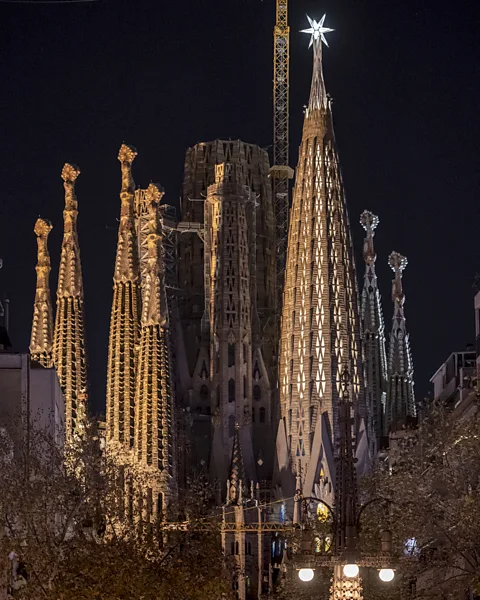
The Tower of the Virgin Mary is 138m (453ft) tall, second only in height to the central Tower of Jesus Christ at 172.5m (566ft).
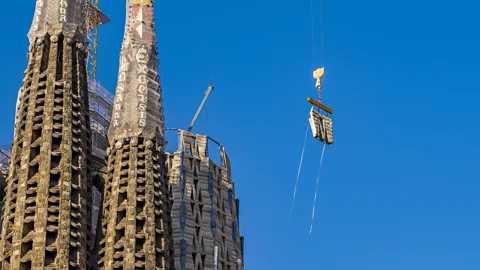
When the Tower of the Virgin Mary was under construction, it was realised the columns underneath would be overloaded if the tower was built using traditional masonry methods or in reinforced concrete with stone facing.
One solution was an internal steel frame to hold up the tower, clad with thinner concrete panels to lighten the tower's load. With this plan, Sagrada Família enlisted the services of a team of structural engineers at the firm Arup in the UK in 2014.
"Sagrada Família is a place of legend, isn't it?" says Steve McKechnie, a structural engineer at Arup who was involved with the project from an early stage. "It's something you would dream of being involved in, and it just came along to us."
 Getty Images
Arup's engineers had a radical idea to address the weight of the tower. They suggested ditching the steel frame and reinforced concrete entirely. Instead, they proposed using a thinner layer of stone stressed with internal steel tendons. It was a significant departure from the plan.
"That was a very big shift," says McKechnie. "There was a time when we thought our services weren't going to be required, and the project went very quiet."
Happily, McKechnie says, that changed.
The theory behind the pre-stressed stone panel idea is that masonry can be extremely strong if it is compressed. If you do the opposite of compression and try to pull it apart, it cracks easily under the tension and loses strength
When wind blows against a tower and pushes it backwards, it brings the windward side of the tower into tension. Imagine leaning back yourself – the back of your body will go into slight compression, while your front is stretched out under tension. This tension puts the stone tower at risk of cracks and damage.
The shape of the catenary arch helps keep the stone in compression using the mass of the tower itself. But using panels that have been internally stressed with steel tendons adds even more compression, making it stronger. With this design, when the wind blows, very little tension appears on the windward side.
 Getty Images
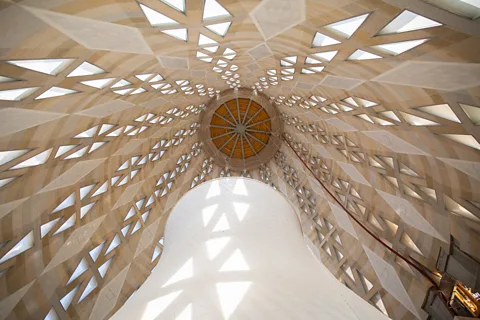
Tendons above and between the windows also helped pre-stress areas that might otherwise be prone to cracking. This was important, because Gaudí's designs were full of windows, allowing natural light to stream into the basilica below.
Although the windows added to the complexity of the design, they are a major part of the joy of the tower, says McKechnie. "Without the windows the point of the tower is lost, isn't it?"
The Tower of the Virgin Mary and five other central towers were completed using pre-stressed stone panels, including the Tower of Jesus Christ. Since 2014, Sagrada Família has widely used this method.
 Xavier Farré/ BBC
"Gaudí would have been really excited by the possibilities" of these new technologies, Van Hensbergen believes.
Gaudí experimented with different methods on the Tower of Saint Barnabas on the Nativity Façade, completed in his lifetime. He started at the bottom with sandstone quarried from the nearby Montjuïc mountain, which subtly varies in colour from grey to beige, green, ochre, gold, purple and red. By the top, he was using Portland cement.
More like this:
"It was a new material in Barcelona at the time, and so he was already experimenting and seeing new technologies arriving," says Duff.
His experiments paid off. "It's impressive to know the quality of the construction from Gaudí's time," says Fernando Villa, director of technology and innovation at the Sagrada Família, who describes the tip of Tower of Saint Barnabas as "perfect" after 100 years.
 Xavier Farré/ BBC
Gaudi's still unfinished church
As dignitaries including Pope Leo XIV gather to inaugurate the church's tallest tower on the centenary of Gaudí's death, the build is still far from over. Among other things, the church's main front, the Glory Façade, still to be finished.
Even after completion, modern technologies will help maintain the building. Changes in wind, temperature and the movement of the building over time can all lead to cracks proliferating inside and outside the church, says Villa.
Previously Sagrada Família relied on climbers to survey cracks and faults in the building, spending two years to take in every part of the basilica. Today, they use drones and AI to detect cracks that need attention. "Once we have the AI trained, it will be possible to scan all the basilica in one month," says Villa.
Far from being a fixed monument of stone, the Sagrada Família responds to the elements almost like a living thing. This constant movement and evolution speaks to Gaudí's organic design of the church, says Villa.
"Nature is his teacher."
--
If you liked this story, sign up for The Essential List newsletter – a handpicked selection of features, videos and can't-miss news, delivered to your inbox twice a week.
