Farming and living in Neolithic Britain

The Neolithic period brought many changes to Britain.
It was a time when people stopped hunting and gathering and began to farm.
They used tools to build settlements and permanent homes that were made to last. They also built monuments, which were special structures created to remember people or important events, like stone circles and tombs.
The remains of these tools and buildings have helped archaeologists, who study objects and places from the past, understand how Neolithic people may have lived and what was important to them.
Important words
Important words on what we know about Prehistoric Britain.
| Keyword | Definition |
|---|---|
| Archaeologist | Someone who studies objects and places from the past. |
| Domesticate | To train a wild animal so it can live with people. |
| Long barrows | A large grave built from stone and covered with earth. |
| Monument | A special statue or structure built to remember someone, an event or idea. |
| Neolithic period | This period, also known as the New Stone Age, was when people created settlements and started to farm. |
| Settlement | A place where people live and sometimes work. |
How did life change in the Neolithic period?

4,000 years ago, people started farming.
This was the new Stone Age or Neolithic period.
The early farmers chopped down trees so they could grow crops and vegetables.
They kept cattle, sheep and pigs.
People began to settle down in one place and build permanent homes.
What were the first farms like?

By 3500BC people in many parts of Britain had set up farms.
The early farmers grew wheat and barley, which they ground into flour.
Some farmers grew beans and peas.
Others grew a plant called flax, which they made into linen for clothes.
Neolithic farmers kept lots of animals:
- The cattle provided beef, as well as milk and cheese.
- Sheep and goats provided wool, milk and meat.
- Wild pigs were domesticated, meaning they were trained to live with people, and kept in nearby woods.
- Dogs helped on the farms too, they herded sheep and cattle and worked as watchdogs.
Watch: Take a tour inside a Stone Age house at Skara Brae
Take a look at this Stone Age house at Skara Brae on the Orkney Isles.
It dates from between 3200 and 2700BC.
What was inside a Neolithic home?
The dresser would have been the first thing you would see when you came through the door. It was clearly important. What kind of things would they have placed on it?
Well, think of what people display today in their homes - things important to them, things that make statements about them.
Though 5,000 years ago, there weren’t any clocks or picture frames. These beautiful objects are the kind of things that would have been displayed there.
As you sat on the large stone seat directly in front of the dresser, you'd have a clear view of the door and be able to see whoever crawled in.
As they entered, they'd have to look up at you. The door itself is only lockable from the inside. So when you came in here, you’d be able to shut the outside world out, have privacy.
We think a bone, or a piece of wood, could have been used to hold the door in place. But today all that remains are the holes in the stone which held the bar.
Once your guest had arrived and the door was closed, you could offer fresh fish and meat cooked on the fire. And in winter, smoked meat stored in the smoky roof space would be available.
Huge storage jars, too big to be brought in through the door, were buried in the corner of the house. The top of these pots were beautifully decorated and the area where they sat was surrounded by stone to protect them from being bumped and broken.
What monuments did Neolithic people build?

Neolithic people built many large monuments for different a variety of reasons.
Neolithic people built grave mounds to bury their dead.
Known as ‘long barrows’, these long mounds were often made from stone and covered with earth. Many long barrows were used as places to store the bones of the dead although some may have been used for other purposes.
People also started to build stone circles.
They also built large wood circles, such as Woodhenge, and stone circles, such as Stonehenge, which were used for religious ceremonies.
This practice continued into the early Bronze Age.
How do we know what happened in the Neolithic period?
The Neolithic period was a very long time ago.
It was a time when people did not write things down.
This means archaeologists need to use clues to understand what may have happened and what life was like for Neolithic people.
Discovered Neolithic tools, homes like the Skara Brae settlement, and monuments such as Stonehenge, help archaeologists understand how Neolithic people may have lived and what was important to them.
Stonehenge
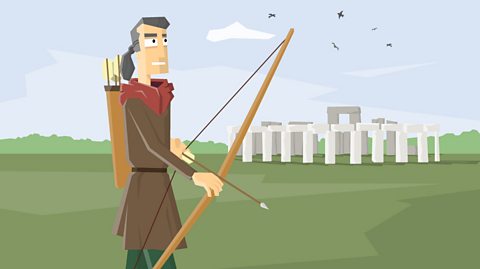
Stonehenge is an ancient stone circle that was built by the Neolithic people around 3000BC on Salisbury Plain, in Wiltshire.

It is not known why it was built, but different artefacts found around Stonehenge, such as tools made of antlers, have helped archaeologists to understand more about the people who lived there, what it may have been used for and how it may have been built.
Skara Brae
Skara Brae is a prehistoric settlement that was built on the Orkney Islands around 3100BC.

It is one of the best-preserved Neolithic villages in northern Europe.
The remains of the many stone houses and other artefacts like tools, pottery and jewellery have helped archaeologists understand more about the Neolithic people’s daily lives and how they may have lived.
Think like a historian

Have a look at the thinking points below and think about your answer to each question. You could even write them down on a piece of paper or discuss them with somebody else if you want to.
Neolithic people started to farm and settle down in one place. Why do you think this was such a big change for the people in Britain?
Neolithic people began to keep and use animals for farming. How is this similar or different to how animals are used today?
Archaeologists discovered that homes at Skara Brae had doors that could be locked from the inside. What do you think can be learnt about the Neolithic people from this?
Did you think that it meant people started to gather together and build permanent homes and settlements? This meant more people could live and work together. Maybe you thought it was a big change because it meant people could now focus on other tasks, such as building monuments to bury their dead. This change in how people lived may have helped communities grow. By staying in one place, people could share their ideas and beliefs with one another.
You may have thought that farmers in the past, and now, keep cattle to get milk, cheese and meat. Did you think that farmers today also use dogs to herd sheep or work as watchdogs? Perhaps you thought about how Neolithic people kept some wild animals, like pigs, in the forests near their settlements, but today most farm animals are not wild.
Did you think that the locks on their doors show that Neolithic people may have wanted their homes to feel safe and private? Maybe you thought that it shows that they wanted to shut out the outside world and to protect themselves from the weather.
Activities
Activity 1: What tools did they make?
Neolithic people made a range of tools and other objects to help them in their daily life. Click on each object to find out more.
What would you make if you lived like them?
Activity 2: Neolithic Stone Age quiz
Let's find out what you know about Neolithic Stone Age Britain in this quiz.
Grown-ups corner
Are you a parent, carer or teacher?
Take a look at some of the links below on KS2 History which are packed full of knowledge, videos, quizzes and activities.
KS2 History: New Stone Age
BBC Bitesize for Teachers
KS2 History / PSHE and Social Studies: Stone Age farming and homes
BBC Bitesize for Teachers

KS2 History / PSHE and Social Studies: What do ancient bones tell us about the Stone Age?
BBC Bitesize for Teachers

Horrible Histories: Raid and Trade game! game
Play Horrible Histories: Raid and Trade KS2 History
More on Prehistoric
Find out more by working through a topic
- count16 of 21
- count17 of 21
- count18 of 21
- count19 of 21