Iron Age Britain

The Iron Age began in Britain around 800BC.
It was a time when new discoveries, such as the metal iron, changed how people lived.
Iron Age people lived in tribes, large groups of people who shared a common culture, religion and language. Tribes were led by warrior kings.
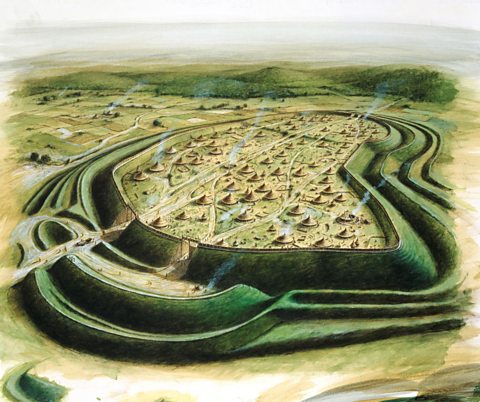
They lived in hill forts, settlements built on top of a hill and surrounded by walls made from wood. Living there helped to protect them from attacks.
Iron Age people enjoyed feasting, music and poetry.
They also believed in many powerful spirits. They believed that these invisible beings existed in the natural world around them.
Important words
Important words on life in the Iron Age.
| Keyword | Definition |
|---|---|
| Archaeologist | Someone who explores objects and places from the past. |
| Carpenter | A person who makes items, such as wheelbarrows, from wood. |
| Clan | A group of people, often families, who live and work together. |
| Hill fort | A settlement built on top of a hill and surrounded by walls made from wood. |
| Potter | A person who makes items, such as pottery, from clay. |
| Settlement | A place where people live and sometimes work. |
| Spirit | A ghost or invisible being that people believed could live in certain special places. |
| Tribe | A larger group of people who share a common culture, religion and language. |
How did Iron Age people live?

Around 800BC, people in Britain learned how to use iron.
This had a big impact on everyday life.
Iron tools made farming much easier than before.
Coins were produced and used to buy things.
People lived in clans. These individual groups of people, often made up of families, lived and worked together. They belonged to larger groups of people called tribes which were led by warrior kings.
Rival tribes fought with deadly iron weapons.
Many people lived in hill forts to keep safe from attacks.
During the Iron Age, the Celtic people spread out across Europe and many settled in Britain.
The ancient Britons followed a Celtic way of life.
They enjoyed feasting, music and poetry.
They produced fine metalwork which they traded with people in mainland Europe.
Watch: What was an Iron Age hill fort?
Watch the video to learn more about Iron Age hill forts.
Raksha Dave visits Maiden Castle in Dorset to find out about Iron Age tribes.
A very long time ago in ancient Britain, there were no written words.
This was the time before history was recorded.
It's prehistory.
The only clues to life back then come from the objects, burials, cave paintings and monuments which speak to us about Britain's ancient past.
My name is Raksha Dave, I'm an archaeologist and I'm in search of Britain's Ancient Voices.
This may look like an odd-shaped hill, but, in fact, it's what's left of an Iron Age hillfort, built 2,500 years ago.
This is Maiden Castle.
At this time, people in Britain lived in tribes, but as land began to be used up, tribes started to fight each other, so some built hillforts to defend their territories.
This is the largest hillfort of them all.
In fact, it's as big as 50 football pitches.
It's incredibly steep, so must have been really difficult to attack.
This is hard work.
Oh, and once you think you've got to the top, there's another ridge to get over.
Maiden Castle isn't built from stone, but carved from the hill.
To make the hillfort hard to enter, banks were built all around it.
These banks, known as ramparts, are built out of chalk, dug from the ditches down here, which were much deeper in the Iron Age.
And, of course, there were no mechanical diggers back then, so digging this by hand was hard, physical work.
The ramparts would have been a brilliant chalky white and visible from a long way away.
Finally, I've reached the top, and up here is where the tribe would have lived.
Here at the hillfort's entrance, you'd have a bird's-eye view of who was arriving, and if any enemies were spotted, they would be lobbed with stones kept in large pits here.
And we know this because 20,000 of them, like these, were found at the eastern entrance just for that purpose, and they could be deadly.
The tribe must have felt very protected living here, on top of the hillfort.
Just imagine the roundhouses here in neat little rows, with sheep outside bleating in their pens, children practising with their slingshots, their parents warning them to be careful, people sharing stories and food around the campfire, tribal elders calling them for a meeting.
Maiden Castle was also a safe place to buy and sell crops, pots, weapons and jewellery.
And to pay for these goods, they used grain, which they kept in special pits on top of the hillfort.
And they used metal ring money, too.
These are actual Iron Age coins, about 2,500 years old.
They look very different from the flat coins that we use today.
The bigger the ring, the more it weighed, and the greater the value of the coin.
It's amazing to think that on top of this hill, inside these walls, this was a place teeming with life, where people were busy going about their daily activities— working, trading and meeting people, and keeping an eye on the crops and animals in the fields below Maiden Castle.
No wonder it's called Mai-dun—the Iron Age words for "great fort".
Who lived and worked at a hill fort?
By the end of the Iron Age many people lived in hill forts.
The forts were surrounded by walls and ditches.
Warriors defended their people from enemy attacks.
Men and boys trained as warriors.
They had to be prepared to fight at any time.


Homes
Inside the hill forts, families lived in round houses.
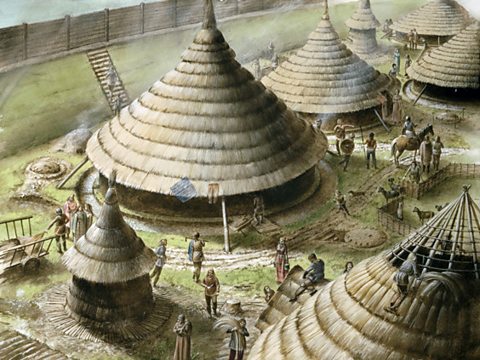
These were simple one-roomed homes with a pointed thatched roof and walls. The walls were made from wattle and daub - a mixture of mud and twigs.
In the centre of the round house was a fire where meals were cooked in a large metal pot called a cauldron.
Around the walls were jars for storing food and beds made from straw covered with animal skins.
Farming
Iron Age farmers grew crops and vegetables.
They kept geese, goats and pigs and had large herds of cows and flocks of sheep.
Jobs
Some people worked as potters, carpenters and metalworkers.
What did Iron Age people believe?
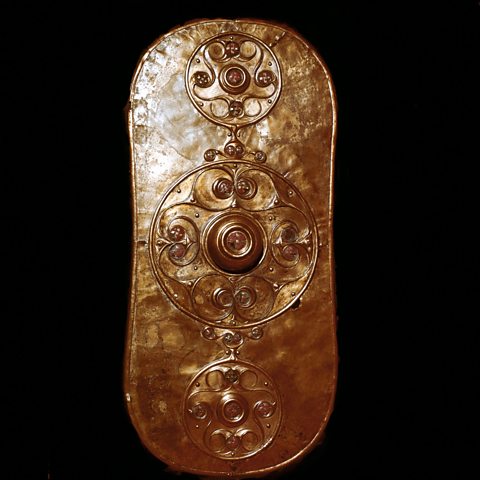
People in Iron Age Britain believed in powerful spirits.
Priests known as druids led religious ceremonies.
They sacrificed animals and sometimes humans too!
The druids gave precious offerings, such as swords and cups, to the spirits.
They buried the offerings in the ground or threw them into rivers, lakes and bogs.
When the Romans first arrived in Britain they wrote about the religion of the ancient Britons.
They described four of their main festivals:
- Imbolc was held in February to welcome the birth of the first lambs.
- Beltane was celebrated in May, when the cattle were moved to their summer fields.
- Lughnasadh was held in August to celebrate the ripening of the crops.
- Samhain took place in November and marked the end of the year.
Think like a historian

Have a look at the thinking points below and think about your answer to each question. You could even write them down on a piece of paper or discuss them with somebody else if you want to.
Many Celtic people came from Europe and settled in Britain. What do you think can be learnt from this about Iron Age Britain?
Hill forts were used for trading and for religious gatherings. Why do you think it was important to have a safe place for so many different activities?
The Romans described four of the Iron Age people’s main festivals, like Imbolc in February and Samhain in November. What do these festivals tell historians about what was important to the Iron Age people?
Did you think that when different tribes moved from Europe to Britain that they brought their culture, customs and ways of life with them? Maybe you thought it shows how Britain was not made up of just one type of person, but many different people who came from other parts of Europe.
Did you think a hill fort was important as people from different tribes could meet safely there to trade their crops, weapons or jewellery? They would be safe and not have to worry about being attacked. Perhaps you thought the hill fort allowed the whole tribe to come together to work, worship and share their stories.
Perhaps you thought the festivals show how the Iron Age people organised their year around farming. Many of their celebrations marked key moments in the farming calendar, such as the birth of lambs, the movement of cattle and the time for harvesting crops. As these festivals were closely linked to the passing of the seasons, it could suggest that caring for animals and growing food were very important parts of Iron Age life throughout the year.
Activities
Activity 1: Iron Age tools
Iron Age people developed some very useful tools to help them in their daily work.
Click on these pictures to find out more.
Activity 2: Iron Age quiz
Let's find out about what you know about life in the Iron Age in this quiz.
Activity 3: What changed from the Bronze and Stone Age?
Watch the video about what stayed the same and what changed between the Bronze Age and the Iron Age.
Can you write down three of the biggest changes from the Bronze Age?
Life in Iron Age Britain shown through the eyes of a typical family as they deal with a raid by another tribe. The impact of the discovery of iron is explored.
People have been living in Britain for thousands of years.
People just like us, but living very different lives in very different times.
This is their story.
This is the story of Britain.
3,000 years ago, and our settlement is under attack.
BOY: Oh!
What the…!
Ow!
BOY 2: — What is it?
BOY: — What?
The cattle!
NARRATOR: Tribes stealing from each other and fighting over land is a big problem.
A tribal meeting is called to discuss what to do.
TRIBE LEADER: Another tribe, the Regni, have stolen some of our cattle.
WOMAN: But what can we do?
WOMAN 2: We're just not protected, living here.
See this, we captured one of the thieves.
THEIF: I was caught by the enemy tribe, they made me their slave.
TRIBE LEADER: If you tell us where we can get this metal you can join our tribe.
THEIF: It's in the rocks.
It's much more plentiful than the copper and tin you need to make bronze.
They call it iron.
Look, if you heat it up, you can make it into anything.
Even a sharp sickle for you to cut your crops with.
NARRATOR: Learning the secret of making iron is a revelation to the Britons.
TRIBE LEADER: You can turn it into something else.
NARRATOR: The rocks that contain iron can be found much more easily than those needed to make bronze.
Iron has more uses too.
It can be hammered into shape and mended when broken.
And while bronze is expensive and only for the important few, almost everyone can have something made from iron.
Our family puts their new discovery to use immediately.
TRIBE LEADER: We can make enough iron spears to defend our land.
That might be enough.
MAN: I'll just finish this last one.
We have new iron weapons.
Now we can fight the Regni tribe.
WOMAN: But remember, we must consult the druidess first.
TRIBE LEADER: Oh!
NARRATOR: Druids are the wise priests of the Iron Age and can be men or women.
In some ways they are even more important than the tribe's leader and it's believed they can look into the future.
They act as healers, teachers and judges, not just for one tribe, but for many tribes over a great area.
They have so much power that people say they can walk into the middle of a battlefield and actually stop the fighting.
DRUIDESS: What is your question?
TRIBE LEADER: Should we go into battle with the Regni tribe?
NARRATOR: To help them predict the future, Druids pour liquids between special spoons.
DRUIDESS: No. You should not go after the cattle thieves.
TRIBE LEADER: No?
DRUIDESS: They have iron, you have iron, many on both sides will die.
I have been given a better idea.
This is a hillfort.
It will help you defend your tribe.
NARRATOR: In the Iron Age, forts are built on top of hills, often with surrounding ditches, to help protect tribes from their enemies.
Hillforts are places where tribes live and work, where crops are prepared and stored, goods traded and exchanged, and religious gatherings are sometimes held.
BOY: We can see for miles.
BOY 2: North, South, East, West.
Uh-oh.
TRIBE LEADER: Give them a warning shot!
Whoa!
CHEERING
NARRATOR: Life in Britain is changing once again.
Helped along by the introduction of this new metal.
This is the Iron Age.
Grown-ups corner
Are you a parent, carer or teacher?
Take a look at some of the links below on KS2 History which are packed full of knowledge, videos, quizzes and activities.
KS2 History: Iron Age Britain
BBC Bitesize for Teachers

KS1 / KS2 History: Hill forts
BBC Bitesize for Teachers

KS2 History / PSHE and Social Studies: Iron Age forts and tribes
BBC Bitesize for Teachers

Horrible Histories: Raid and Trade game! game
Play Horrible Histories: Raid and Trade KS2 History
More on Prehistoric
Find out more by working through a topic
- count18 of 21
- count19 of 21
- count20 of 21
- count21 of 21