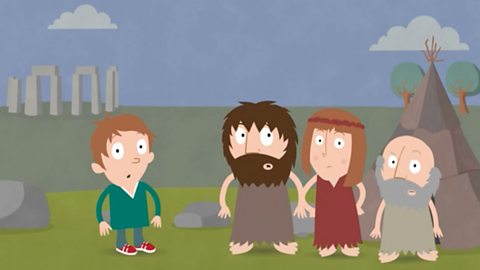
Iron Age Britain and its people
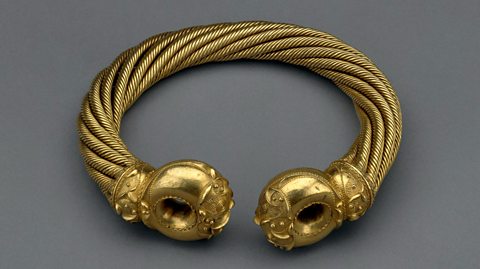 Image source, © Trustees of the British Museum
Iron Age Britain was a land of many different tribes (a larger group of people who share a common culture, religion and language).
Each tribe had their own leaders and traditions.
The Iron Age people were skilled farmers and talented craftsmen (someone who makes items by hand, such as jewellery or weapons).
Archaeologists (someone who studies objects and places from the past) have discovered many of these items and learnt about how they lived and what they made.
Created in partnership with English Heritage
Image source, © Trustees of the British MuseumImportant words
Important words on what Iron Age people made.
| Keyword | Definition |
|---|---|
| Archaeologists | Someone who studies objects and places from the past. |
| Boundaries | A line or fence which marks the edge of a piece of land. |
| Coinage | A set of coins which have different values. |
| Craftsmen | A skilled worker who makes items by hand, such as jewellery or weapons. |
| Enclosure | A boundary, such as a long ditch, made to keep animals together. |
| Kiln | A very hot oven used for burning, baking or drying something. |
| Tribes | A larger group of people who share a common culture, religion and language. |
Iron Age tribes and clans

During the Iron Age, Britain was divided into different tribes.
Each one had their own leader and traditions.
Many of these groups shared similar languages, religious beliefs and art styles with people who lived across western Europe.
Some people call Iron Age Britons ‘The Celts’.
The word ‘Celt’ comes from the Ancient Greeks who called these people Keltoi, but it is not a name that they called themselves.
What food did people make and grow?
Iron Age people grew their own crops to make food, like wheat, oats and barley.
They used cattle to make milk, cheese, meat and leather and to pull ploughs and carts.
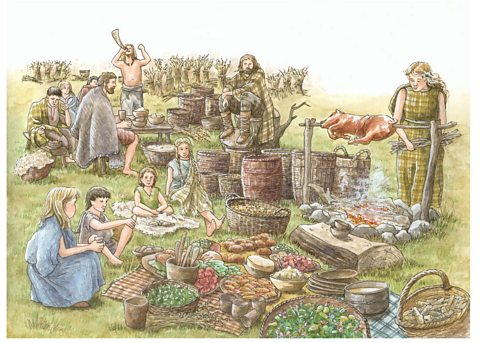 Image source, Clwydian Range and Dee Valley AONB
What were farms like?
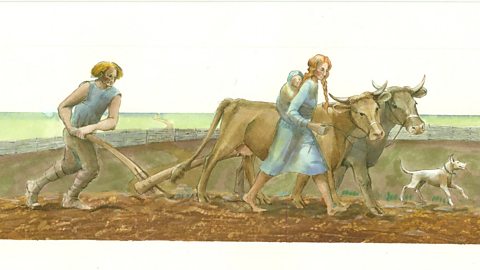 Image source, © Historic England (illustration by Judith Dobie)
People laid out boundaries (the edge of a piece of land) around their fields with fences.
The remains of the boundaries can still be seen on aerial photographs today.
Long ditches and enclosures (a space made to keep animals together) were built to make fields for their cows.
People used horses to pull carts and in battles.
Image source, © Historic England (illustration by Judith Dobie)What did Iron Age people make?
People decorated items with curly or swirling patterns.
They often designed animals, birds or plants.
This type of decorative craftsmanship is often called ‘Celtic art’.

Pottery
Some Iron Age potters used potter’s wheels and special kilns (a very hot oven used for burning, baking or drying something) with bellows to change the colour of the clay they were using.
They decorated their pottery by painting them or stamping them with pictures of animals.
Pottery remains have helped archaeologists understand more about Iron Age people’s daily lives and how they cooked food.

Coinage
Around 150BC, the Iron Age people began to use coins that were brought to Britain from Europe.
Around 80BC, Iron Age people began to make their own coins. This was tricky to do and required a lot of skill.
Different tribes made different coins and decorated them with different designs.
Coinage (a set of coins which have different values) became more important as more people began to trade. They were used to buy items and show the wealth and power of different tribes.
Archaeologists have found many Iron Age coins. This has helped them to understand more about the many different tribes and how the Iron Age people lived.
What weapons and armour did Iron Age people make?
 Image source, © Trustees of the British Museum
Weapons and armour
Long swords - Warriors used these to cut and slash enemies. Daggers were for close range combat. They were carried in decorated leather holders called scabbards, and were made of bronze, wood or leather.
A spear or javelin - Iron Age warriors could throw these at an enemy who was far away.
Helmets - These protected the wearer from slashing swords, spears and arrows.
Shields - A shield made of iron, wood or leather was also used for protection.
Image source, © Trustees of the British MuseumThink like a historian
Have a look at the thinking points below and think about your answer to each question. You could even write them down on a piece of paper or discuss them with somebody else if you want to.
Iron Age people decorated their items with swirling patterns, animals and plants. Why do you think the Iron Age people spent so much time making their items look special?
Why do you think we know so much about what the Iron Age people made?
Archaeologists have discovered many different Iron Age coins. Why do you think different tribes made different coins?
Did you think they decorated their items to show how skilled they were at making beautiful art and items? Perhaps you thought it was important to them to have special and unique items. Maybe you thought it helped to show who was wealthy and powerful.
Did you think about the pottery, tools and jewellery discovered by archaeologists? These items have helped people understand what was important to the Iron Age people and how they may have lived. Maybe you thought about how strong these items were. This would mean they would survive many years underground and would be found by archaeologists. Other items made from cloth or wood can be harder to find and may have rotted away over time.
Perhaps you thought it shows that each tribe was different and separate from each other? This meant they would make their own special coins. Maybe you thought about how coins were used to show wealth and power. Different tribes would want their coins to look different and stand out. Many coins even showed the faces of powerful Iron Age leaders.
Activity: Quiz – Life in an Iron Age hill fort
Grown-ups corner
Are you a parent, carer or teacher?
Take a look at some of the links below on KS2 History which are packed full of knowledge, videos, quizzes and activities.
KS2 History: Iron Age Britain
BBC Bitesize for Teachers

KS2 History / PSHE and Social Studies: Iron Age forts and tribes
BBC Bitesize for Teachers

KS2 History: Ancient Voices
BBC Bitesize for Teachers

Horrible Histories: Raid and Trade game! game
Play Horrible Histories: Raid and Trade KS2 History
More on Prehistoric
Find out more by working through a topic
- count20 of 21
- count21 of 21
- count1 of 21
- count2 of 21