Summary

  1. WATCH: Belfast Trust respondspublished at 14:57 BST

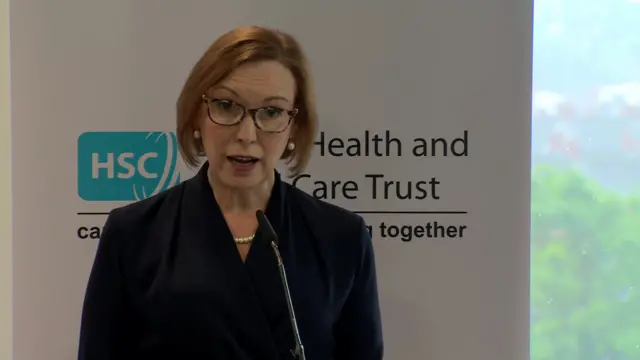
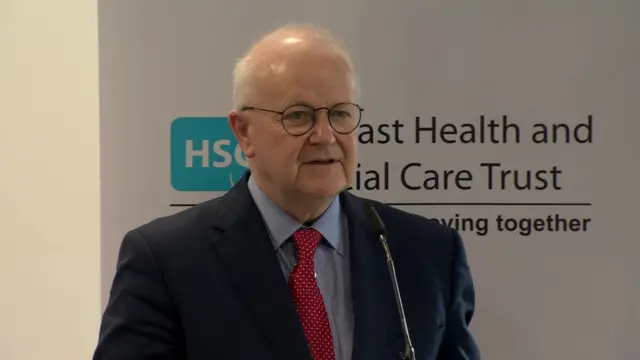
    If you click play at the top of the page you can watch the press conference with both the chairman of the Belfast Trust Professor Stuart Elborn and chief executive of the Belfast Trust Jennifer Welsh.

  2. Muckamore Inquiry 'must lead to lasting reform'published at 14:53 BST

    Politicians in Northern Ireland are beginning to react.

    DUP Leader Gavin Robinson and DUP Health Spokesperson Diane Dodds said the findings "must mark a turning point for health and social care services in Northern Ireland".

    Robinson said: "Vulnerable individuals who should have been protected and cared for were failed".

    Dodds said the recommendations "must now be implemented in full" and "must mark the beginning of meaningful and lasting reform."

    Alliance's Nuala McAllister says she won't accept a "slow pace" when it comes to action.

    Some of the patient experiences are intense and graphic," she tells BBC Radio Ulster's Talkback programme, added that the 700 page report is hard and important reading.

  3. Without accountability it's a waste time, father sayspublished at 14:42 BST

    Glynn Brown went on to say that without accountability "this is all a waste of time".

    "The people in senior positions do not recognise accountability," he says.

    "It's something they talk about, but they don't believe in it, it's not for them it's for the plebs at the bottom. That's the problem "

    Glynn Brown

    Claire McKeegan of Phoenix Law, who represents some of the families, says implementation of the report must happen immediately.

    "We have seen too many reports welcomed in principle and quietly shelved."

  4. Patient's sister says brother cried all the timepublished at 14:34 BST

    Margaret smiling at the camera. She is wearing hoop earrings and a pale blue jacket with large black buttons. She has long grey hair.
    Image caption,

    Margaret McGuckin, who's brother was in Muckamore, pictured in 2024

    Margaret McGuckin, whose brother Kevin was in Muckamore, says she was "shocked" as well as "pleased and elated" at the report.

    "There was systemic abuse, that’s what I needed to hear.

    "Many of us were in disbelief at being believed."

    McGuckin says Kevin "cried all the time" and wanted to go home from Muckamore and did not want to talk about it.

    McGuckin questions: "Why were they not guarded and protected?

  5. Report can be a powerful tool to help familiespublished at 14:29 BST

    Tom Kark says they recognise that there are still allegations of abuse at other facilities in Northern Ireland.

    He says relatives will continue "in your struggle to get the best for the people you love".

    "This report should be a powerful tool to assist you," he says.

    He says the report does not address in detail the issue of redress for victims.

    "Importantly, however we do recommend that the Department of Health should set up a working party to consult patients, service user groups and families of those who have suffered abuse at Muckamore.

    "That will ensure that the issue of redress to meet the needs of the victims can be considered and looked at in a proper, focused manner."

  6. What were the critical findings?published at 14:16 BST

    For readers just joining us - the findings of a public inquiry into the abuse of patients at Muckamore Abbey Hospital have been published.

    The inquiry found that patients were abused, systematically bullied by some members of staff and that there was a culture of not reporting abuse.

    It also found:

    • Ineffective external inspection failed to uncover the abuse and the system failed to function as a meaningful safety net.
    • A long-term policy beginning in 2001 to move all patients with Learning Disabilities and Autism from hospital settings into community based care was not matched by necessary investment.
    • Prior to 2017, incidents of peer on peer and patient on staff assaults increased even as the patient population was diminishing, indicating a rise in intensity and potential danger.
    • Safeguarding arrangements did not provide effective protection for vulnerable adults
    • Systems and structures in place were wholly inadequate to manage the scale of abuse uncovered through CCTV review in 2017.
    • Evidence from CCTV footage taken from inside the hospital captured patients clinging to wheelchairs, being spat at and so heavily medicated that they'd become "zombified"

  7. Vindication not the same as justicepublished at 14:11 BST

    Muckamore families

    Brown says for the families, being vindicated is not the same as getting justice.

    His son Aaron was among those whose physical abuse was captured on CCTV.

    He calls for support, treatment and counselling to be provided to survivors of the abuse and to families.

    He also calls for financial redress that "reflects the gravity and duration of what was suffered".

    Brown adds: "The families will not stop until there is real change and meaningful redress for those that were harmed.

    "Anything less would be yet another insult to our loved ones."

    He calls for the health minister to meet families urgently.

  8. Report a confirmation of truth, families saypublished at 14:06 BST

    Families of patients at Muckamore Abbey Hospital says the inquiry's findings are the "the formal confirmation of a truth we have lived and fought to expose for years".

    Reading a statement, Glynn Brown whose son was a patient, says families were not believed.

    "For years these families were told they were exaggerating.

    Muckamore families

    "Today the inquiry confirmed what we always knew, that their loved ones were abused on a staggering scale and that the failure was systemic, that the warning signs were there to be seen and that those in power to stop it did not.

    "This report belongs to the families and the patients, including those who did not live to see it."

  9. Do not 'side step' Kark warns health officialspublished at 13:58 BST

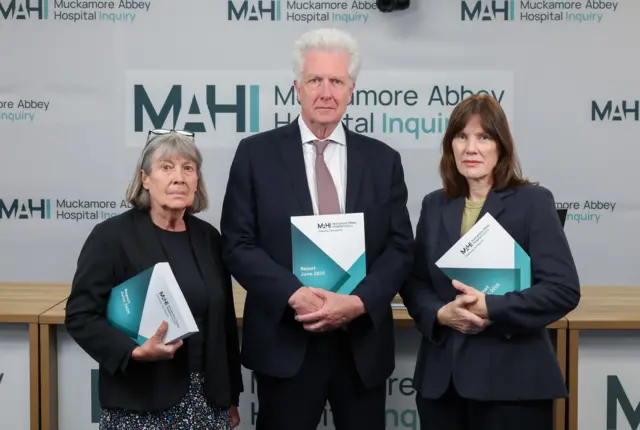
    Kark says there must be a commitment to ensure that what happened at Muckamore Abbey Hospital can never be repeated.

    The report has been formally submitted to Northern Ireland's health minister.

    “The inquiry was established to examine what happened, why it happened, and how it was allowed to continue for so long.”

    He says recommendations must be implemented immediately and monitored rigorously.

    The lessons, he says, are stark.

    "This cannot be allowed to happen again. There should be no delay, no dilution, and no side-stepping in the delivery of the recommendations.”

  10. Politicians must implement recommendationspublished at 13:55 BST

    Tom Kark says politicians now need to get on with legislation to implement the inquiry's recommendations.

    "We don't do that very well in Northern Ireland," he adds.

    Muckamore inquiryImage source, bbc

    Kark says one of the things that went wrong at Muckamore was that people "lost sight of the fact that they were dealing with individuals who had personal needs and requirements.

    "That led to dysregulated behaviour, and that led to far too much restraint, overmedication and eventually abuse."

  11. How did CCTV hold the key to what was happening?published at 13:40 BST

    Closed circuit television (CCTV) played a pivotal role in uncovering abuse.

    In fact the report goes as far as to note that without it, the abuse of patients is unlikely to have been exposed, and the inquiry itself may never have been established.

    But, CCTV and its use must be "carefully considered, regulated and monitored".

    There was a significant lag between its installation in communal areas and the policy around its use being approved in about 2017.

    CCTV camera

    The pivotal time came in August 2017 after a report that a patient had been struck by a staff member. When CCTV was reviewed "they discovered not only that the incident had been recorded, but that other unreported incidents were visible on the footage".

    The panel notes that while it was essential in revealing the truth the Trust was "unprepared for the consequences of that revelation".

    The panel concluded that CCTV can be a powerful safeguarding tool in high-risk settings, but only if accompanied by clear policy.

  12. Many staff devoted to patient carepublished at 13:34 BST

    The also report makes it clear that it was not every single member of staff whose behaviour was a problem.

    There were "many members of staff who devoted a significant part of their working lives to caring for the patients at MAH and who took no part in the abuse and may not even have been aware of it".

    It's "unfortunate" then that the reputations of hard-working and well-intentioned members of staff have been unfairly tarnished by what happened.

    The report pays tribute to those staff who behaved with professionalism.

    Kark, in his comments, paid tribute those who showed "bravery" in coming forward to the inquiry.

    Of 740 patients about 10% were represented in evidence.

  13. Shocking and difficult readingpublished at 13:21 BST

    Marie-Louise Connolly
    BBC News NI Health Correspondent

    These findings are shocking and are testament to why what happened inside Muckamore is regarded as the biggest criminal adult safeguarding case in the UK.

    Evidence from CCTV footage taken from inside the hospital captured patients clinging to wheelchairs, being spat at and so heavily medicated that they'd become "zombified".

    Tom Kark found there was a closed culture and a lack of reporting of what was happening between staff and patients.

    Warning signs from as far back as 2012 within the hospital's Ennis Ward were missed after an incident triggered several arrests among staff, one of use resulted in a conviction.

    While that case should have triggered questions and further investigations, the inquiry found it didn't and instead some managers stood back and turned a blind eye to what was going on.

    Chapter 1 of the report is difficult reading where the inquiry outlines examples of where and how patients were maltreated.

  14. Bad behaviour was 'normalised'published at 13:16 BST

    Kark says he found the evidence "very distressing to hear" and it would have been even worse for the families.

    "I think what surprised and shocked us most was that there was plainly a culture there," he told BBC News.

    "We've referred to the normalisation of, of deviance, in other words, bad behaviour becoming normalised, that people were walking past and allowing this to happen, and neither intervening nor reporting it.

    "I think that's profoundly shocking."

  15. Relatives felt powerless, inquiry chair sayspublished at 13:11 BST

    Tom KarkImage source, PA Media

    Tom Kark says relatives saw their "zombified" loved ones but felt powerless to do anything about it.

    He said when the abuse came to light many relatives felt guilty about about placing their loved ones in Muckamore.

    "To give that evidence in the full glare of a public inquiry must have been for most and probably all exceptionally difficult," he says.

  16. Families say patients 'zombified' by medicationpublished at 13:04 BST

    The report covers the use of restrictive practices with those with learning disabilities and/or autistic people.

    It makes the point that some practices once considered "benign" became outdated and staff training did not keep pace with this evolving understanding.

    There was a pattern of frequent use of physical restraint, seclusion and PRN (‘pro re nata’) sedation sometimes where the use of "de-escalation or other preventative, person-centred or behavioural interventions" might have reduced or avoided the need for restrictive measures.

    Seclusion was a particular area of concern as was the use of PRN medication for restriction.

    But families said they often found loved ones sedated, disengaged or "zombified".

    The report does recognise that, often, there was an absence of appropriate alternatives such as psychological interventions and the impact of staff shortages on effective de-escalation of challenging behaviours.

  17. Patients' personal hygiene also neglectedpublished at 12:58 BST

    The panel concluded that injuries such as bruises and marks were not "isolated" but visible indicators of systemic failure.

    Unchecked physical abuse and neglect caused "lasting harm to patients and profound distress to their families".

    As well as that personal care and hygiene was often lacking

    Descriptions were given of patients being unkempt, with dirty hair and smelling of body odour and urine. On some visits relatives noted that incontinence pads were full or fingernails had faeces under them.

    Some patients were dressed in another patient's clothes.

    Weight loss and weight gain was also noticed.

  18. CCTV shows 'dragging, pushing and inappropriate restraint'published at 12:52 BST

    Key to finding out what happened at Muckamore was the discovery of CCTV footage with catalogued the physical abuse.

    In it the "forceful handling, dragging, pushing and inappropriate restraint" of patients could be seen.

    These incidents provided confirmation that unexplained injuries reported by families over many years could "not be attributed solely to patient behaviour or peer-on-peer violence".

    We are told about the "worry and trauma" this caused families, as well as guilt for "exposing their relatives to harm".

    "In truth, of course they bear no blame whatever, but the burden for many was expressed clearly through the families’ evidence, which was often and understandably emotional."

  19. Who were the residents of Muckamore?published at 12:47 BST

    Muckamore Abbey Hospital was designed and built as a long-stay facility for people with learning disabilities and/or autistic people, and some were admitted through the criminal justice system into forensic care wards, the report says.

    However, the report says their experiences changed over time as the facility changed.

    The inquiry heard about people who were admitted as young as six years old and who moved through different wards as they grew older. Resettlement of patients often failed.

    Some lived nearly their whole lives there.

    "For some it was all they knew and they regarded it as their home for life," the report explains.