Summary

  • Patients at Muckamore Abbey hospital were abused and systematically bullied, inquiry report, external finds

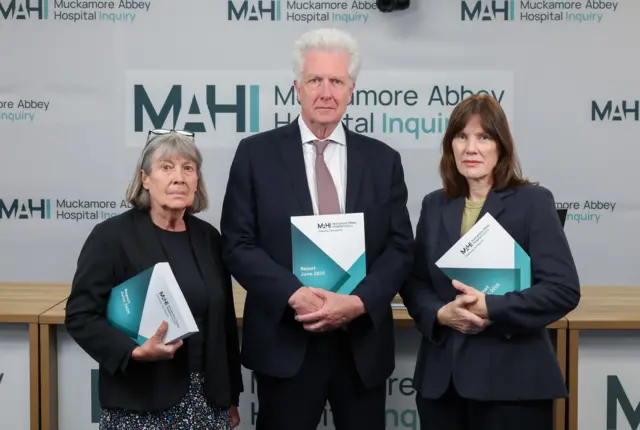
  • Inquiry chair, Tom Kark KC, says abuse "was clearly preventable"

  • The hospital provided inpatient care for people with severe learning disabilities and mental health needs

  • Allegations of abuse emerged in 2017, triggering a police investigation

  • A public inquiry ran from 2022 until 2025

  • The Police Service of Northern Ireland (PSNI) described it as the biggest criminal adult safeguarding case of its kind in the UK

  • The inquiry report says abuse did not involve every patient nor every member of staff

  1. Shocking and difficult readingpublished at 13:21 BST

    Marie-Louise Connolly
    BBC News NI Health Correspondent

    These findings are shocking and are testament to why what happened inside Muckamore is regarded as the biggest criminal adult safeguarding case in the UK.

    Evidence from CCTV footage taken from inside the hospital captured patients clinging to wheelchairs, being spat at and so heavily medicated that they'd become "zombified".

    Tom Kark found there was a closed culture and a lack of reporting of what was happening between staff and patients.

    Warning signs from as far back as 2012 within the hospital's Ennis Ward were missed after an incident triggered several arrests among staff, one of use resulted in a conviction.

    While that case should have triggered questions and further investigations, the inquiry found it didn't and instead some managers stood back and turned a blind eye to what was going on.

    Chapter 1 of the report is difficult reading where the inquiry outlines examples of where and how patients were maltreated.

  2. Bad behaviour was 'normalised'published at 13:16 BST

    Kark says he found the evidence "very distressing to hear" and it would have been even worse for the families.

    "I think what surprised and shocked us most was that there was plainly a culture there," he told BBC News.

    "We've referred to the normalisation of, of deviance, in other words, bad behaviour becoming normalised, that people were walking past and allowing this to happen, and neither intervening nor reporting it.

    "I think that's profoundly shocking."

  3. Relatives felt powerless, inquiry chair sayspublished at 13:11 BST

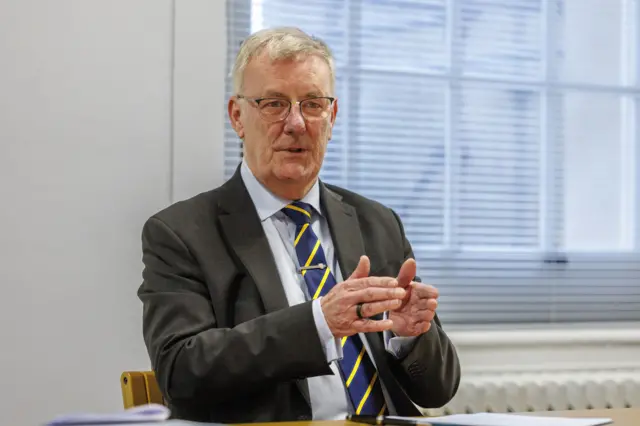
    Tom KarkImage source, PA Media

    Tom Kark says relatives saw their "zombified" loved ones but felt powerless to do anything about it.

    He said when the abuse came to light many relatives felt guilty about about placing their loved ones in Muckamore.

    "To give that evidence in the full glare of a public inquiry must have been for most and probably all exceptionally difficult," he says.

  4. Families say patients 'zombified' by medicationpublished at 13:04 BST

    The report covers the use of restrictive practices with those with learning disabilities and/or autistic people.

    It makes the point that some practices once considered "benign" became outdated and staff training did not keep pace with this evolving understanding.

    There was a pattern of frequent use of physical restraint, seclusion and PRN (‘pro re nata’) sedation sometimes where the use of "de-escalation or other preventative, person-centred or behavioural interventions" might have reduced or avoided the need for restrictive measures.

    Seclusion was a particular area of concern as was the use of PRN medication for restriction.

    But families said they often found loved ones sedated, disengaged or "zombified".

    The report does recognise that, often, there was an absence of appropriate alternatives such as psychological interventions and the impact of staff shortages on effective de-escalation of challenging behaviours.

  5. Patients' personal hygiene also neglectedpublished at 12:58 BST

    The panel concluded that injuries such as bruises and marks were not "isolated" but visible indicators of systemic failure.

    Unchecked physical abuse and neglect caused "lasting harm to patients and profound distress to their families".

    As well as that personal care and hygiene was often lacking

    Descriptions were given of patients being unkempt, with dirty hair and smelling of body odour and urine. On some visits relatives noted that incontinence pads were full or fingernails had faeces under them.

    Some patients were dressed in another patient's clothes.

    Weight loss and weight gain was also noticed.

  6. CCTV shows 'dragging, pushing and inappropriate restraint'published at 12:52 BST

    Key to finding out what happened at Muckamore was the discovery of CCTV footage with catalogued the physical abuse.

    In it the "forceful handling, dragging, pushing and inappropriate restraint" of patients could be seen.

    These incidents provided confirmation that unexplained injuries reported by families over many years could "not be attributed solely to patient behaviour or peer-on-peer violence".

    We are told about the "worry and trauma" this caused families, as well as guilt for "exposing their relatives to harm".

    "In truth, of course they bear no blame whatever, but the burden for many was expressed clearly through the families’ evidence, which was often and understandably emotional."

  7. Who were the residents of Muckamore?published at 12:47 BST

    Muckamore Abbey Hospital was designed and built as a long-stay facility for people with learning disabilities and/or autistic people, and some were admitted through the criminal justice system into forensic care wards, the report says.

    However, the report says their experiences changed over time as the facility changed.

    The inquiry heard about people who were admitted as young as six years old and who moved through different wards as they grew older. Resettlement of patients often failed.

    Some lived nearly their whole lives there.

    "For some it was all they knew and they regarded it as their home for life," the report explains.

  8. Broken bones, black eyes and other bruisespublished at 12:43 BST

    The report lays bare the nature of the injuries the relatives saw on their loved ones, many of whom were "non-verbal". Because of this establishing how an injury had been caused was often extremely difficult, the report explains.

    "Some patients will have caused injuries to themselves, to other patients and to members of staff," it's acknowledged.

    However when abuse was seen on CCTV many relatives "understandably thought the worst and realised the possibility that at least some of the injuries seen upon the patients were a sign of deliberate abuse by staff".

    Muckamore Abbey Hospital

    Some relatives commented that patients seemed to receive injuries such as broken bones, black eyes and other bruises at the facility that they had never suffered at home.

    There was evidence about "bruises, unexplained marks and signs consistent with physical abuse".

    Families saw "bruising to arms, legs, faces and torsos, including what appeared to be grip marks, finger bruises and injuries appearing in clusters".

    "Relatives reported being informed by staff that injuries were caused by self-harm, behavioural incidents or peer-on-peer violence."

    They were told their relative was "clumsy or may have fallen in the night".

    The report says many families lost confidence in these explanations.

  9. Belfast Trust's 'adversarial approach' concerningpublished at 12:38 BST

    This is the second major public inquiry into it the Belfast Trust within last decade.

    The inquiry found the "adversarial and oppositional approach" taken by the health trust in this case concerning.

    It said correspondence from their lawyers was "frequently confrontational" and they were disappointed the trust "did not accept that the evidence given by families and patients should be given equal weight to records held by the Trust".

    The inquiry acknowledged that the trust's lawyer recognised on its behalf that it had "failed in its core duties to look after the safety of its patients" at Muckamore, but that it was committed to learning as much as possible through the process.

    However, the report says that the "attitude of the trust" seen in correspondence sent on its behalf, during the course of the inquiry gives rise to "serious concern as to whether the Belfast Trust has the capacity to change its ways independently and without external forces brought to bear".

  10. Inquiry chair says it 'was clearly preventable'published at 12:35 BST

    Tom Kark KC says there were clearly warning signs at Muckamore "for many, many years before the 2017 revelations, certainly going back to 2012 and before".

    He says senior managers and the board should have identified them as red flags.

    "This was clearly preventable," he adds

    Kark says "you cure systems by looking at systemic problems, and there clearly were systemic problems here that we've tried to address".

  11. Patients were abused and systematically bullied, inquiry findspublished at 12:32 BST
    Breaking

    "Patients were abused at Muckamore Abbey Hospital. It is important to state that bold and simple fact."

    The report says the revelation in 2017 of the abuse of patients at Muckamore Abbey Hospital "shocked" the relatives of those patients, the health community and the whole of Northern Ireland.

    The report also makes it clear that abuse did not involve every patient nor every member of staff, nor a majority of the staff.

    But many patients had their lives made "miserable" by systematic bullying by certain members of staff whose job it was to look after them.

  12. More than 100 people referred to PPS over abusepublished at 12:26 BST

    Since the investigation began in 2017, the Police Service of Northern Ireland (PSNI) has reported 124 people to the Public Prosecution Service (PPS).

    So far, prosecutors have directed charges against 58 people, who are at various stages of the judicial process.

    To date, three people have been prosecuted, two cautioned and one case dismissed.

    Separately, the Belfast Health and Social Care Trust investigated 192 members of staff.

    Of those:

    • 19 were dismissed or sacked
    • 64 referred to the Nursing and Midwifery Council – unclear how many have lost their registration
    • 24 referred to the Northern Ireland Social Care Council
    • 52 cases remain outstanding as they await investigation
    • Others have left voluntarily with no case to answer
  13. What happened to our daughter in that hospital?published at 12:19 BST

    Marie-Louise Connolly
    BBC News NI Health Correspondent

    For years, Marjorie and Mark Sharp have asked themselves the same question: what happened to their daughter inside Muckamore Abbey Hospital?

    Now 41, Laura was admitted aged 16 and spent more than 17 years there.

    Her story, alongside dozens of others, will be included in the inquiry report.

    "When Laura hears the word Muckamore she becomes anxious and fidgety she doesn't want to talk about it - things happened to her in there which she can't explain.

    "One particular time she pulled her T-shirt up and she had bruises all around her chest and she stood up and said 'I'm scared'," Marjorie said.

    Laura is looking toward the camera and smiling. She is dressed in a red t-shirt with white text and is wearing a grey zip hoody.

    Laura has learning disabilities and at times challenging behaviour, but she is also a young woman who loves playing badminton and who attempts to communicate through touching hands and smiling.

    Her parents said it's a different picture from her days in Muckamore which confined her development and progress.

    Like so many families caught up in the scandal the couple have many unanswered questions.

  14. What will the report say?published at 12:10 BST

    The final report runs to around 700 pages and is expected to contain dozens of recommendations.

    They are likely to focus on safeguarding and the future of care for vulnerable adults in Northern Ireland.

    The inquiry was set up to:

    • Examine the nature and scale of abuse at the hospital
    • Understand how it happened
    • Ensure it can never happen again
  15. What is the Muckamore Inquiry?published at 12:01 BST

    The Muckamore public inquiry began in June 2022 and examined events at the hospital between December 1999 and June 2021.

    It was chaired by Tom Kark KC

    It heard evidence from 181 witnesses and considered more than 300 statements before concluding in March 2025.

    Its final report is expected to outline the extent of the mistreatment of patients.

    A specialist team, including police officers, trawled through more than 300,000 hours of CCTV footage from the hospital as part of the investigation.

    Tom Kark is looking into the camera. He has white hair and is dressed in a dark suit and tie with a white shirt.Image source, Presseye
    Image caption,

    Tom Kark KC, Chair of the Muckamore Abbey Hospital Inquiry

  16. What is Muckamore Abbey Hospital?published at 11:51 BST

    Muckamore Abbey Hospital has provided inpatient care for people with severe learning disabilities and mental health needs since 1949.

    Allegations of abuse emerged in 2017, sparking a police investigation and later a public inquiry.

    The hospital is set for closure, but remains at the centre of what the PSNI has called the UK’s biggest criminal adult safeguarding case.

    To date, three people have been prosecuted and two cautioned.

    In June 2022 a public inquiry into the allegations began.

  17. Welcomepublished at 11:44 BST

    The image shows a large blue and white sign. It reads Belfast Health and social Care Trust and below it is 'Muckamore Abbey Hospital'.Image source, PA Media

    The long-awaited final report into the abuse of vulnerable adults at Muckamore Abbey Hospital will be published later today.

    It is expected to reveal the scale of mistreatment suffered by patients.

    Over the years we have heard from families who say their loved ones suffered bruising, broken bones, verbal harassment and goading while staying at the hospital.

    Some of the abuse was captured on CCTV.

    The PSNI has described it as the biggest criminal adult safeguarding investigation of its kind in the UK.

    We’ll bring you the key findings, reaction and latest developments throughout the day.