How successful were the Romans in Scotland?

The Romans tried to invade Caledonia (what we now call Scotland) several times, but never managed to completely control it.
Large parts of southern Scotland were ruled over by the Romans, but conquering the whole land proved too difficult and parts of it were left unconquered.
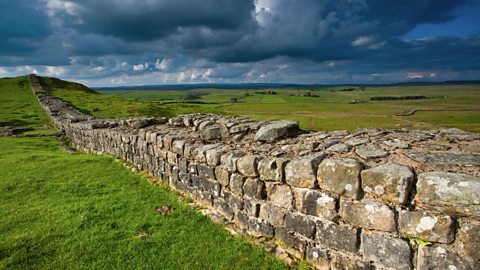
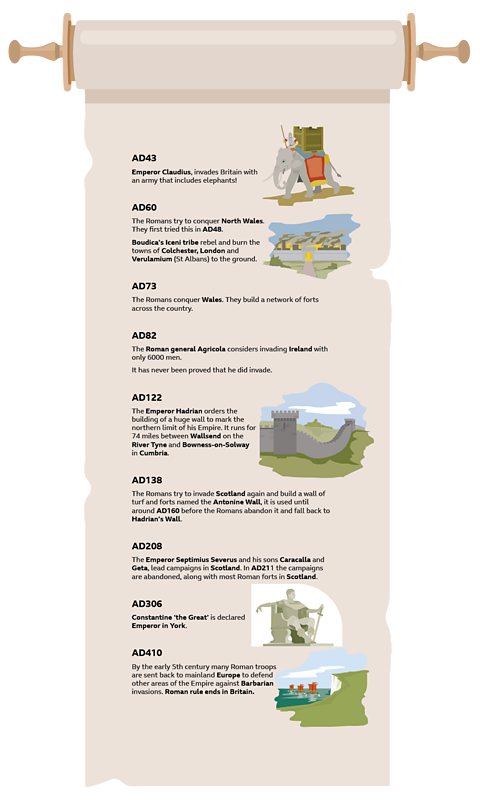
In AD122, the Emperor Hadrian (AD117 to 138) ordered his soldiers to build a wall between Roman Britain and Caledonia.
Hadrian's Wall served as a military border but was also a hub of travel and trade.
Important words
Important words on whether the Romans conquered Scotland.
| Keyword | Definition |
|---|---|
| Barbarians | What the Romans and Greeks called someone who was not Roman and Greek. |
| Bribe | To offer someone something to help you or make them do what you want. |
| Caledonia | The Roman name for Scotland. |
| Enslaved | To be captured by someone and forced to work. |
| Tribe | A group of people who share similar ideas or culture like language, food, clothing and religion. |
Watch: How we know the Romans invaded Scotland
Watch the video to learn more about the Roman invasion of Scotland.
Find out how we know the Romans invaded Scotland
Did the Romans invade Scotland?
Well, yes and no.
Yes, because they invaded the north part of what we now know as Britain, but no, because it wasn’t called Scotland 2,000 years ago.
The Romans actually knew it as Caledonia.
Do we know they invaded for sure?
Well, sometimes we’re scratching about for clues, but, in this case, we couldn’t be more sure. It’s a definite yes.
There’s tons of evidence, ranging from forts and walls to sculptures and stuff left behind, or “artefacts”, to use the technical term.
Who was here to greet them?
Back then, Caledonia was made up of various different groups of people or tribes.
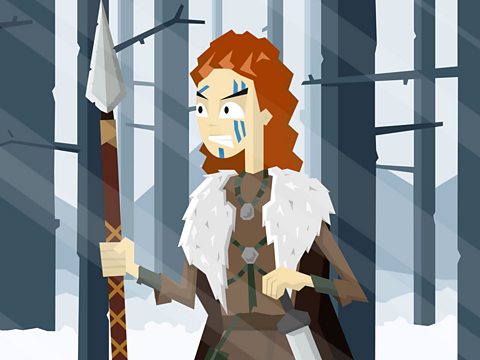
Some tribes tried to resist the invasion and fought back.
Others just surrendered and lived under Roman rule.
In fact, most of the tribes in southern Caledonia probably made peace with the invaders and everybody got on reasonably OK.
Much like the tribes here in 21st century Scotland.
Person sitting on grass: Oi! Oi!
Well, OK-ish.
Why were the Romans interested in Scotland?

By the end of the first century AD, Rome controlled most of southern Britain.
However, it was a different story in Scotland - it was still controlled by fierce warrior tribes (a group of people who share similar ideas or culture like language, food, clothing and religion), who refused to bow to the Roman Empire.
The Romans were interested in Scotland for several reasons:
Scotland had valuable natural resources, like lead, silver and gold.
The Romans could also get rich by charging the people they conquered taxes and forcing them to become enslaved (to be captured by someone and forced to work).
The Romans came for ‘the glory of Rome’ too. They wanted to conquer new lands and make their empire even bigger and better.
Who was living in Scotland?

In Roman times, there was no such country as Scotland.
What we now know as Scotland was called ‘Caledonia’, and the people were known as the ‘Caledonians’.
Caledonia was made up of groups of people or tribes.
These included the Caledones, Damnoni, Taexali, Votadini and Venicones.
Some got on peacefully with the Romans, but others fought back.
What was the Battle of Mons Graupius?

In the summer of AD83 or AD84 some Caledonian tribes joined forces and stood against the invading Roman army.
The two sides fought at a place called Mons Graupius (the Grampian Mountains).
The Romans were led by the general Julius Agricola and the Caledonians were led by a fierce chief named Calgacus.
The Caledonians had as many as 30,000 warriors, about twice as many as the Romans, but the Romans were better organised and defeated the Caledonians.
Calgacus and his army fled but the Caledonians returned many times to raid the Roman frontier.
Watch: Was the Roman invasion successful?
Watch the video to learn more about how successful the Roman invasion of Scotland really was.
Boom! Boom, boom! Aargh!
Awesome! Oh! Sorry.
What was a typical battle between the Romans and the Caledonians like?
Well, probably the most famous battle between the Romans and the northern tribes was the battle of Mons Graupius and thanks to a first-hand historical account, we know quite a bit about it.
The Romans won, but why?
Well, two main reasons.
Number one – the Romans were better organised and number two – the Romans were better equipped.
But first, let’s look at the organisation.
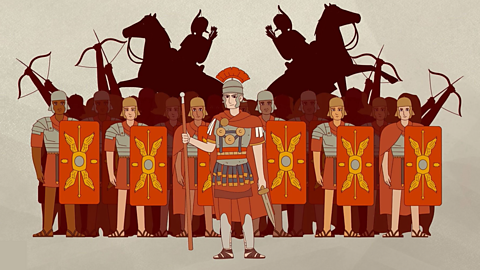
When the hordes of Caledonians charged, the Romans were waiting for them in lines, swords drawn and shields linked to make a solid wall.
When spears started to rain down on them, the Romans huddled together and held their shields above their heads to form a giant protective shell, which is what we call the Tortoise Effect.
Equipment-wise, well, a few Caledonians had some armour but ALL Romans did.
And Romans had over-lapping metal body armour, plus they had more swords and spears, so the results were several thousand dead Caledonians but only a few hundred dead Romans.
Roman solider: Aargh!
Oh, Roman Guy! You just knocked them all down! You play with your own toys! Keep on your own side.
How important was Hadrian’s Wall?
The Caledonian attacks were costing the Romans time and money.
In AD122, the Emperor Hadrian ordered his soldiers to build a wall between Roman Britain and Caledonia.
It stretched across the whole of the West to East coast of the North of England.
The Romans also built forts and stationed soldiers along the wall to keep watch and fend off any attacks.
Soldiers on the wall came from all over the Roman Empire, from Spain to North Africa.
Hadrian's Wall was built for defense but it was also home to different cultures, travel hubs and trading posts.

In AD140 the Romans added another wall further North inside Caledonia, between the River Clyde and the River Forth.
It was called the Antonine Wall after the Emperor Antoninus.
As it was deep inside Northern Caledonia it was often attacked by Caledonian tribes, from both sides.
In AD160 the Romans abandoned the Antonine Wall and moved its soldiers further South to Hadrian’s Wall, which was more easy to defend.
What happened to the Romans in Scotland?

The Roman's main concern was to protect Roman Britain from attack.
After the Battle of Mons Graupius, most Caledonian tribes accepted the Roman rule.
Some tribes were bribed (to offer someone something to help you or make them do what you want) or given gifts by the Romans.
In AD200 to 300 there was more fighting along Hadrian's Wall, Emperor Septimius Severus (AD193 to 211) had to come to Britain to fight the Caledonian tribes. This was the last major Roman battle in Caledonia (Scotland).
Attacks increased in AD300 to 400 and the Roman army finally packed up and left in AD410.
Barbarian (what the Romans and Greeks called someone who was not Roman and Greek) tribes were attacking the city of Rome and the Emperor Honorius (AD393 to 423) decided that the Roman legions in Britain were needed elsewhere.
Watch: What happened to the Romans in Scotland?
Find out why the Romans said goodbye to Scotland
Well, they all had to go south to deal with attacks by a Gaelic-speaking tribe from Ireland called the Scots and attacks by the Anglo-Saxons from Germany and Denmark.
Their other big problem was that many Caledonians were uniting into a larger group called the Picts and as if that wasn’t bad enough, there was also trouble brewing back in Rome and in other parts of the empire.
So, it was time for many Romans to pack up and leave Britannia all together.
Some went off to fight elsewhere and others just returned home to wherever they came from in the first place.
Even though some stayed… (talking to the Roman solider) not you, you can go…there were no Roman soldiers left in Caledonia.
The nearest Romans were living around Hadrian’s Wall.
(To Roman solider) See ya!
So, what exactly did they leave behind?
A wealthy land, thanks to the Roman silver and jewellery they brought to bribe us and the tribes of Caledonia started to work together to become more organised and this, some people believe, was the start of the Scottish nation.
A land which would become known as Scotland.
Roman invasions
Think like a historian

Have a look at the thinking points below and think about your answer to each question. You could even write them down on a piece of paper or discuss them with somebody else if you want to.
Why did the Romans have such a tough time conquering a land with such a small population?
Why did the Romans continue to try and conquer Scotland?
Why was it significant that the Romans never fully conquered Scotland?
It can actually be harder to defeat a smaller enemy who can retreat into hilly areas. Hunting smaller groups down would have taken large amounts of Roman soldiers spread out all across Scotland.
The northern part of Britain never fully accepted Roman rule and kept on raiding, keeping soldiers from being sent to other parts of the empire. Rome also wanted to prove that it could conquer anyone and everyone.
The fact that the Romans never fully conquered Scotland went to prove that the Romans weren’t unstoppable. It was also partly the reason that the Romans left Britain around AD 410 as they were tired of fighting in Britain and needed soldiers elsewhere across the empire.
Activity: Quiz – Did the Romans invade Scotland?
Grown-ups corner
Are you a parent, carer or teacher?
Take a look at some of the links below on KS2 History which are packed full of knowledge, videos, quizzes and activities.
KS2 History: The Romans
BBC Bitesize for Teachers
KS2 History: The Romans. 4: The Romans in Britain
BBC Bitesize for Teachers
KS2 History: The Romans. 2: The Roman Empire
BBC Bitesize for Teachers

Horrible Histories: Raid and Trade game! game
Play Horrible Histories: Raid and Trade KS2 History
More on Roman Britain
Find out more by working through a topic
- count3 of 8
- count4 of 8
- count5 of 8
- count6 of 8