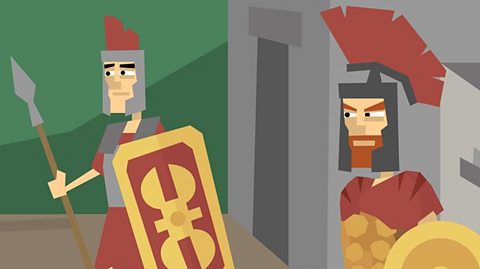
What did the Romans want from Britain?

The Roman invasion (the use of an army to take over land and resources) of Britain was one of the most significant events in British history.
The Romans wanted resources from Britain such as gold, tin, iron and cattle.
They brought new ideas about buildings, language and culture that slowly started to change parts of Britain.
For 400 years, Britain became part of the Roman Empire.
Important words
Important words on how the Romans conquered Britain.
| Keyword | Definition |
|---|---|
| Barbarians | What the Romans and Greeks called someone who was not Roman and Greek. |
| Conquer | To take control of someone or something by using force. |
| Empire | The control of a large area by one person, ruler or country. |
| Invasion | The use of an army to take over land and resources. |
| Rebellion | To fight against a ruler or government. |
| Tax | Money given as payment to the government or ruler to help pay for services. |
Watch: What do we know about the Roman invasion?
Watch the video to learn more about the Roman invasion of Britain.
Why did the Romans invade Britain?
Over 2,000 years ago, the Romans first arrived in Britain. Although that was way back in the past, many clues still survive which tell us what life was like during Roman times.
From the remains of ancient forts to the jewellery, letters and household items still being dug up by archaeologists today. We can find out brilliant details of what they ate, what their homes looked like and even what they did for fun.
And thanks to a book written all those years ago by the famous Roman commander, Julius Caesar, we also know one reason why the Romans wanted to come to Britain in the first place - they wanted to make use of the amazing natural resources to be found here.
Caesar wrote, "The Britons have a huge number of cattle, they use gold coins or iron bars as their money, and produce tin and iron." That description helps to explain why Caesar and his army decided to pile over here to Britain to try to invade. Rome wanted to get its hand on all those British resources to make itself even richer.
Back then, before the Romans invaded, we didn't have one king or queen ruling over the nation. Britain was made up of different groups, or tribes, known as the Celts or native Britons.
We get an idea of what the native Britons looked like thanks to a description of them in here. But do remember, of course, they were Caesar's enemy, so his opinion might be a little bit one-sided. "All Britons used woad to dye their bodies a blue colour, which makes them terrifying when they are fighting in battle."
The Celts also put lime in their hair to make it stiff and thick, which made them look even more ferocious. "They used their chariots in battle, steering them in all directions while hurling their weapons, generally causing the enemy to separate apart. Then one of the warriors leaps from the chariot and fights on foot."
It was all just too much for Caesar. He invaded the country twice, but he never actually managed to take over. That would have to wait until 100 years later when the Emperor Claudius tried again and this time, he succeeded. And that is how we became part of the Roman Empire.
When did the Romans come to Britain?
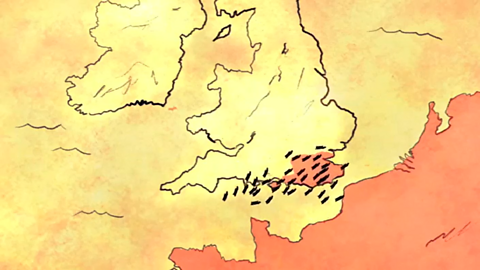
In 54-55BC, Julius Caesar (AD49 to 44) launched an expedition (a journey to make contact and find out about a place) to Britain with troops, and made contact with the people there.
He did not take over the land.
In AD43, ordered by Emperor Claudius (AD41 to 54), a big Roman army landed on the beaches in Kent.
Over the next year it battled inland, storming through hill forts and conquering (to take control of someone or something by using force) anyone who stood in their way.
Watch: How did the Romans gain an enormous empire?
Explore how the Romans gained an enormous empire with Quartatius, a Roman soldier.
Salve! Hello!
It’s your boy, Quartatius.
We're expanding Roman territory again. Spreading the way we do things. Here's a plan.
Rome is here, and we've taken this, now we’re taking this, and maybe after that we'll take this.
Every place we’ve got to so far, we’ve brought Roman laws, made Roman towns.
Some local rulers decided to work with us. They keep their thrones, trade with Rome as long as they follow our lead.
Others… well, they're not so keen.
Oh, and these roads! Life-saver, mate.
Straight, strong, and built to last.
They make marching from place to place soooo much easier on the ol’ feet.
We get brought supplies along them and traders and messengers use them all the time.
They also help us send news back to Rome fast, so the Emperor always knows what's happening.
And when we're done, the roads help keep the peace. If there's any trouble, the Emperor sends his main man.
Wherever we march, we build forts. You should see ‘em! Walls, big gates, barracks, storehouses… everything we need.
We don't just camp. We build.
Makes it easier to hold places once we’ve moved on.
Give us a few more days on this one!
Not everyone's thrilled to see us. But others? They work with us and keep their leaders, for a while at least.
We give them protection from their enemies, great trade with the Empire, baths, and theatres.
These guys, however, see us as invaders. Apparently, they don't want to pay Roman taxes or follow Roman laws.
They want us to go away, which isn't gonna happen.
Seems we might have a problem on our hands.
Right, gotta go.
Vale! Goodbye!
How did the Celts fight back?

If the Celts and Britons made peace with the Romans, they agreed to obey Roman laws and pay taxes (money given as payment to the government or ruler to help pay for services). In return, they could keep their kingdoms.
However, some of the Celt and Briton leaders chose to fight.
After years of heavy taxes and the Romans taking their land, some Celtic tribes were desperate for revenge.
In AD60, one leader who chose to fight was Queen Boudicca of the Iceni tribe.
Watch: Who was Queen Boudicca?
Watch the video to learn more about Boudicca and her war on the Romans.
Find out why Queen Boudicca led a rebellion against the Romans.
Boudicca: I am Boudicca, Queen of the Iceni. When my husband died, he left his kingdom both to me and the Roman emperor, Nero, to share.
It was meant to keep the peace between us.
Narrator: It is 60AD. The Romans have invaded and taken over much of southern Britain.
Some of the native British tribes have agreed to support and work with the Romans, but others are not so happy.
The Roman army is heading to North Wales, but elsewhere, trouble is brewing – led by Boudicca.
Boudicca: But the Romans want it all!
Nero had me whipped in front of my people. He demands we pay taxes on land that belongs to us.
Beretta: She is magnificent.
Boudicca: Fight with us.
Beretta: I want to fight too. I want to be like Boudicca.
Beretta’s Father: No, Beretta.
Beretta: You named me Beretta, Beretta means strong.
Beretta’s Father: Yeah, that was a mistake.
Narrator: Beretta and her father follow Boudicca and her army. They head for Colchester, an important Roman town, and burn it to the ground.
Boudicca: What’s your name?
Beretta: Beretta.
Boudicca: You live up to your name. And now, onto Londinium.
What did Boudicca do?

Boudicca'srebellion (to fight against a ruler or government) began in around AD60.
Boudicca and her army burned the Roman towns of Camulodunum (Colchester) and Londinium (London), before heading to St Albans.
When the Roman army heard about this, they turned back from their campaign in Wales to face her.
Even though the Romans were outnumbered by Boudicca's 200,000 warriors, they were better trained and had better weapons and armour.
Both sides clashed in a fierce battle near the Midlands, but the Romans won and Boudicca's rebellion ended.
Watch: What happened to Boudicca?
Watch the video to learn more about what happened to Boudicca after her rebellion.
What happened when Boudicca faced the Roman army?
Was Boudicca’s rebellion a success?
After burning down Colchester, Boudicca's army destroyed the Roman town of London, before heading north to St Albans.
Meanwhile, the Roman army is busy conquering Wales. But messengers soon bring them news of Boudicca's campaign, and their plans are changed.
“The Britons have done too much damage. If we don't defeat them now, we will have to leave these islands and all the riches they contain. We must end their revolt once and for all.”
Native British warriors blow war horns, known as carnyx, to put fear into the Romans and are experts at driving two-wheeled chariots. They use iron-tipped spears and long slashing swords, but wear little armour. They don't fear death, believing they will come back braver and stronger in their next life.
“Charge!”
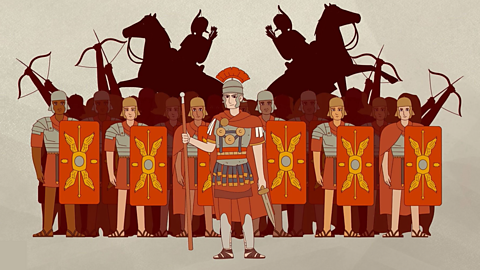
Roman soldiers are put into groups of around 6,000 men known as legions. The Roman army is well armed, very skilled at working together and heavily protected by armour.
Britons outnumber the Romans by up to 20-to-1, but the Roman soldiers are highly trained. Boudicca and the Britons are defeated. Around 80,000 Britons are killed. Rome will control most of Britain for the next 350 years.
“Welcome, men, this is Roman Britain.”
Did the Romans conquer the rest of Britain?
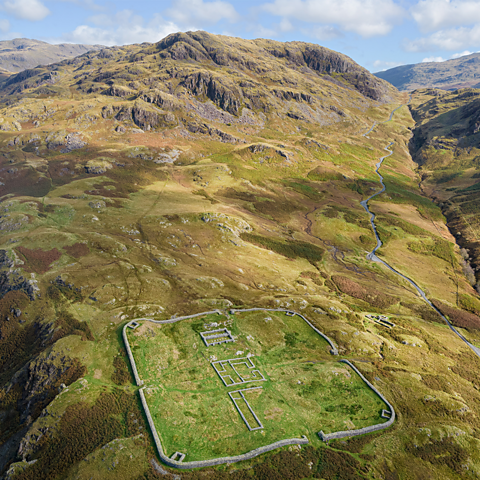
Over the next 300 years, the Romans managed to take control of Wales and the rest of England.
They tried several times to conquer Scotland but couldn’t control all of it, only parts of the south of Scotland.
Over time, large parts of Britain became ‘Roman’, living in towns and cities, speaking Latin, building roads and paying taxes (money given as payment to the government or ruler to help pay for services) to Rome.
The Romans built forts and walls, like Hadrian's Wall, to defend their British empire from the Celts and tribes in Caledonia (Roman word for Scotland).
Some parts of Britain, mainly in the north, kept fighting back though.
Eventually the Romans abandoned Britain in around AD410 to defend Rome from Barbarian attacks.
Think like a historian

Have a look at the thinking points below and think about your answer to each question. You could even write them down on a piece of paper or discuss them with somebody else if you want to.
Why was conquering Britain significant for the Romans?
Why might the Romans have thought Britain was important for their empire?
Do you think that much changed in Britain when it was ruled by the Romans?
The Romans wanted precious metals, animals and taxes from Britain to send around their empire. They also wanted to control more land to continue making their empire even larger.
Britain was important for the Roman Empire as it added new lands, more people and more resources. It had never been a part of the empire before and pushed the borders of the empire further north.
Some parts of Britain changed but not all of it. Some people started living in towns and villas but lots of people still lived in wooden houses in villages. Some people started speaking Latin whereas most people still spoke their normal language.
Activities
Activity 1: Roman emperors
Click on each image to discover which Roman emperors invaded Britain.
Activity 2: Quiz – Roman invasion of Britain
Grown-ups corner
Are you a parent, carer or teacher?
Take a look at some of the links below on KS2 History which are packed full of knowledge, videos, quizzes and activities.
KS2 History: The Romans
BBC Bitesize for Teachers
KS2 History: The Romans. 4: The Romans in Britain
BBC Bitesize for Teachers
KS2 History: The Romans. 7: Letters from Vindolanda
BBC Bitesize for Teachers
Horrible Histories: Raid and Trade game! game
Play Horrible Histories: Raid and Trade KS2 History
More on Roman Britain
Find out more by working through a topic
- count6 of 8
- count7 of 8
- count8 of 8

- count1 of 8